Down the Mississippi #9
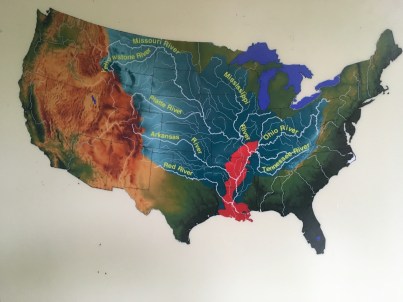 Every inch of this drive reminds us what a workhorse the Mississippi River is … and that is not just the Mississippi itself; it is the entire system: the Ohio, the Missouri, the Illinois, the Wisconsin, the Iowa, the Arkansas, the Atchafalaya, and all of the other rivers and tributaries that join the Mississippi along the way. It is among the largest river systems in the world, and it supports an almost unimaginable range of activities, from rice harvesting to soybeans and corn to quarries to barges to grain elevators. Railroad tracks are everywhere; the trains run constantly – very, very long trains as a rule … that look a lot like Lionel electric train sets. Bird life thrives along the Mississippi River National Wildlife Refuge, which abuts the river from north to south. Fishermen (and fisherwomen) are everywhere. It’s impossible not to see the river’s contribution to commerce, farming, and recreation. It’s incredibly beautiful too.
With that thought in mind, we had a real red-letter day last Friday!
When I was a kid, I couldn’t sleep before a great adventure, like a fishing trip or going to summer camp. I still can’t. Last Friday, I awoke at 4:00 a.m. and then waited a couple of hours before rising. Rebecca calls my behavior “Little Boy-ing.” I’ve been a little boy a lot on this trip and hope to never outgrow it.
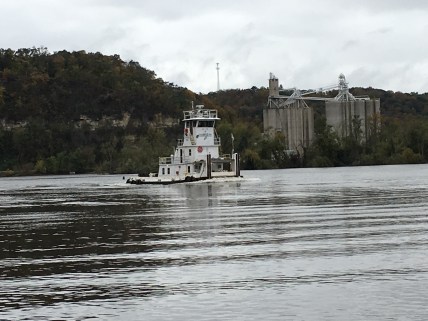
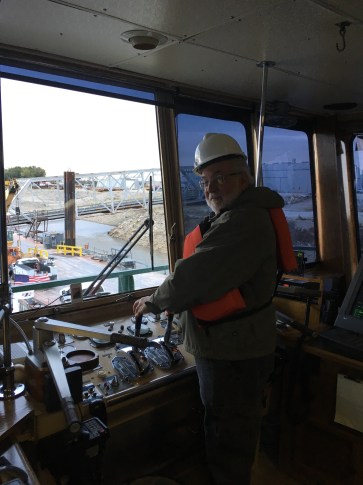 Just after 7:00 a.m., I climbed aboard a bona fide Mississippi River Towboat (not a “tugboat,” mind you, a “towboat.” One of the big guys!) A few hours later, I stood on a platform over the Mississippi at the intake for the Chain of Rocks Water Treatment plant watching where St. Louis’ drinking water gets sucked out of the river and made healthy. After a late lunch, I spent the afternoon a few miles down river gasping for clean air at the Bissell Wastewater Treatment Plant, where St. Louis’ sewage and stormwater gets treated before going back into the river.
From St. Paul south, it is hard to see the main channel of the river without seeing a towboat pushing a tow of barges. Grains and minerals have no better way to travel long distances. With the help of a little googling, I learned that barges are somewhere between 2.5 and 5-times more fuel efficient than trains and about 10 or 12-times more than trucks. That all translates to atmospheric carbon: the more cargo we ship by barge, the less we contribute to carbon build-up in the atmosphere.
The amount of cargo and freight we ship is damn-near incomprehensible. Our transportation system moves something between 40 and 55 tons of freight PER PERSON in the U.S. every year. That’s 80,000 to 110,000 pounds of stuff. It’s as high as 8,000,000 pounds for each of us in a lifetime. That’s the fertilizer that grows the grain that feeds the livestock that gets shipped to market over concrete highways and steel bridges in enormous petroleum-powered vehicles made of steel and composites that require solvents and polymers and machinery and then have to be remade into other products or moved to landfills; its all the stuff that goes into making the buildings to manage that other stuff, including the dirt that comes out of the ground to make the hole for the foundations, and all of the furniture, paper and copiers and computers that human beings actually use including our beds, sheets, soap, and cooking utensils, and, I guess, just about everything else. And now that I am thinking about it, how the hell do we get by with moving so little?
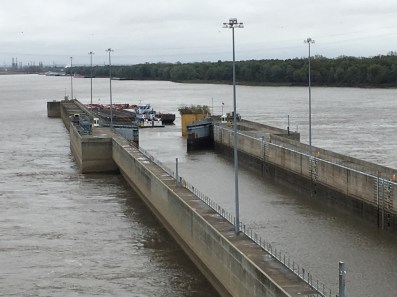 Barge traffic is a mainstay of the river’s work. About 100 years ago, the U.S. government committed the river system to transportation when the Corps of Engineers guaranteed shippers a navigable channel in the Upper Mississippi that was at least 9-feet deep. The “Upper Mississippi” extends from the headwaters to St. Louis. In that span, the river drops about 400-feet. Navigation would be impossible without a series of locks and dams that raise and lower the barges, allowing them to avoid shallows and rapids. From St. Louis south, the river flows unimpeded. The last of the lock and dam structures is in Granite City, just a few miles north of St. Louis.
Thus far in our trip, all of the barge tows we have seen have been no larger than 15 barges: three barges wide by five barges long. (And just in case you are a factoid geek like me, each barge is 195′ X 35′ with a capacity of 1,500 tons. Towboats vary in length, but 150′ seems to be a pretty good midpoint. That means that each tow is roughly 1,125-feet long or slightly under 1/4-mile – and 105-feet wide – so it can fit in the locks – and can carry as much as 22,500 tons, or 45-million pounds!)
The crews who operate the towboats are a memorable lot. If nothing else, they work their butts off … 6-hours on, 6-hours off, 6-hours on, 6-hours off every day … but as my host noted, where else can someone earn as much as they do with a high school diploma or less? Each boat has three crews. Each crew works 28 days and then takes 14 days off, so every 14 days the crew shifts … except for the Captain, and I’m just not sure how that works. Family life has got to be a strain, and that 14-day-off period includes travel time from their home port to wherever the tow happens to be at the time of the shift change … which might be darn-near anywhere. From what I learned, most of the boat owners move the crews around via van, so travel might eat up a day or two on each side of the 14-day “weekend.”
I just bought a book of stories from a towboat captain. (His daughters insisted that he write his stories into a book, so he did.) I haven’t read it yet, so I only know the few stories I learned from Captain Berry during the morning we spent together. He’s been on the river for about 30 years. When I asked about “hairy” moments on the river, he laughed, as if he could start talking and not stop for about 30 more years. The story that stuck with me had to do with the time he had to move a barge perpendicular across the river for a dredging operation. The current caught the barge and lifted it across the bow of the towboat. It finally came to rest on top of the port “tow knee.” (Silly me. I thought he called the vertical contraption on the front of the boat a “tony.”) 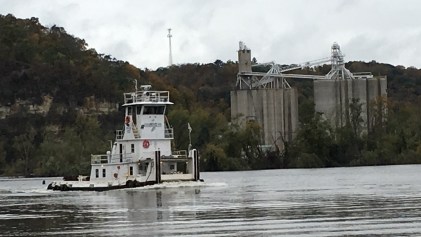 It turns out that the “tow knees” are structural safety elements: each boat has two tow-knees on its bow, one on the port side and one on the starboard. They are steel upright structures that look out of place. They are there to stop a rogue barge if it comes over the towboat’s bow and threatens to crash into the crew quarters and pilothouse. Captain Berry described how the loaded barge came to rest on top of the tow knee. They needed a giant crane to remove it, but the tow knee itself showed no damage and needed no repair. Damn, that’s amazing!
The little boy in me not only wanted to spend the entire day on the towboat with Captain Berry, I wanted to spend the full 28-day shift plying the river. (Careful, Captain, I may be back in touch before my next adventure to see if you have an opening for a near-septuagenarian deckhand.) But the clock drove me away.
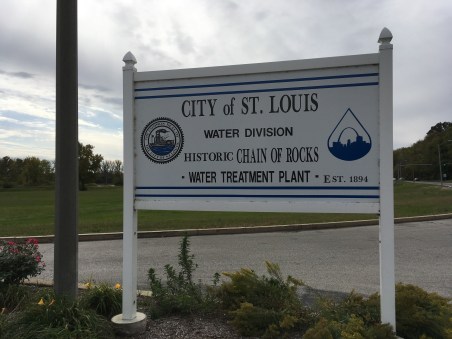 The Chain-of-Rocks Water Treatment plant north of St. Louis was still an hour’s drive away, and the plant superintendent was waiting. Bye Captain Berry, and hello Frank, Pat, and Chain-of-Rocks.
If you look on a map, the Chain of Rocks plant appears to be on the Mississippi, but appearances are only half right. The plant is situated a mile or so south of the confluence of the Missouri and the Mississippi. In that mile, the waters of the two rivers have not yet fully mixed, so the plant actually treats Missouri River water even though it appears to be sucking it out of the Mississippi. The difference is not insignificant. (“Confluence,” by the way, refers to the joining of two rivers while “convergence” refers to the coming together of ocean currents or air currents.)
Despite the nickname of “Big Muddy,” the Mississippi is actually less muddy than the Missouri. The Missouri’s extra goop – known as “Total Suspended Solids,” “TSS,” or “turbidity” in the water business – makes treating that water a tad easier than treating water from the Mississippi. Near the beginning of the water treatment process – after all the floating crap has been screened out – the water gets whacked with a polymer that promotes coagulation. In the part of the treatment process with by-far the best name, “flocculation,” the solid material – called “floc” – settles to the bottom of a basin or floats to the top and gets scraped away. The coagulant works better on the TSS in the Missouri River water than the TSS in the Mississippi, so the location of the plant is helpful. You might say that the chemistry of the Missouri helps plant operators get the floc out. HaHa.
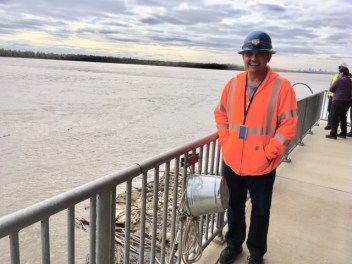 To know how much chemical to add, the plant operators need to know how much stuff is floating around in the water that needs to be removed. The very first bit of water treatment equipment we encountered was a raggedy bucket with a rope tied to it. High tech indeed. With years of experience under their belts, the operators have learned that the best way to draw a sample of raw river water is simply to drop a bucket from the intake platform and pull it up by hand. It works perfectly every time, needs almost no maintenance, and costs practically nothing.
Another very cool characteristic of Mississippi Valley drinking water is that it is high in minerals such as calcium and magnesium. In fortunate concentrations, the minerals form a protective coating along the inside of pipes, preventing contamination from other stuff, like lead in old solder joints. As long as no changes occur in the chemistry, a Flint, Michigan-like problem is not likely to occur in St. Louis, even though it is an old legacy city with a declining population and tax base and very, very old infrastructure.
(That thought about legacy cities is a really important one that deserves much more time than I am giving it … because legacy cities are of national concern and are in no way unique to the Mississippi River. How will a city’s residents continue to pay the costs of water and wastewater treatment and delivery as the population declines and grows poorer while the affluent flee? Along the river, such towns as Clinton, Iowa, Muscatine, Illinois, and Cairo, Illinois have one of the greatest assets imaginable – direct access to the Mississippi River – yet they are cities in decline that leave this pilgrim with a gut-wrenching sense of sadness and concern.)
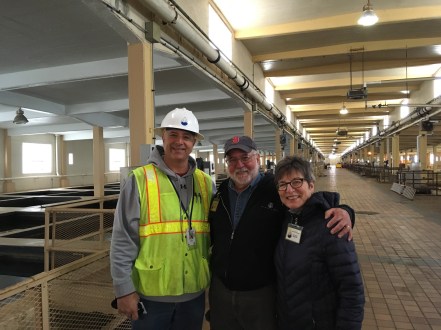 As we left Chain-of-Rocks, the talk turned to a conversation that is common among drinking water people: the general disdain for bottled water. The folks who run St. Louis’s Water Department and the Chain of Rocks plant are genuinely proud of the product they deliver. Despite the high cost of maintenance and treatment and infrastructure, treated drinking water is one of the truly great bargains of our society. Seeing the process work along the length of the Muddy Mississip is simply amazing!
From the conversations about clean drinking water and the inanity of people to buy water in outgassing plastic bottles when health is not at risk, we left for the Bissell Wastewater Treatment Plant, a really shitty place if ever there was one. HaHa again.
Our host, plant Superintendent Becca Coyle, spent the rest of the afternoon with Rebecca and me. We had met her brother earlier at Chain of Rocks. They are both engineers, him in drinking water and her in wastewater. He had prepped us for Becca, assuring us that she was nothing more than a “turd herder,” and we should tell her so. We did. She rolled her eyes. Brothers will be brothers, you know.


Becca is a phenomenal spokesperson and representative for wastewater professionals. She sparkles with energy and enthusiasm as she shows off her plant, never showing the slightest response to any part of the process, stinkiness included. She sparkled as she showed off the size of the various settling basins, as she showed us the comminutor (a grinding device for getting rid of some of the solids), and as she showed off the crystal clear water flowing over the weirs that had been sewage only 6 or 8 hours earlier.
As had happened a few weeks earlier in Bemidji, our conversation turned to unregulated contaminants, such as personal care products, pharmaceuticals, and endocrine disrupters. We quickly agreed on a lot of things: Decades-old wastewater treatment methods will have to change. Making the needed changes will be expensive. Few if any plant owners or plant engineers will pay for the changes until clear regulation is in place so the permissible limits of contaminants is known and fully agreed upon. Until then, any investment could go right up in smoke.
The reason that these unregulated contaminants do not get treated is because of emerging science. Nobody really knows what a “safe” limit is. Until there is widespread agreement on how clean is clean enough, nothing is going to happen. The river … and our drinking water … will be the repository of that stuff. Our reproductive systems and waterways will be the victims of the inaction, and the field of oncology will be one of the prime beneficiaries. Just as happened in the past with inaction in the face of science related to seat belts, tobacco, fossil fuels, atmospheric carbon, and climate change, deep pockets will do everything in their power to ensure that we, the public, stay confused and frightened. Those bastards!
As a society, we show deference to the doctors and practitioners who dedicate their lives to keeping us healthy. We show precious little appreciation to the front-line protectors of public health: the folks who treat drinking water and wastewater. We’d be a mess without them. Hats off to you Becca, Frank, and Pat. Thank you for doing what you do. There simply are not any more important jobs.
© 2017 Kenneth Mirvis
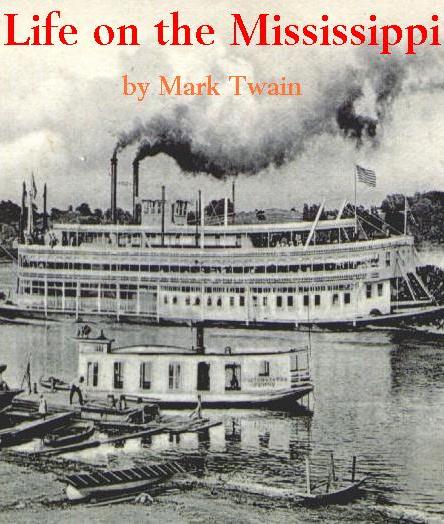 I didn’t read much to prepare for this trip, just a lot of state maps and Mark Twain’s “Life on the Mississippi.” That was all I needed.
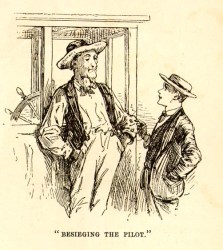 Young Sam Clemens convinced one of the finest pilots on the river, Mr. Horace Bixby, to take him on as a cub. The account, which runs from about Chapter 5 to about Chapter 20, is time very, very well spent.


 The human Mr. Bixby is now buried in St. Louis’ famed Bellefontaine (pronounced Belle Fountain) Cemetery just north of downtown only one block from the river. He is planted a few feet from Augustus Busch. So much about St. Louis is interesting and worth seeing, but nothing drew me to it more than seeing Mr. Bixby’s grave. It was everything I had hoped for.
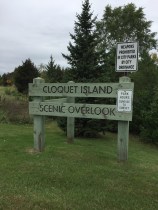 Don’t you get exhausted from all of the driving?


 Why would we be? Fact is, we are having an incredibly good time together! (And when we have our moments, we make sure they only last a few seconds.)


 Just maybe there is some really good juju that comes from having a heart attack. One of the redeeming experiences of spending several months in cardiac rehab at the University of Vermont Medical Center was getting to know the staff at the gym. Tony is a Physical Therapist there who would jawbone with me occasionally as I was enduring an hour on the treadmill. (I much prefer an hour or two of hiking bluffs and Indian Mounds along the Mississippi.)
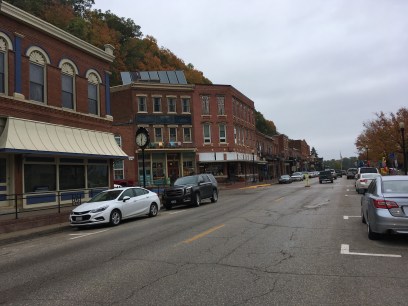 McGregor is a gem! Greater McGregor is a full adventure in and of itself. For starters, downtown McGregor is not really charming. It’s a little too decrepit to be “charming.” Virtually all of the downtown buildings date from the mid-1800s. It is a seriously old river town. The railroad tracks and a good-sized grain elevator separate the town from the river — sort of. The walk from our Inn to the riverbank took about 90 seconds and entailed no stairs or ramps. The town is literally ON the river.
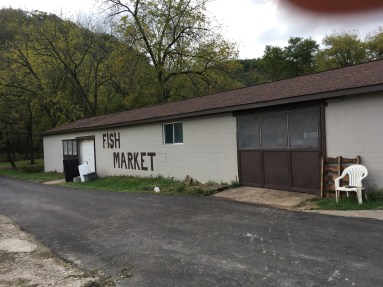 A few miles south, in the hamlet of Harper’s Ferry, we passed Mohn’s Fish Market, a nondescript place if ever there was one. Nondescript, maybe, but any place that sports a “smoked fish for sale” sign catches my eye. A lad of about 10 or 12 stood at the raggedy screen door. I went into a room about 12′ X 12′ with a few refrigerators and a counter. Not much else. The youngster went around me, opened the door to the processing room and yelled, “Hey Grandma, there’s someone here.” Before Diane Mohn made her way out to greet me, I took in a mind-blowing scene that we caught again on the other side of Greater McGregor, in Prairie du Chien — a fish processing operation out of the 1920s: lots of buckets of fish and fish guts, and lots of water hosing the floor. Mohn’s Fish Market, we later learned, is the last commercial fish processor along the river in Iowa.
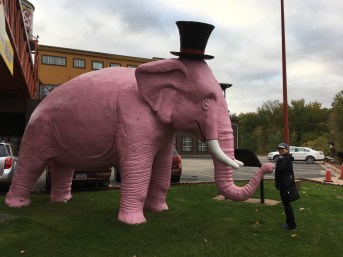 Pinky has a long history of welcoming people to eating establishments in Marquette. In this incarnation, she sits along the highway welcoming folks to the Casino Queen. Oddly, I had been looking forward to meeting Pinky and had read about her in some detail months earlier.
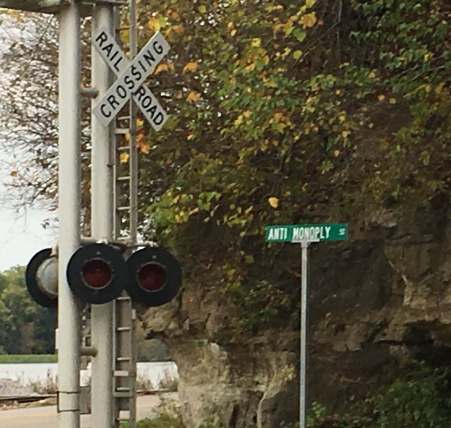 Pinky’s most mysterious attribute is her address … actually the address of the casino: 100 Anti Monopoly Street. How the hell does a town name a street “Anti Monopoly”? The nice lady at the casino tried out an explanation, something about not wanting to be like the game, but it just didn’t resonate. Somehow the town fathers of Marquette Iowa saw fit to name a street Anti Monopoly because it housed a casino. If any of you have a plausible explanation, I am really interested.


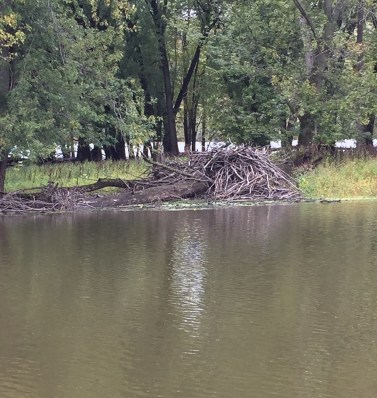 From the boat, we watched bald eagles successfully dive for fish and coot; we watched a mating pair ogle each other from a treetop; we watched pelicans soar overhead; we saw endless signs of beaver and other critters; we learned about button worker strikes in Muscatine and the destruction of the clam beds in the Upper River; we handled his collection of clam shells and the mother-of-pearl orbs used in the cultured pearl trade. We hated for the tour to end and would have spent the afternoon with him if he and his wife had not needed to visit a friend in the hospital.


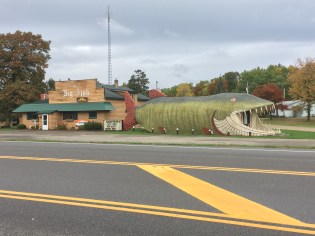 Staying on the byway, however, is at the very least a two-person job. A third would be helpful! While one of us pores over the map and app … when we have enough cell service … the other drives and tries to keep tabs on the few-and-far-between signs. Fortunately, we are able to reserve some capacity for taking in the sights too, which include everything from dams and bucolic parks with walking trails to fearsome toothed fish that double as entrances to rural restaurants.


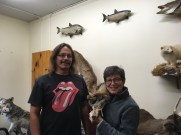 The Ojibwe people have been harvesting wild rice in the waters of Minnesota’s north woods for millennia. Europeans have only been living in the north woods for a couple of centuries. We spent some of Monday with Jeff Harper, a fisheries expert who hosted us for a while on the reservation of the Leech Lake Band of Ojibwe.
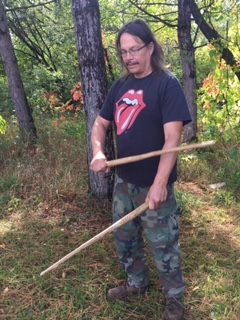 For a few weeks in late summer, Ojibwe canoe to the rice fields with the most primitive – and effective – of tools: “rice knockers.” They are nothing more than two straight, debarked sticks, usually made of white cedar, and often carved with simple hand grips. The rice knockers that Jeff gave to us have no hand grips; they are just simple, tapered, straight, lightweight pieces of wood.


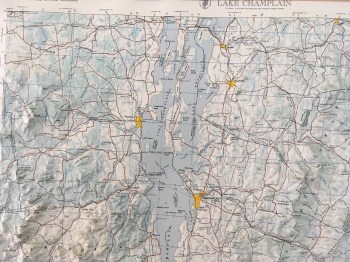 ecca and I live in paradise … in the northwest corner of Vermont on an island in Lake Champlain –– the “sixth Great Lake” according to the US Congress. A poet once referred to Lake Champlain as “that fairest of inland seas.” She was right. We’ll miss it. For now, though, we are on the road again!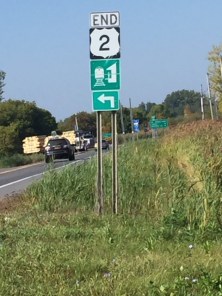
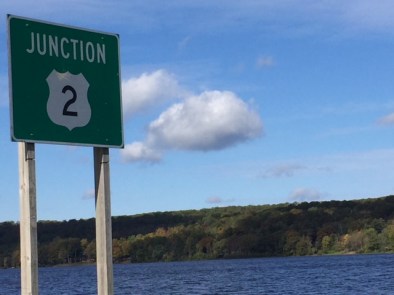
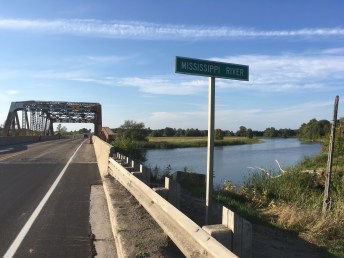 Upon leaving David and Toby’s in Ottawa and before getting to our first motel, we crossed the Mississippi for the first time. That’s correct. While the U.S. Mississippi River may be 1,400 miles from Vermont, the Canadian Mississippi is an easy day’s drive, only an hour west of Ottawa. Crossing the Mississippi River on our first day of a four-day drive to the Mississippi River is yet another stupid thing that I just find ridiculously cool.
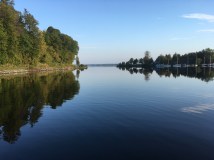 Before leaving Arnprior, we took a fabulous walk up the Mississippi from the mouth. It was gorgeous!
 Anyone who describes Sudbury as “pretty” has some very loose screws. Sudbury is in mineral country. From out of nowhere, the stacks of its smelters appear on the horizon. Its industrial plants are immense. Rail lines and long trains seem to appear out of the ether. One of the stacks is more than 1/4-mile high. Fortunately, once it fades away in the rear view mirror, it is gone.
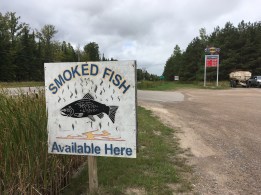 superb smoked whitefish just west of Sault Ste. Marie, met a couple of super nice waitresses, and that was about it. At one point, we went 100 miles between groceries. When we asked the waitress at the “restaurant” we stopped at for breakfast where we could get some fresh fruit, she shrugged. When nothing is in season, fresh fruit is not a U.P. staple. She knew where a grocery was to the east. To the west, she had no idea. Understandably. It’s a long, long way.
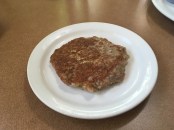 s excellent. While eating the cudighi, I suddenly understood the term “Yooper.” They are folks who live on the Upper Peninsula. U.P. Yooper. Get it! That restaurant was also where we channeled Frances McDormand, catching our first “you betcha” of the trip.
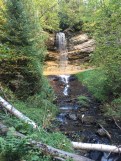 Before leaving Michigan, we hiked gorgeous waterfalls along the eastern edge of Lake Superior, saw stunning rock formations, stayed at the Christmas Motel, ate wonderful fresh fish, and generally had a blast. The Christmas Motel was not so named because of a hokey Christmas theme. It was the only hotel in the hamlet of Christmas, MI, near Munising. The hokey stuff emanated from the shop up the road. The Christmas Motel, on the other hand, sported a photo of a foxy model. The clothing store


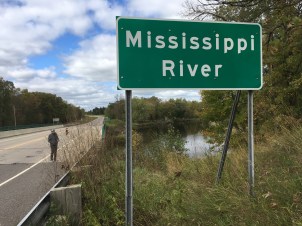 damn-near elegant Super 8 in Bemidji, MN. As we approached the river for the first time, driving on Minnesota Route 200 just west of Jacobson, a mature bald eagle took off from the woods in the south, flew in front of us, and soared off to the north. Nothing could have provided a better welcome to the river. Saturday morning, the real adventure begins. Getting here was only the beginning.
 myinnersociologist