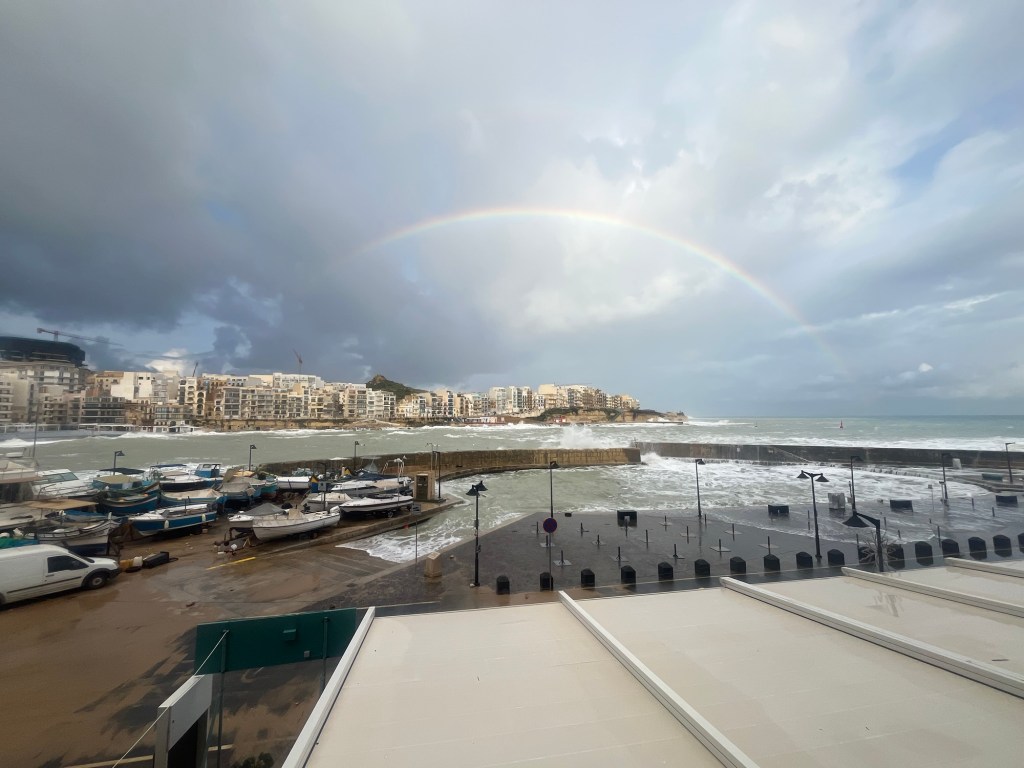
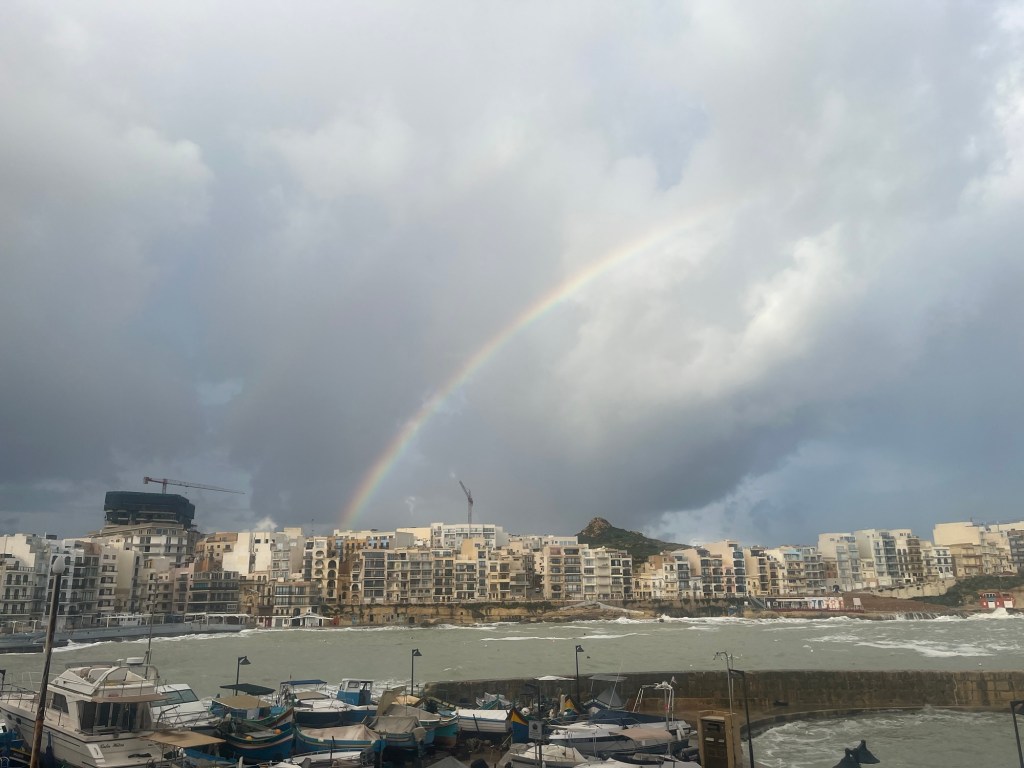
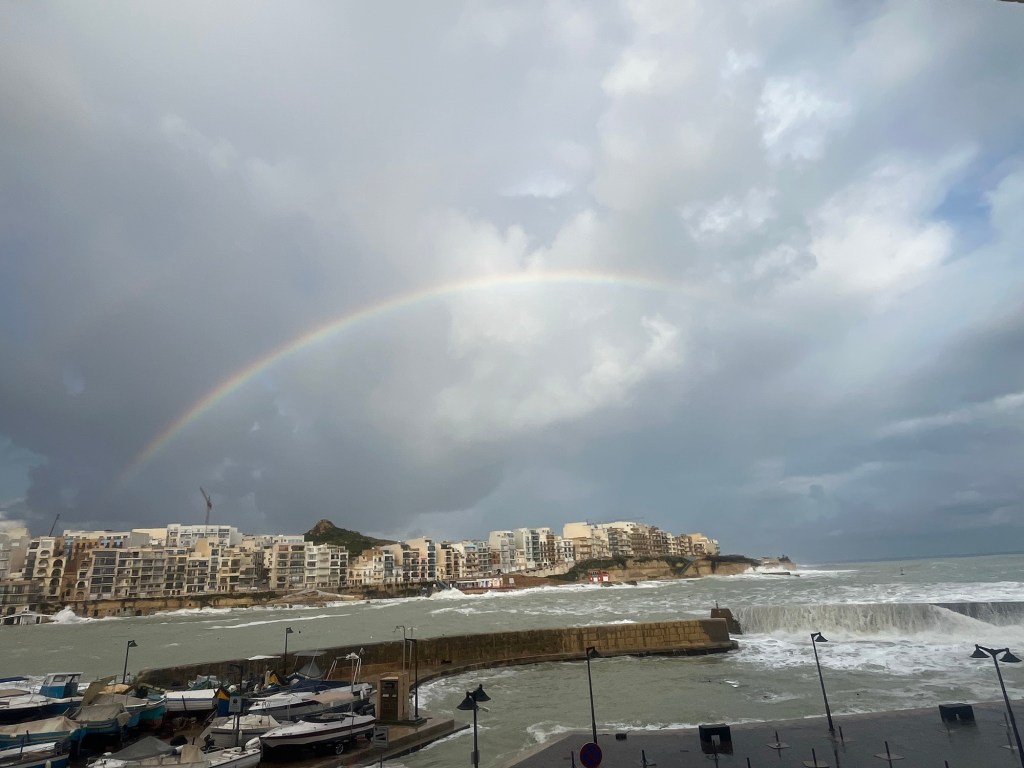
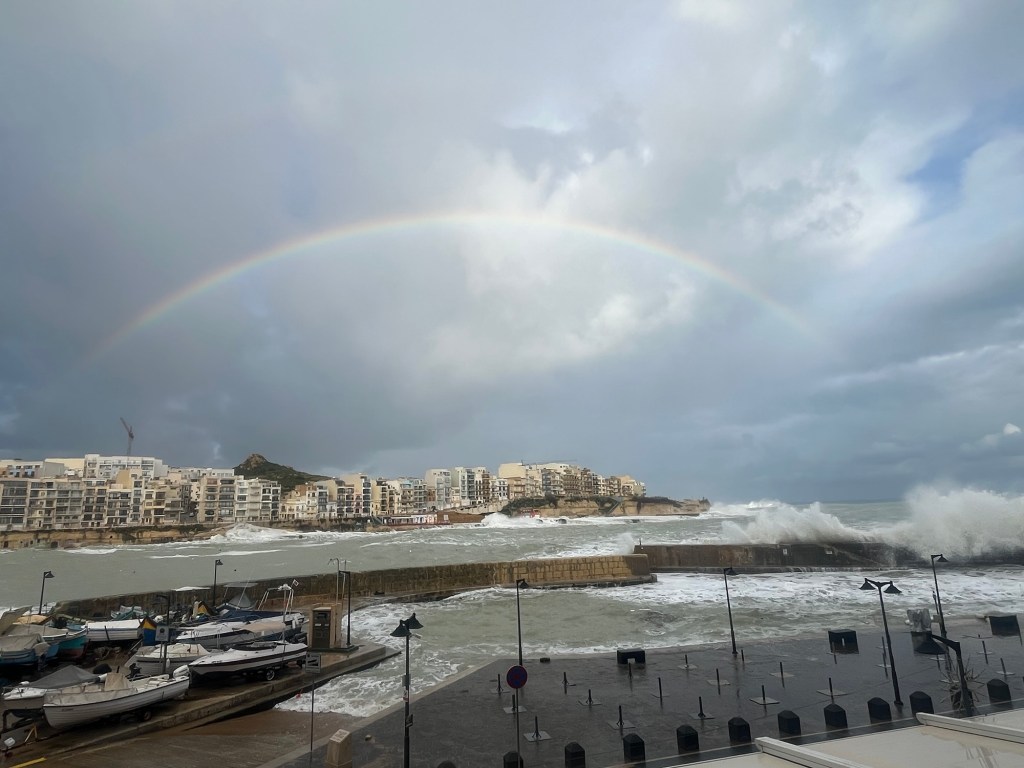
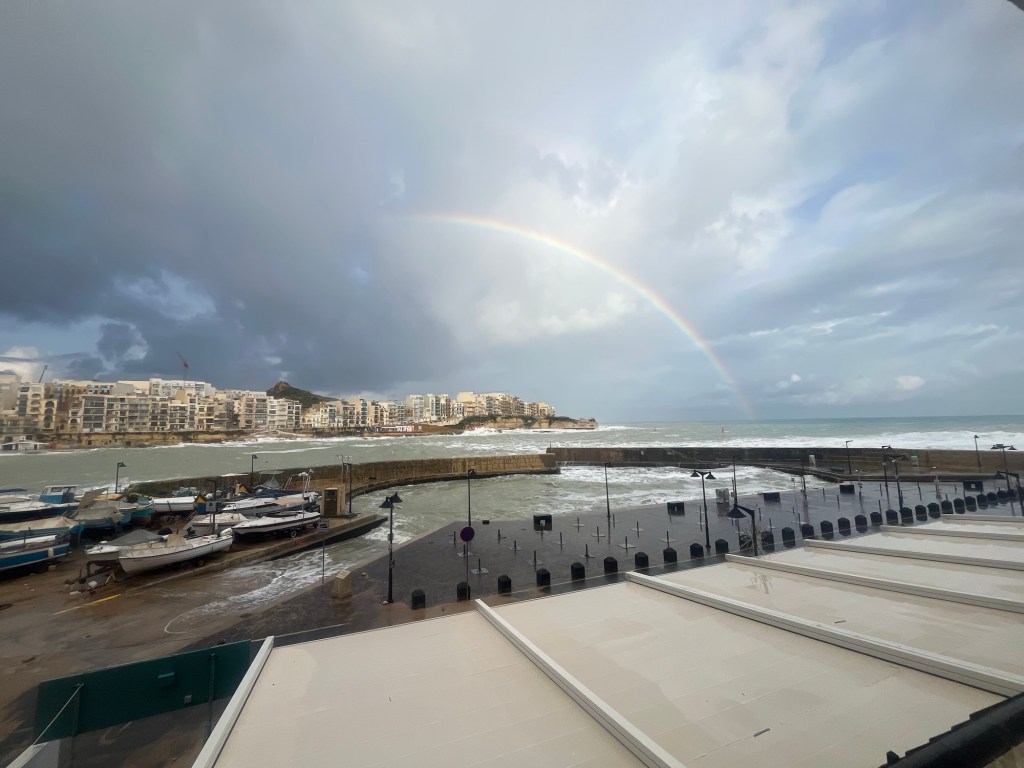
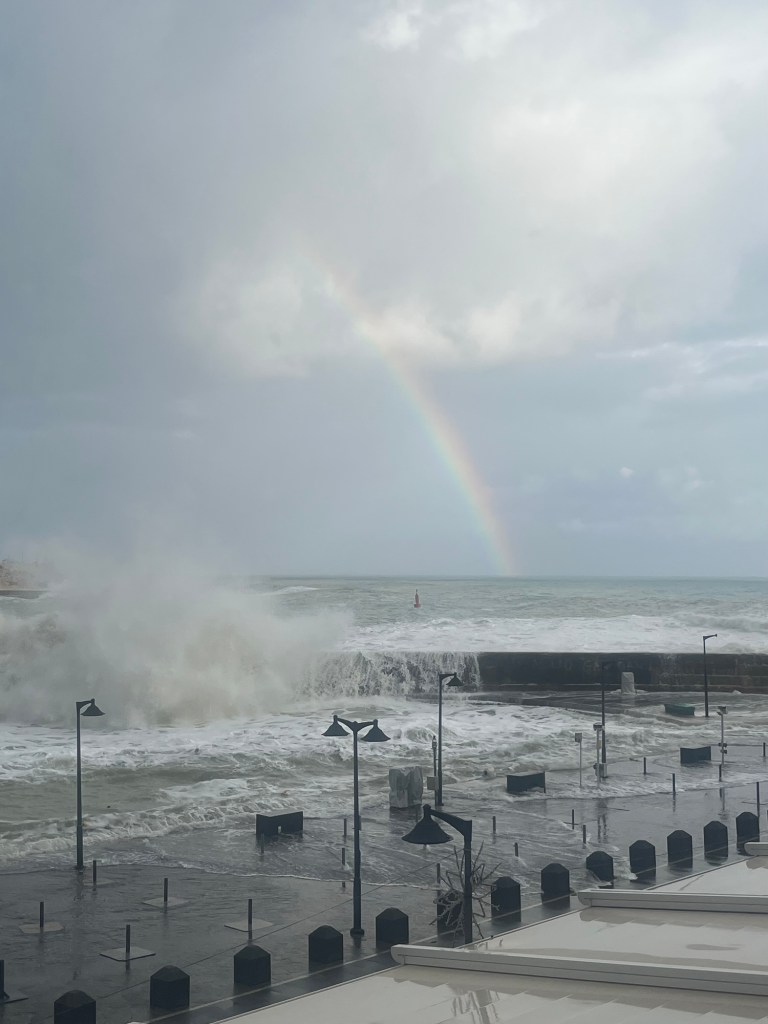
We’ve already experienced one rainbow following the storm, now comes another.
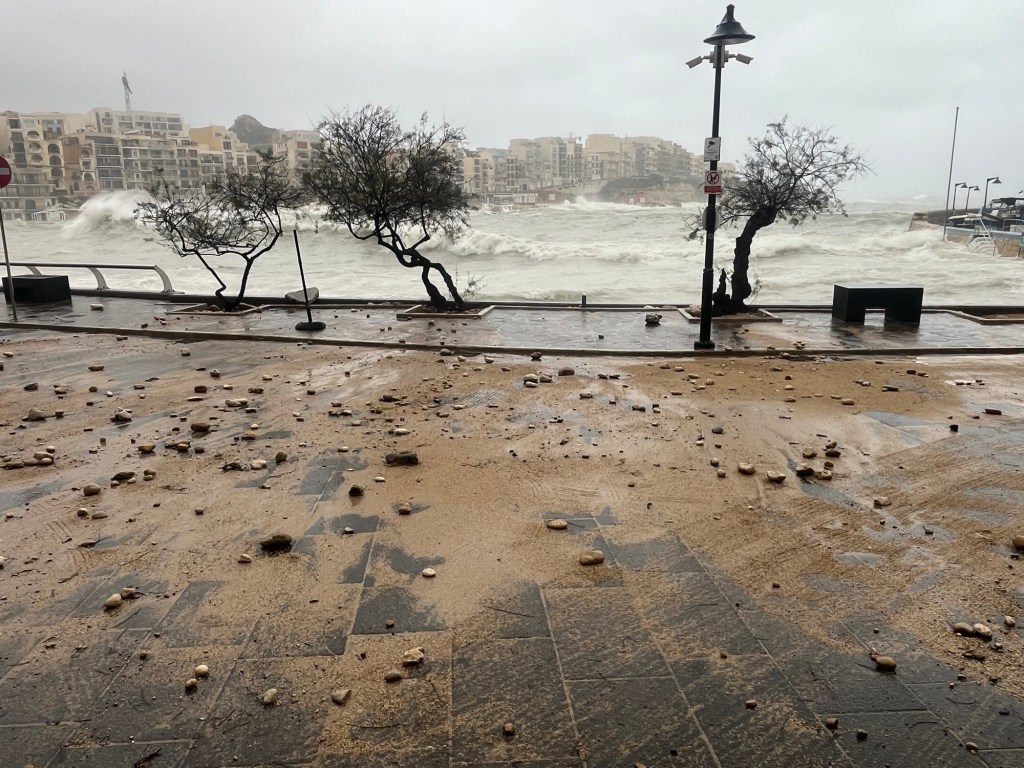
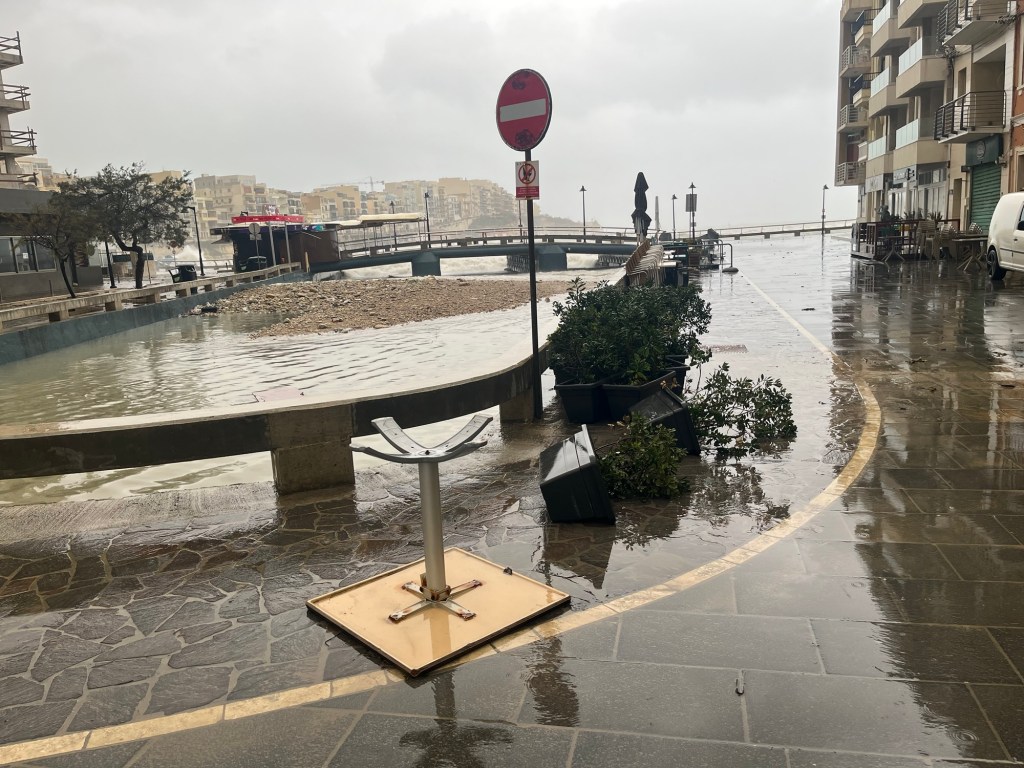
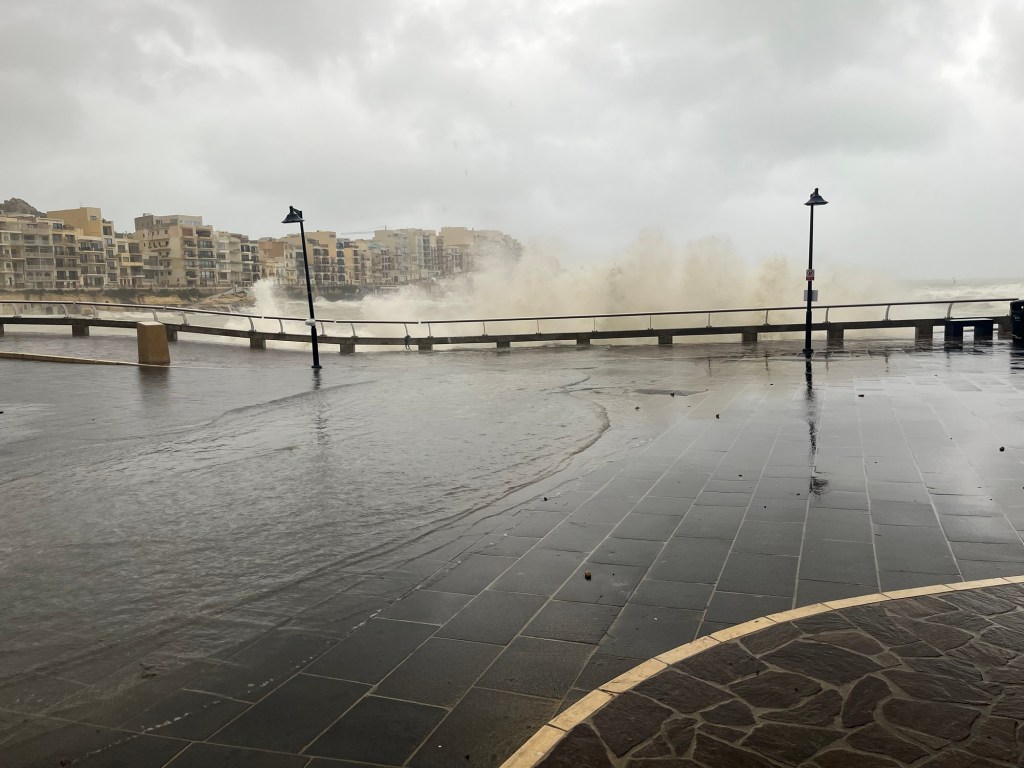
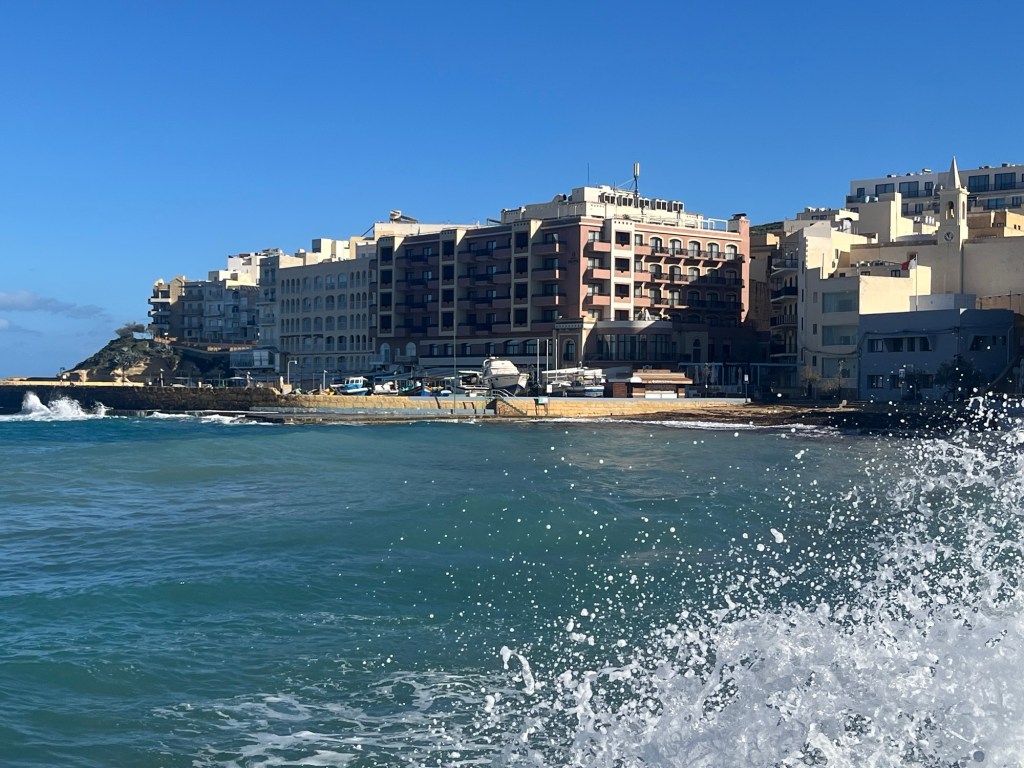
Mediterranean storm Harry was a lulu. Tunisia and Sardinia supposedly got hit harder than Malta. Regardless, Malta got clobbered.
Yesterday, we traveled clear across the country, from Gozo in the west to Marsaskala, at the east end of Malta. Three local buses and a ferry. The trip took us damn near 4 hours … several hours more than if we had traveled by car and did not have to wait more than an hour for the ferry to leave. (I have now confirmed, by the way, that the land mass of all of Malta is about 50% larger than the total land mass of Grand Isle, County, Vermont.)
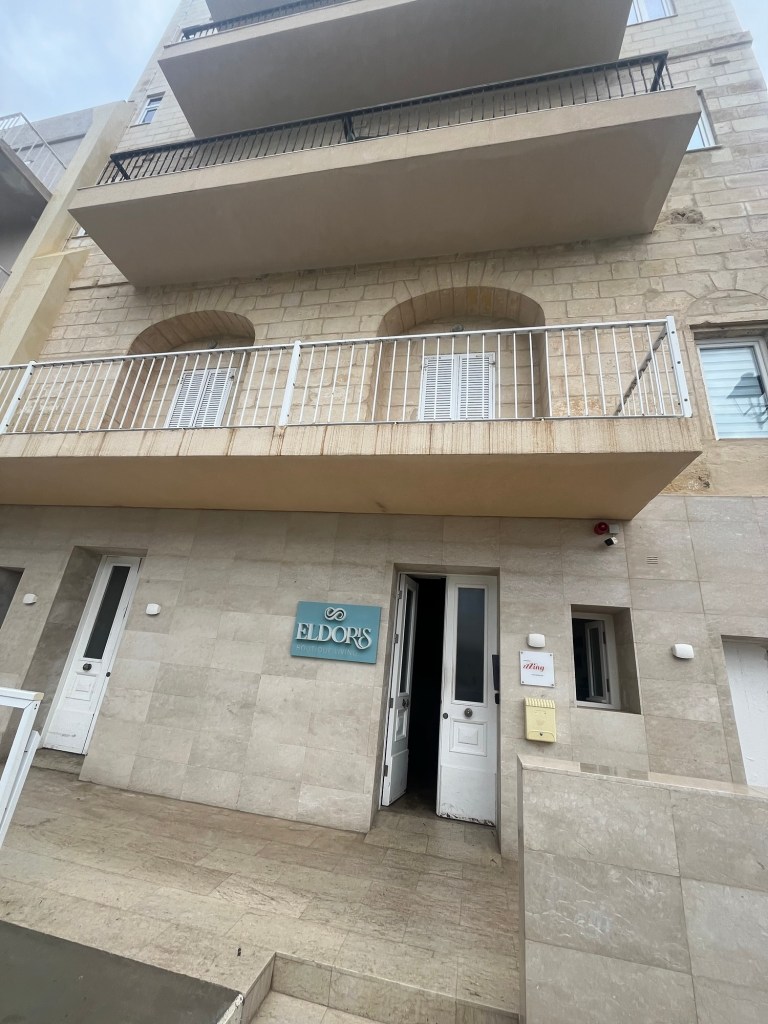
Before leaving Gozo, the desk clerk at our hotel (Tamzin, who is an utter delight!) showed us a video of waves breaking a door down in Marsaskala. Here is that video. Watch it!!!! https://www.facebook.com/share/r/1HBEbdzenf/
When we saw the video, we phoned our hotel to be sure it was still operating. We were told that the images on television are sometimes worse than real life, and they were indeed operating.
When we arrived, the sign on the street-level door said to use the door at the water level, so we walked down some stairs to the water level. The door not only did not open, it didn’t even wiggle. So we walked back to the street-level door and got in. But the elevator wasn’t working, so we lugged ourselves and our bags up a bunch of stairs to our room.
This morning, we learned that the doors in that video are our hotel! It’s a regular Maltese celebrity! The water-level door did not open because it had been braced with a 2X4 from the inside. The elevator didn’t work because the shaft and all of the electronics had flooded.
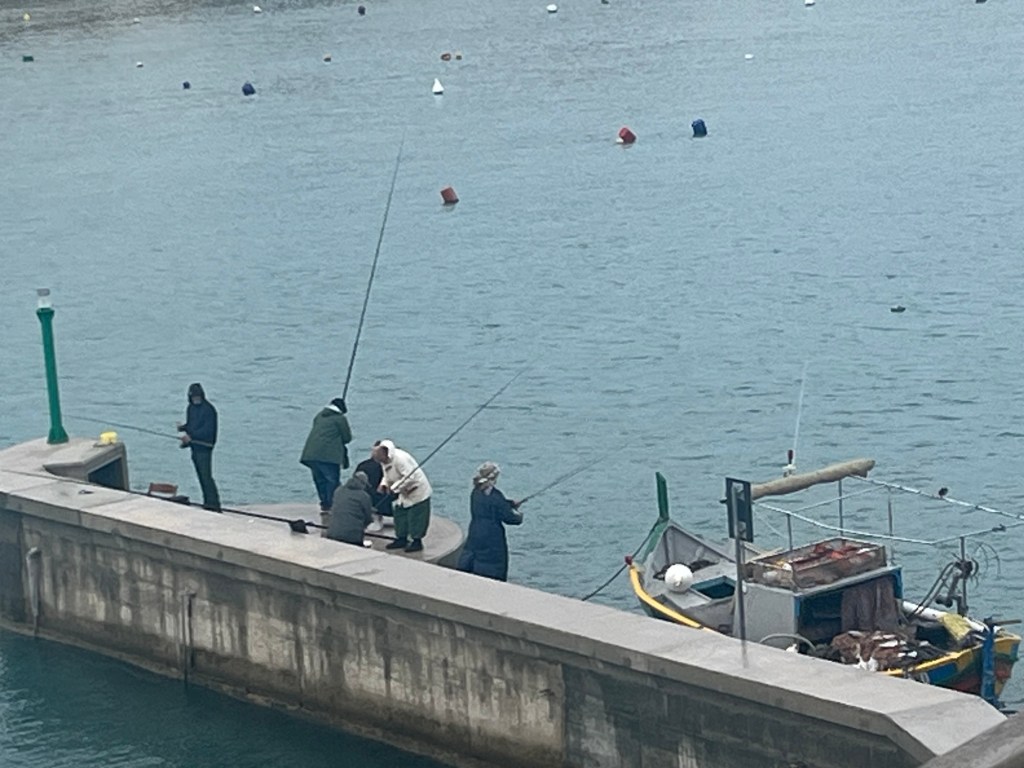
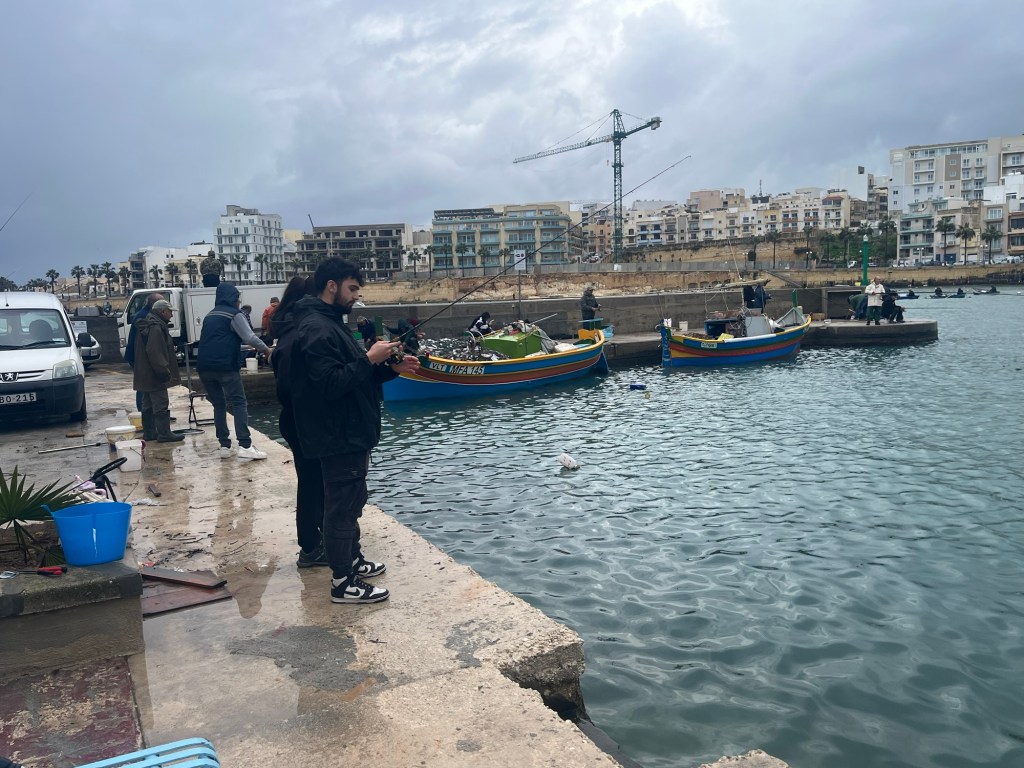
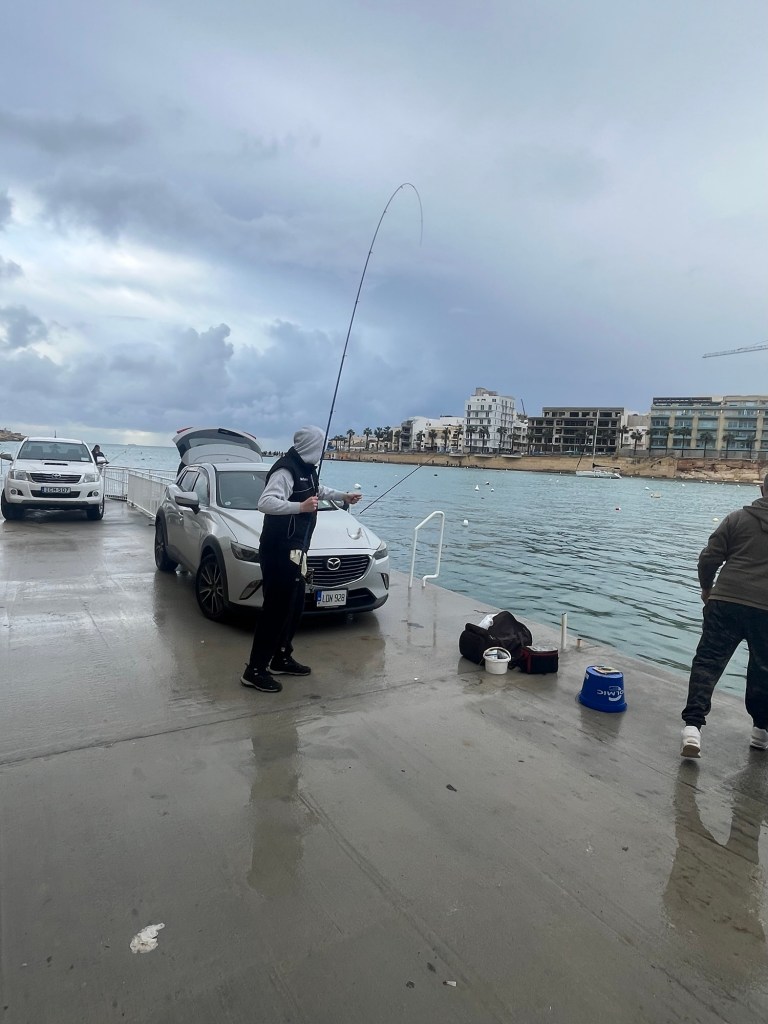
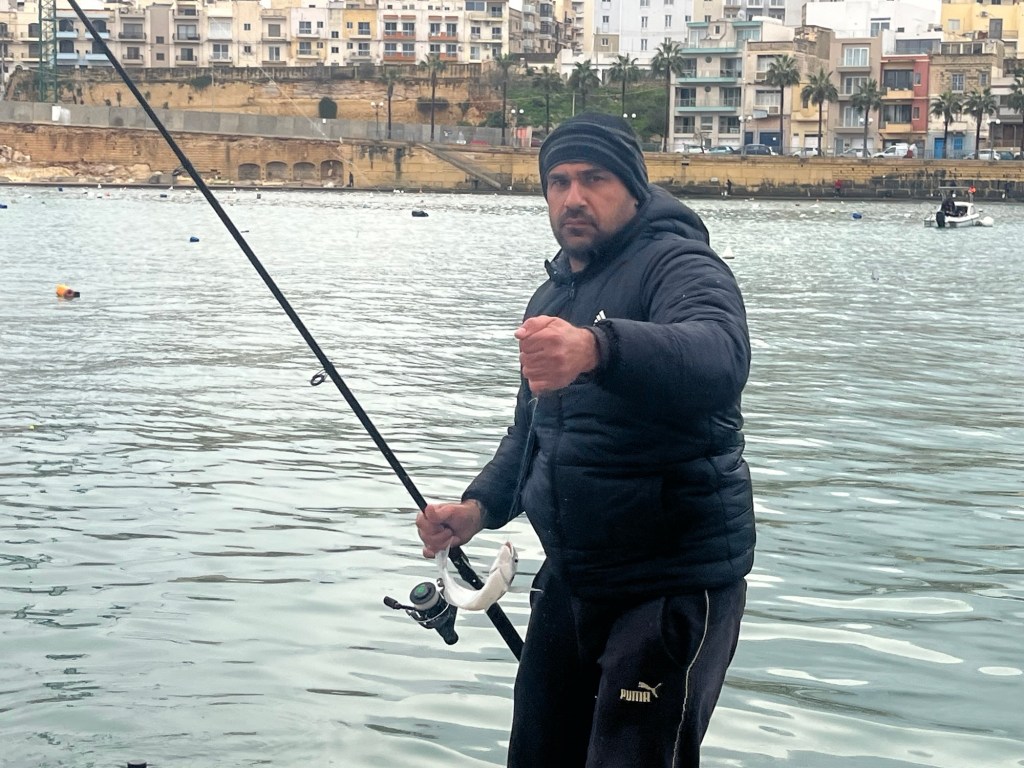
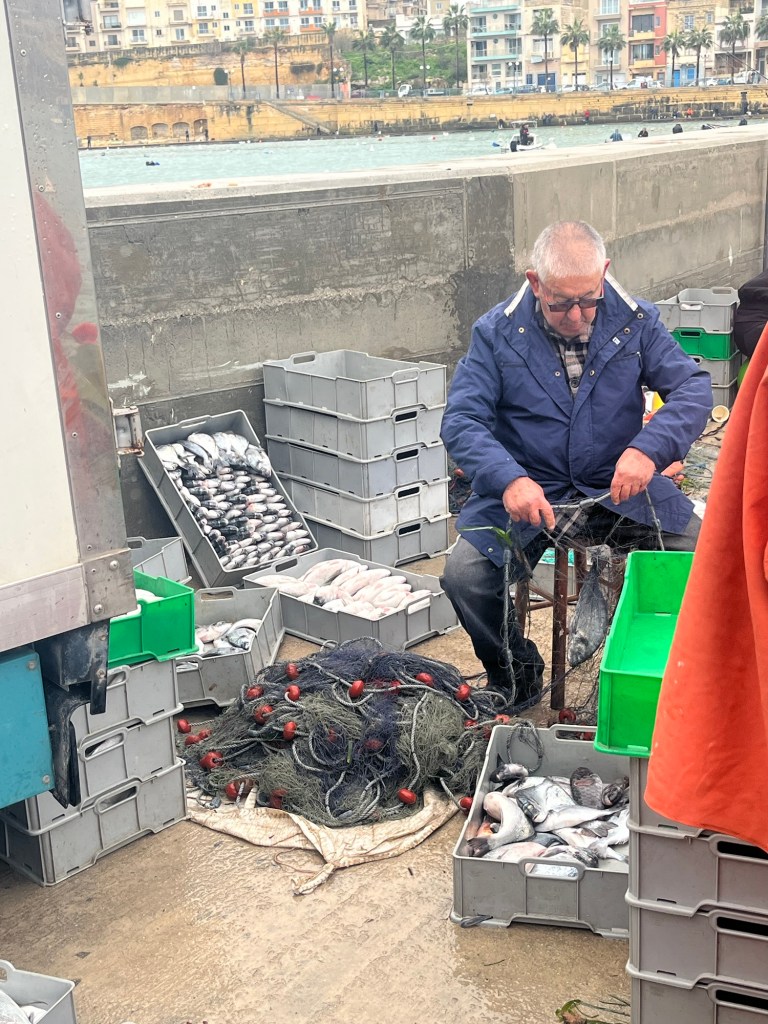
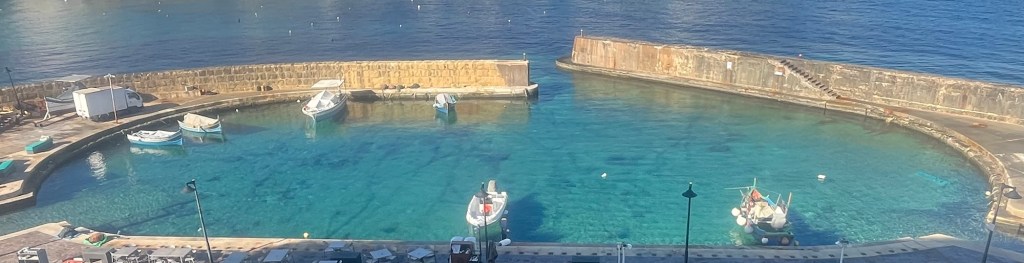
Then came the silver lining. When we woke up and looked out the window this morning, the sea wall along the harbor was thick with people fishing: old, young, male, female, well-equipped, and barely equipped. I dressed and told Rebecca I’d be back in a while, but not to expect me too quickly.
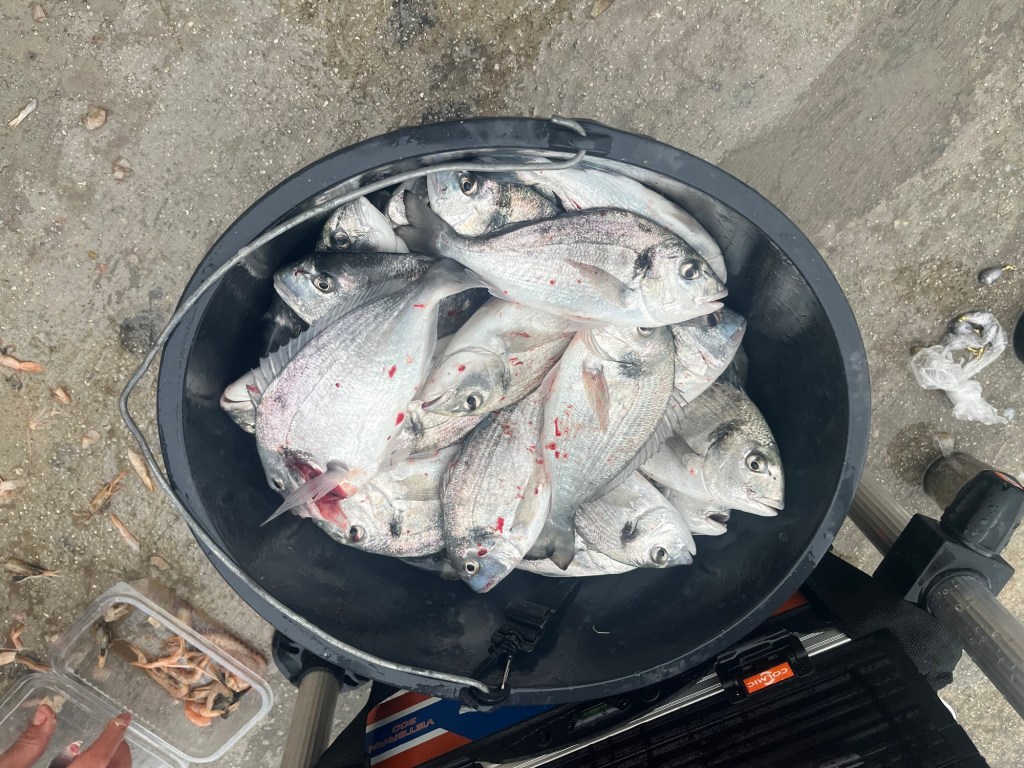
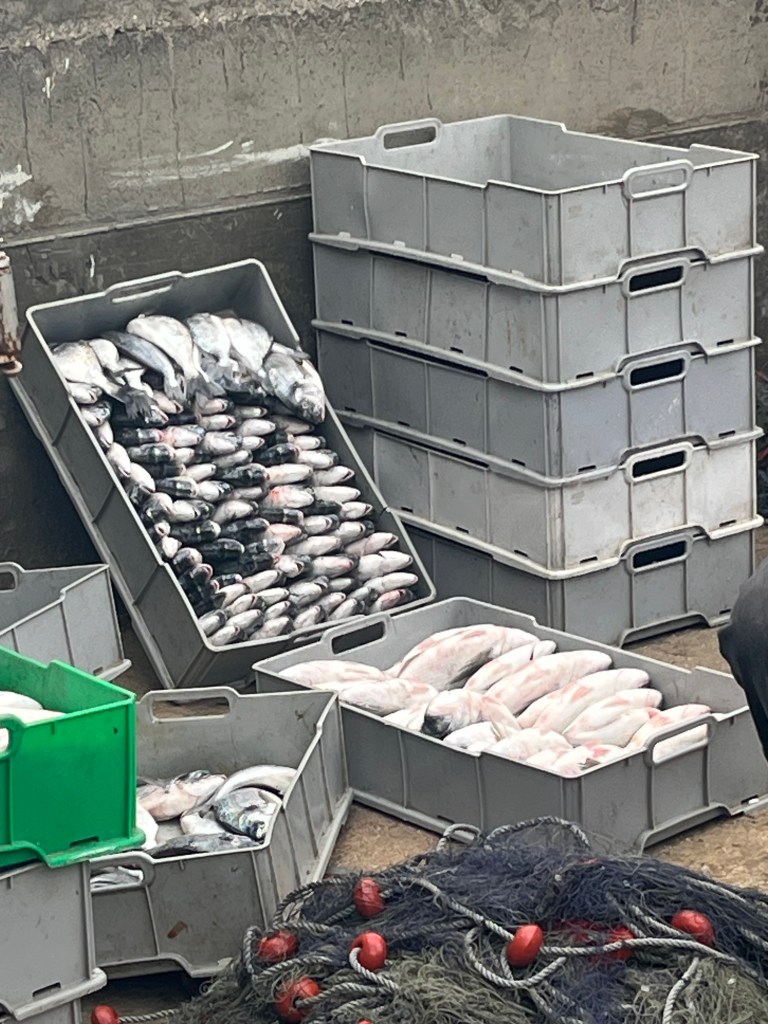
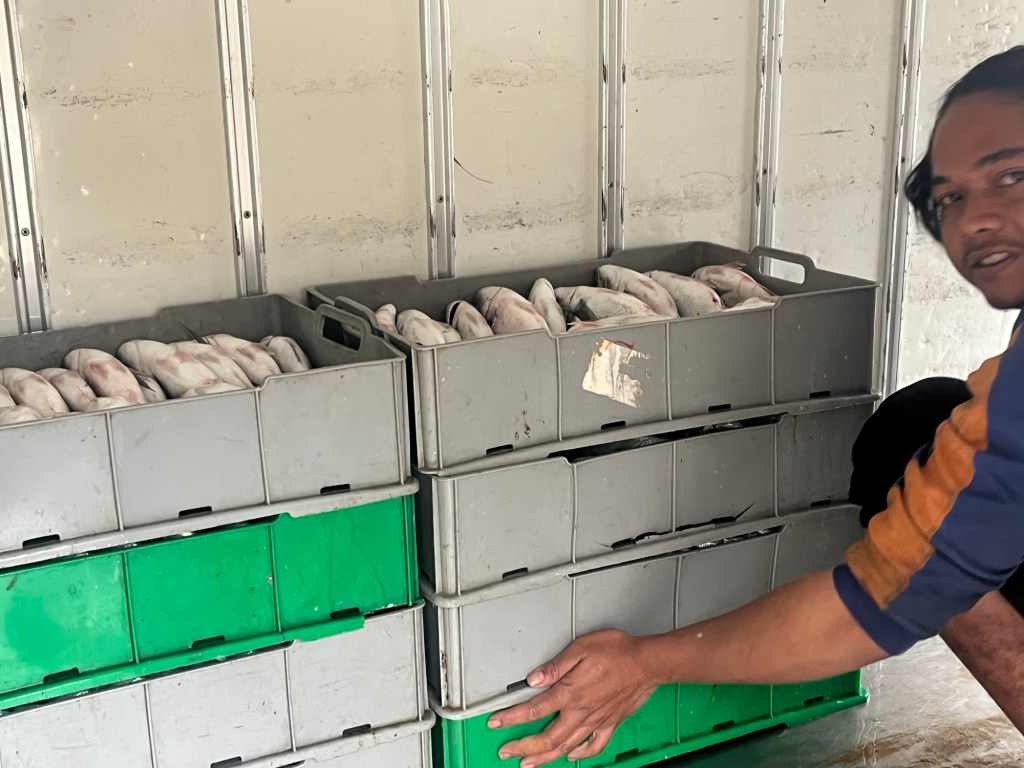
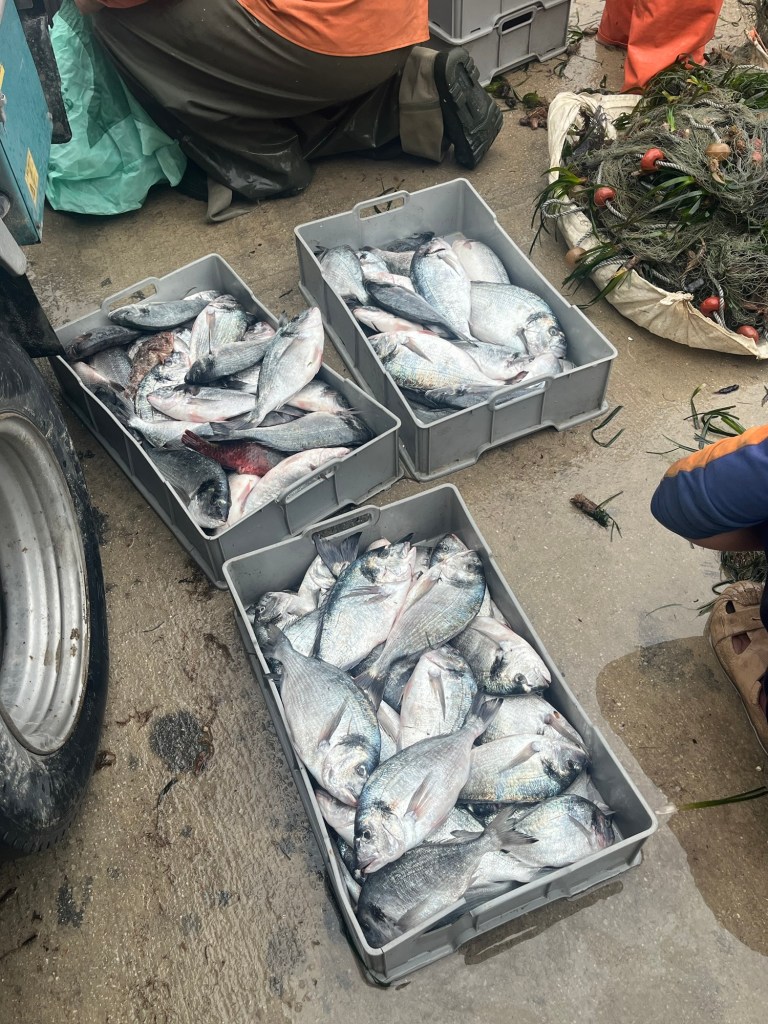
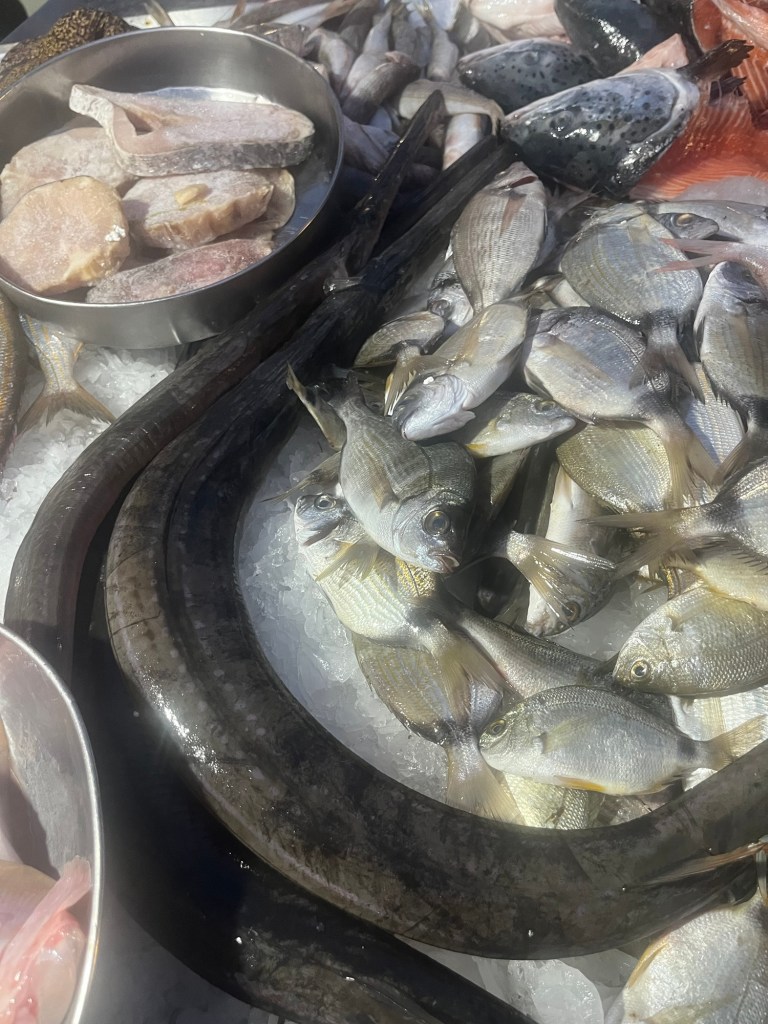
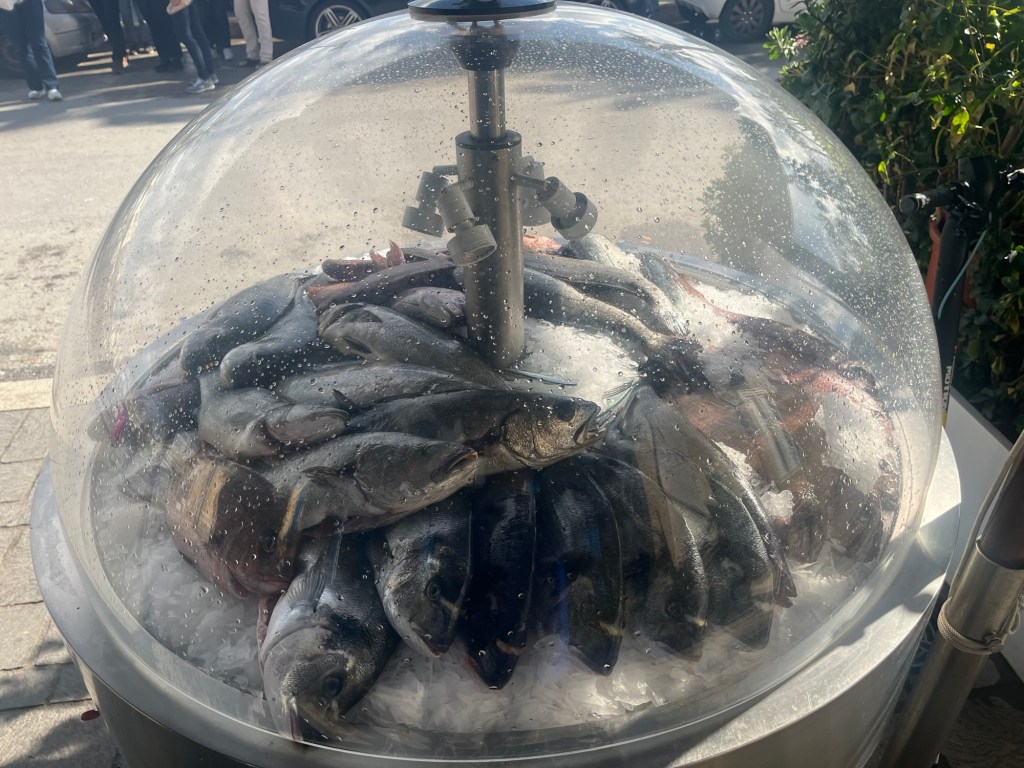
I needed about 10 seconds to learn what was going on: the dam to the local fish farm had burst in the storm. Thousands of “sea bream” had escaped and swum into Marsaskala Harbor. The water was thick with fish, and the residents of Marsaskala were taking full advantage of the windfall.
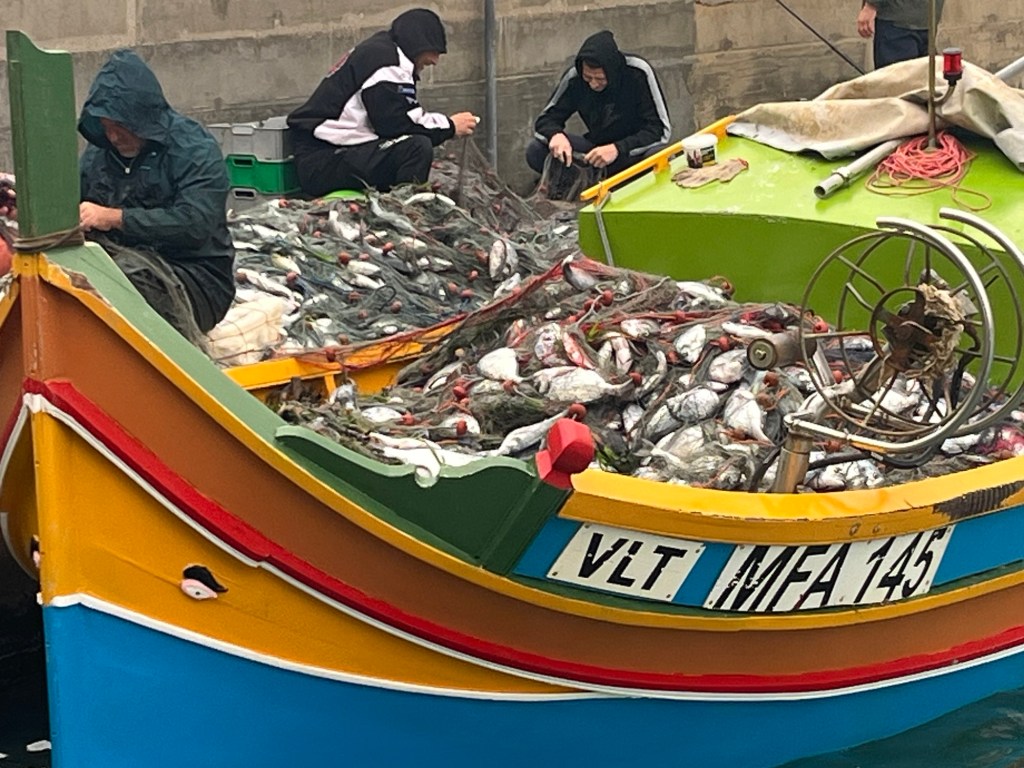
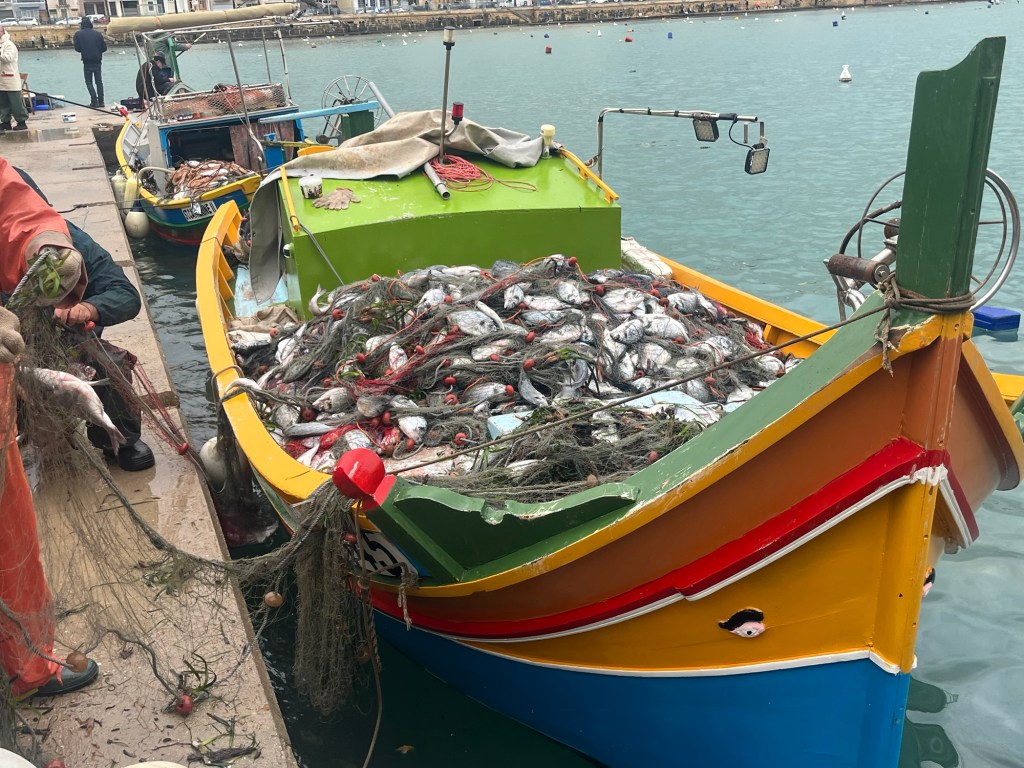
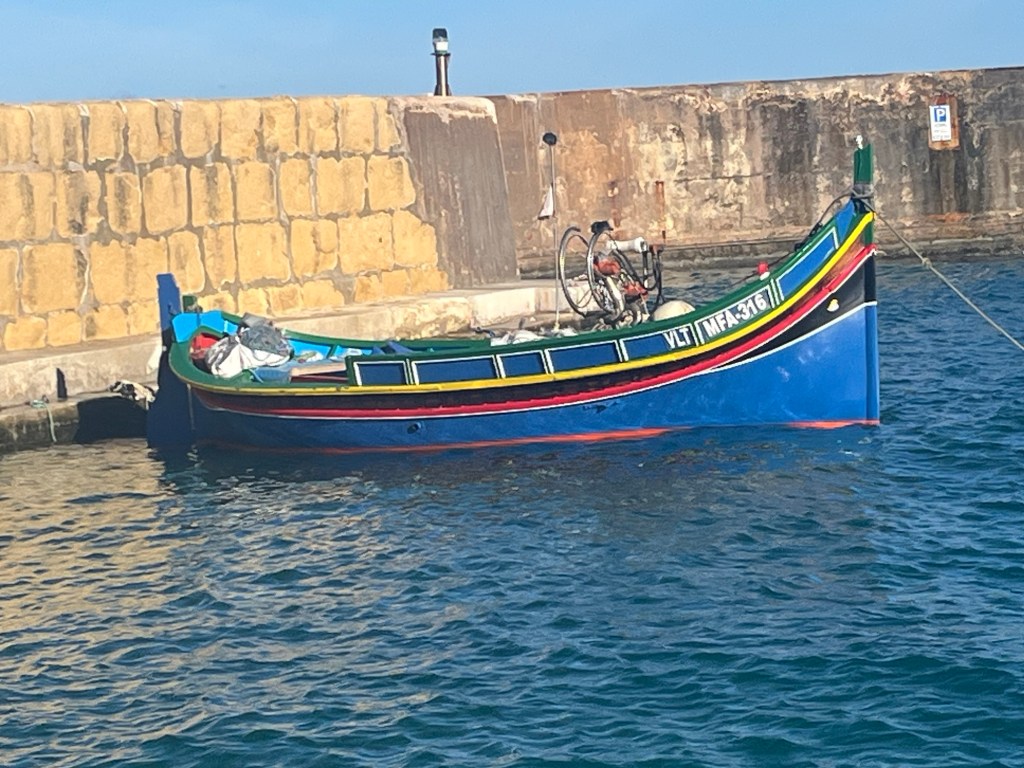
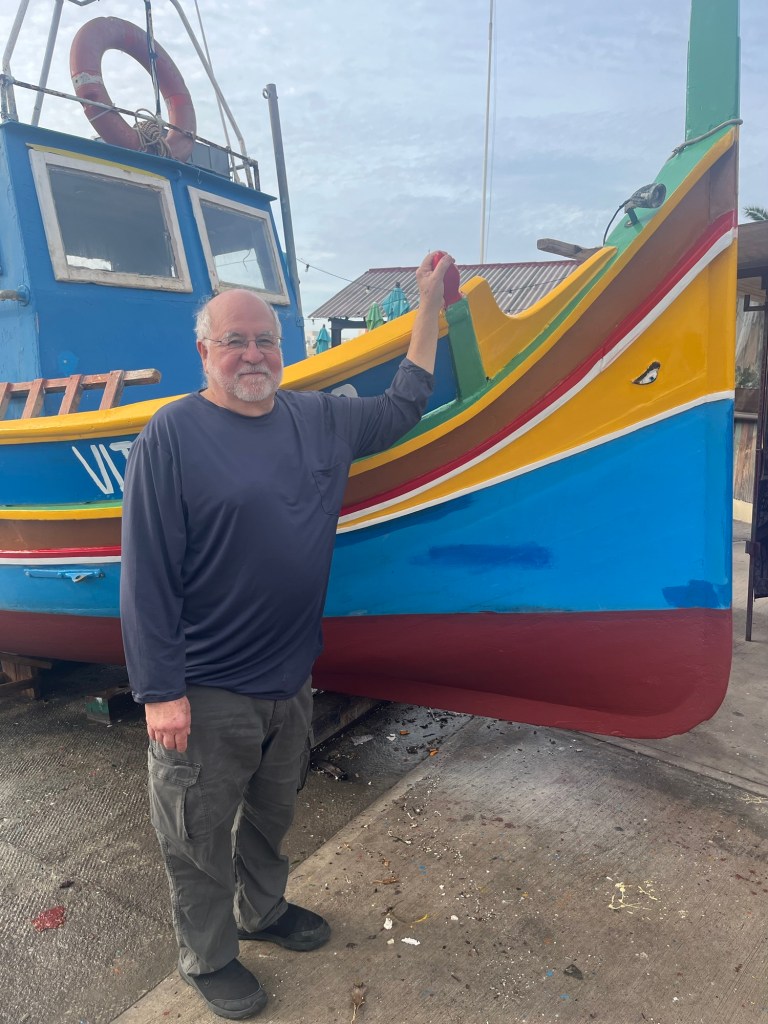
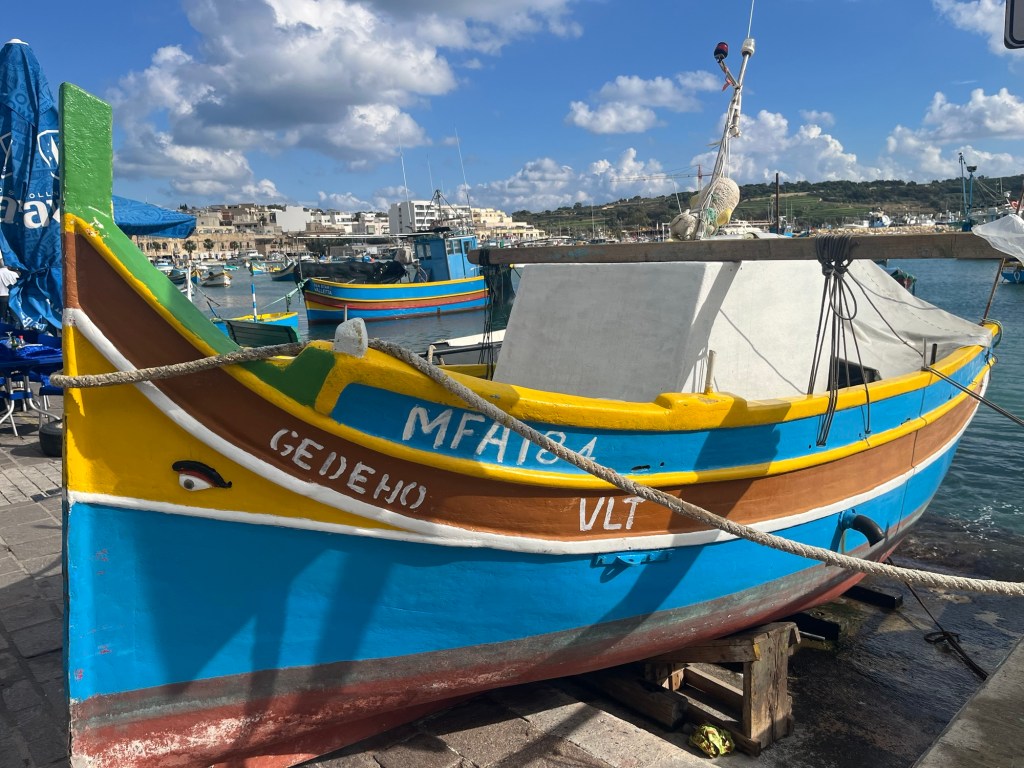
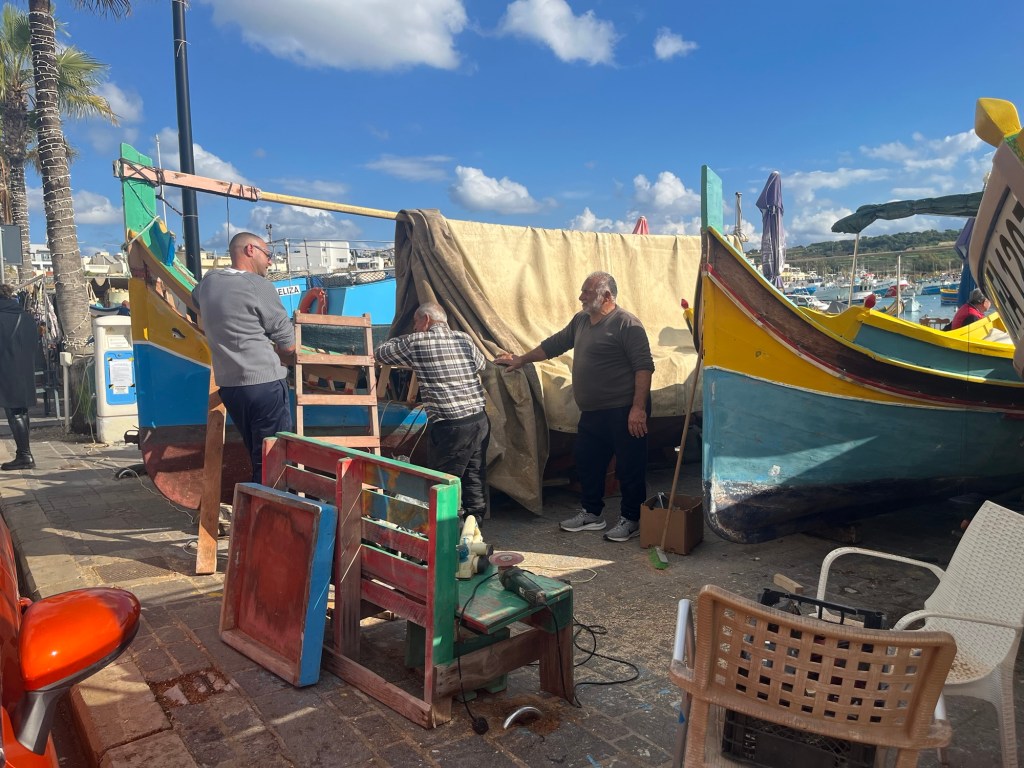
The pros were raking in the bounty too: a couple of luzzus were docked. Their nets contained literally tons of fish.
To me, everybody wins except the poor little fish. The fish farm, I was told, was fully insured. I just don’t tend to worry too much about insurance companies. And the good people of Marsaskala are swimming in an insane supply of fresh fish.
Enjoy the pics! And guess what we are having for supper tonight!
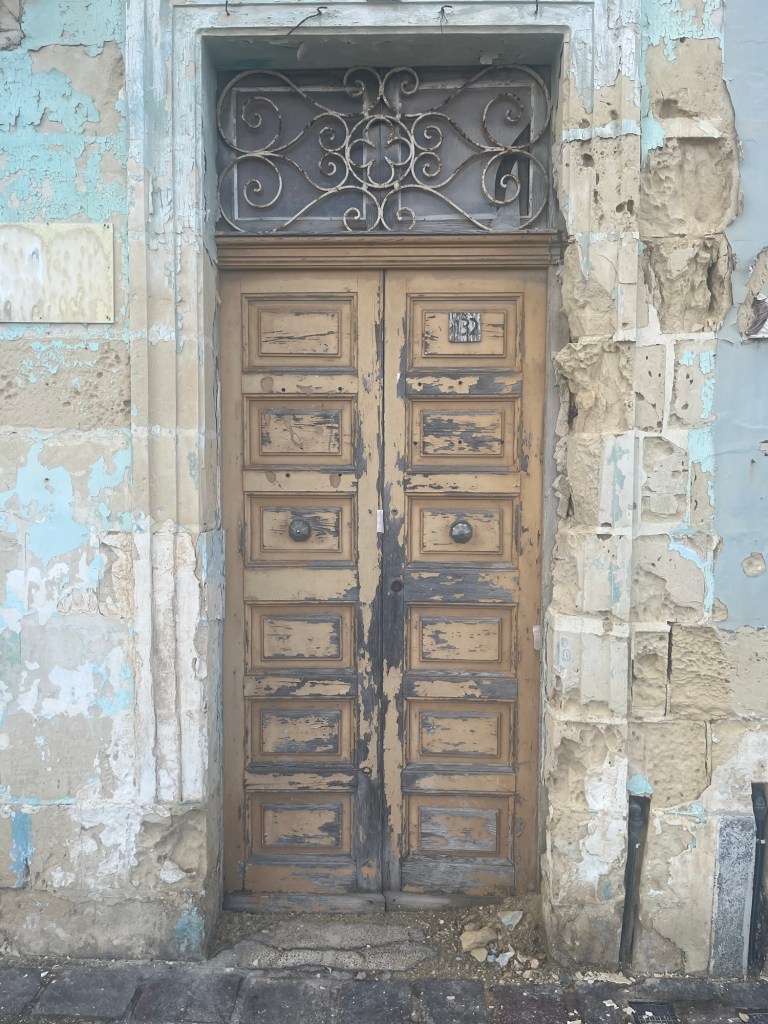
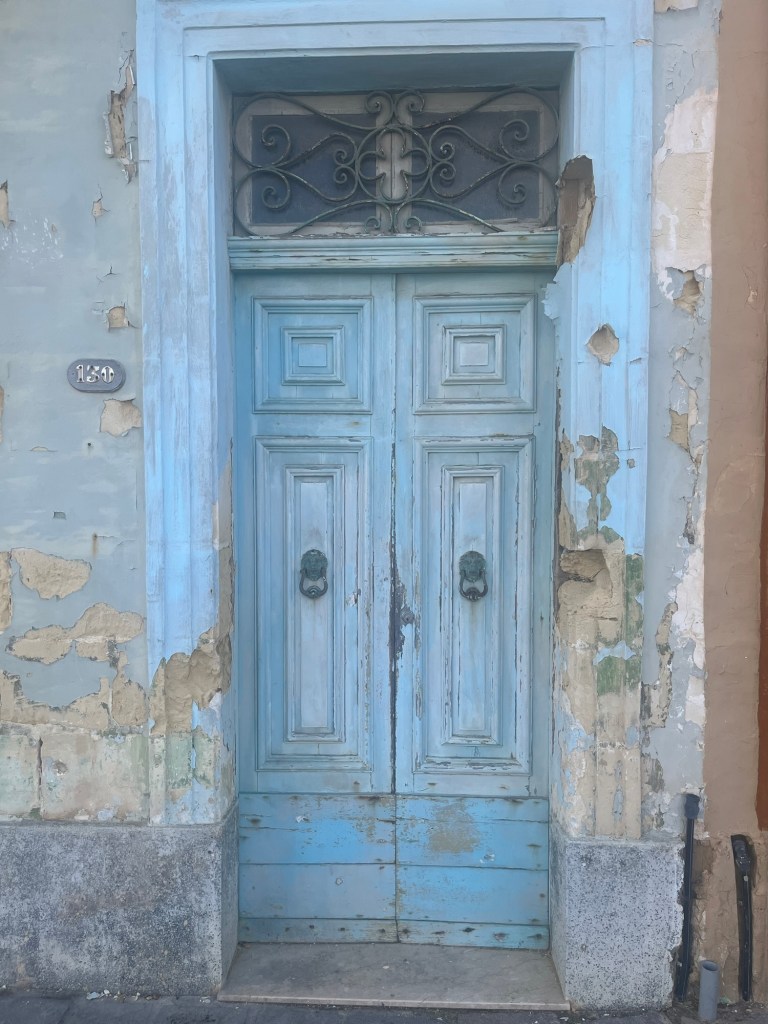
The doors of the El Doris. The video shows the same doors from the inside as the water crashed in.
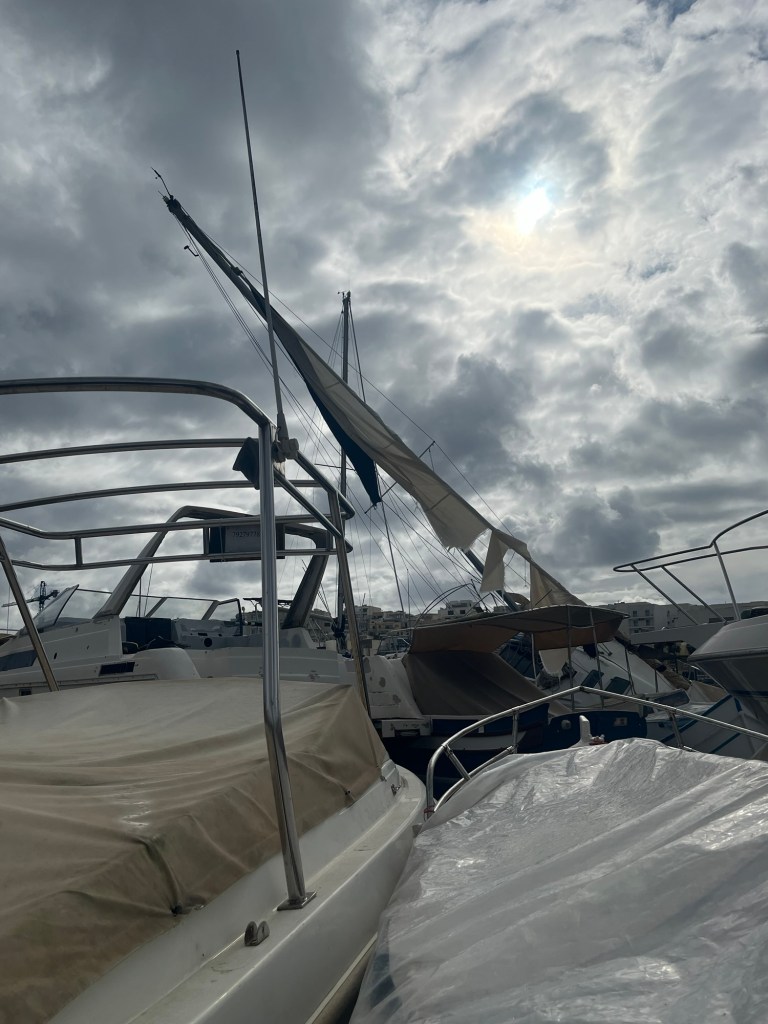
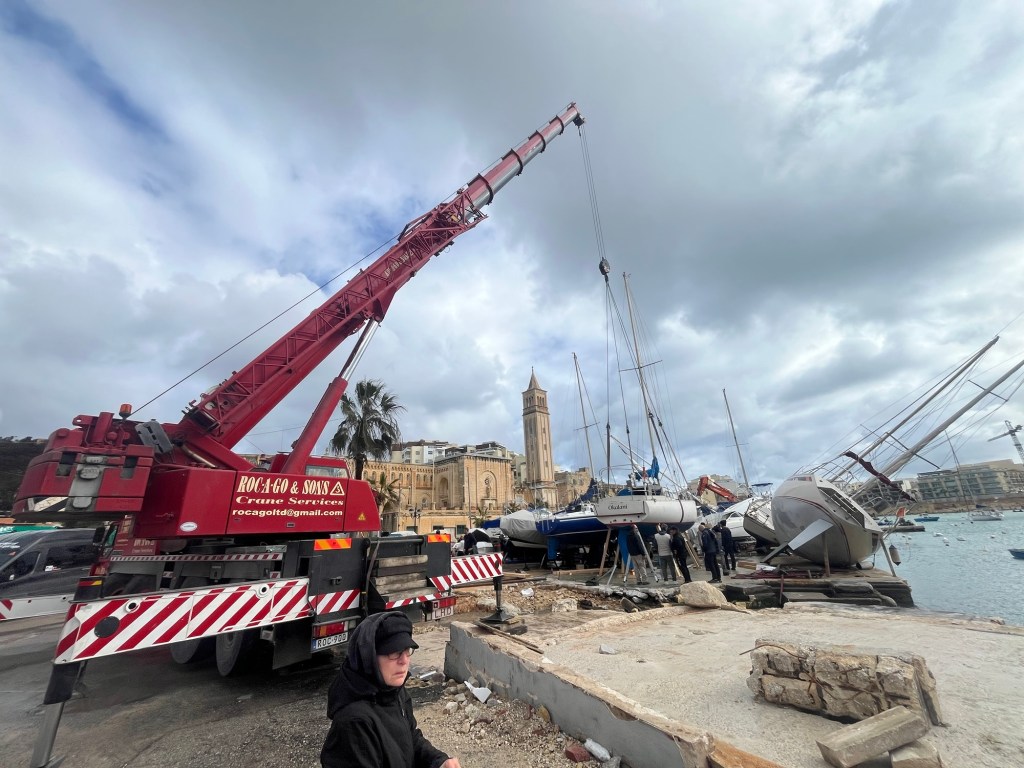
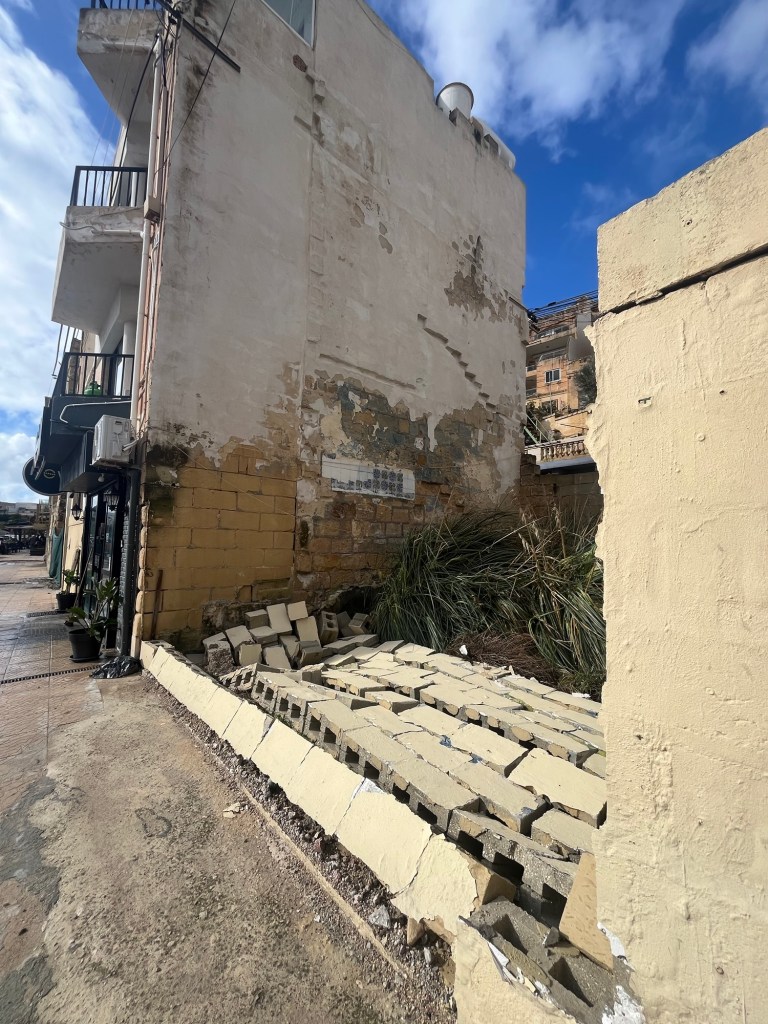
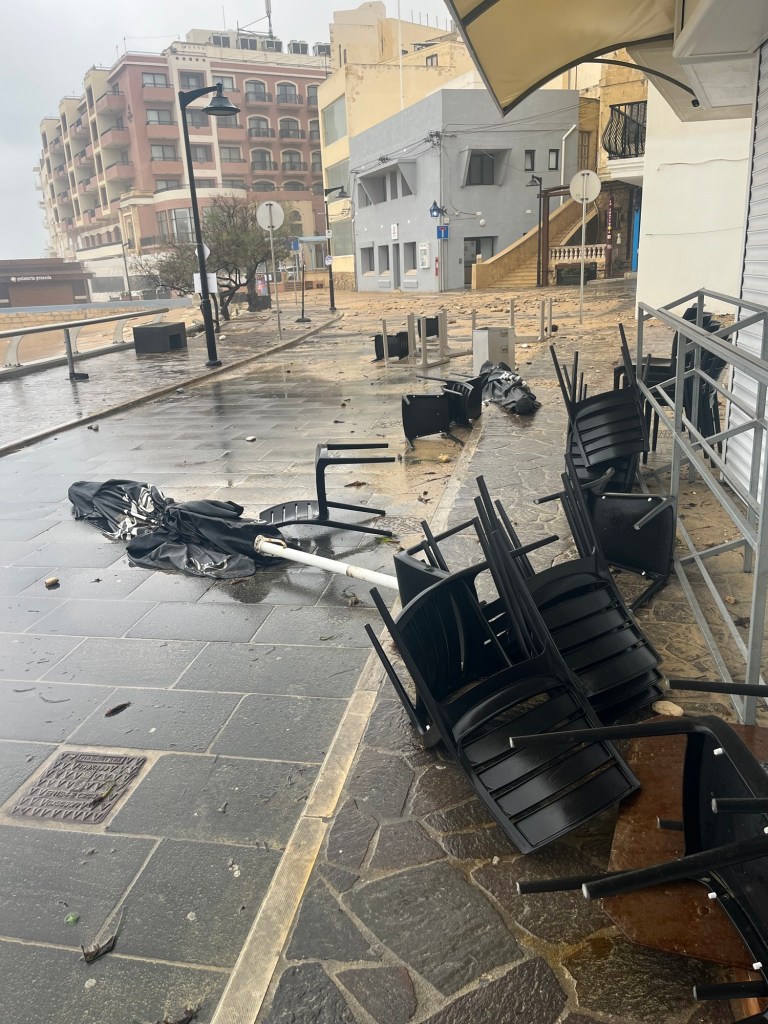
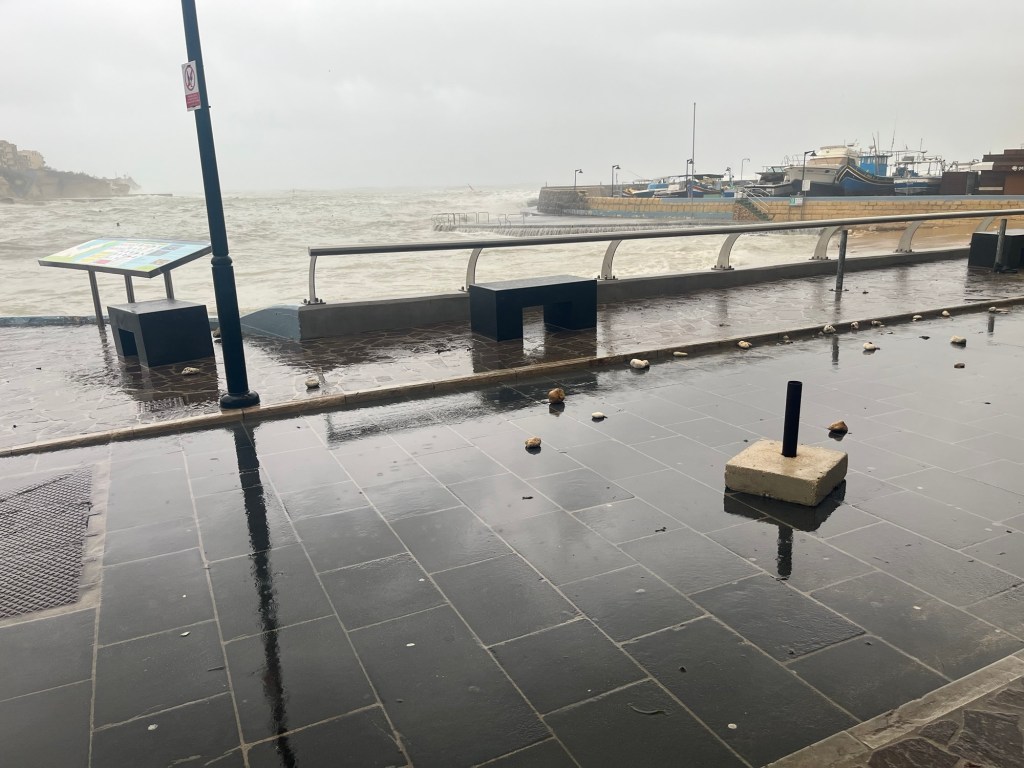
A little more storm damage.
People everywhere taking advantage of the broken fish farm dam!
I will take no credit for the brilliance of this post. It all goes to “the machatunim.” “Machatunim” is Yiddish. It literally means “father of my son-in-law.” Colloquially, it means the entire extended family. In this case, it really does mean the father of my son-in-law, Bernie.
In my last post, I asked for recommendations about places in Sicily. We got some great ones: Syracusa, Taormina, Agrigento, Cefalu, and a whole bunch more. I also made the off-handed comment that Googling “small fishing villages in Sicily” just isn’t specific enough. Bernie suggested that instead of using Google, I use ChatGPT. He tried it, sent me the results, and opened up a whole new world of possibilities.
I instantly realized what makes planning this adventure so challenging: we have constraints I had not really thought of because I did not think we could manage them. For example, Rebecca’s balance is messed up. She walks with poles, cannot carry her own baggage, goes slowly, and prefers holding onto my arm. (That is why we have successfully limited our baggage to one small roller bag and two backpacks, one that hooks onto the roller bag handle and one for my back.) Another is that we have no car, so we need places that are convenient by train or bus. Another is that we want to avoid big hills and rough, uneven terrain. Another is that we want relatively non-touristed villages with comfy lodging and good food … in the off season.
ChatGPT is unbelievably good at finding villages that meet our needs … villages that we would never have thought to look at without its help. Once we have a list of potential villages, Google Maps and Booking.com give us the specifics we need to find places and specific locations within a town. It’s really working!
Here is the plan du jour: We leave Gozo tomorrow. (We extended our stay for several days because we just endured a monster Mediterranean storm with winds exceeding 65 mph and humongous waves. It’s a good thing we had a perfect third-floor room with a balcony overlooking the full wrath of Mother Nature!)
From Gozo, we head to the other side of Malta again, first to a small fishing village we want to see, Marsaskala, and then back to Marsaxlokk so we can experience the Sunday market one more time.
After Marsaxlokk, the winds are supposed to be lingering around a non-gale-like 20 knots or so, so we will be taking the ferry from Valletta, Malta to Pozzallo, Sicily.
We thought Pozzallo would be a scrappy ferry/seaport town, so we thought we’d spend the night there and head out for a real village on Tuesday morning. ChatGPT tweaked that thinking. Not only does Pozzallo sound like a cool place, it has a vibrant downtown with lots of cafes, a long, sandy beach, and great-sounding hotels that are right downtown, one block from the beach, and still totally affordable. I guess Pozzallo will be stuck with us for a few days, and we will be able to judge whether or not we agree with ChatGPT’s assessment of places.
From the Pozzallo train station, we will be able to take a short train trip west to Sampieri or northeast, to Syracusa/Ortigia, which will probably be our first major stop after Pozzallo.
Despite Sicily’s reputation for being home to some of the best preserved ruins in the world, we expect to appreciate what we see and not make special trips to see more. We’ve seen Athens and the Greek Islands and Izmir and Petra and, here in Malta, the Hypogeum and Ggantila. At this stage in our lives, we are more interested in village life than in more sightseeing. We’ll see how that pans out over time.
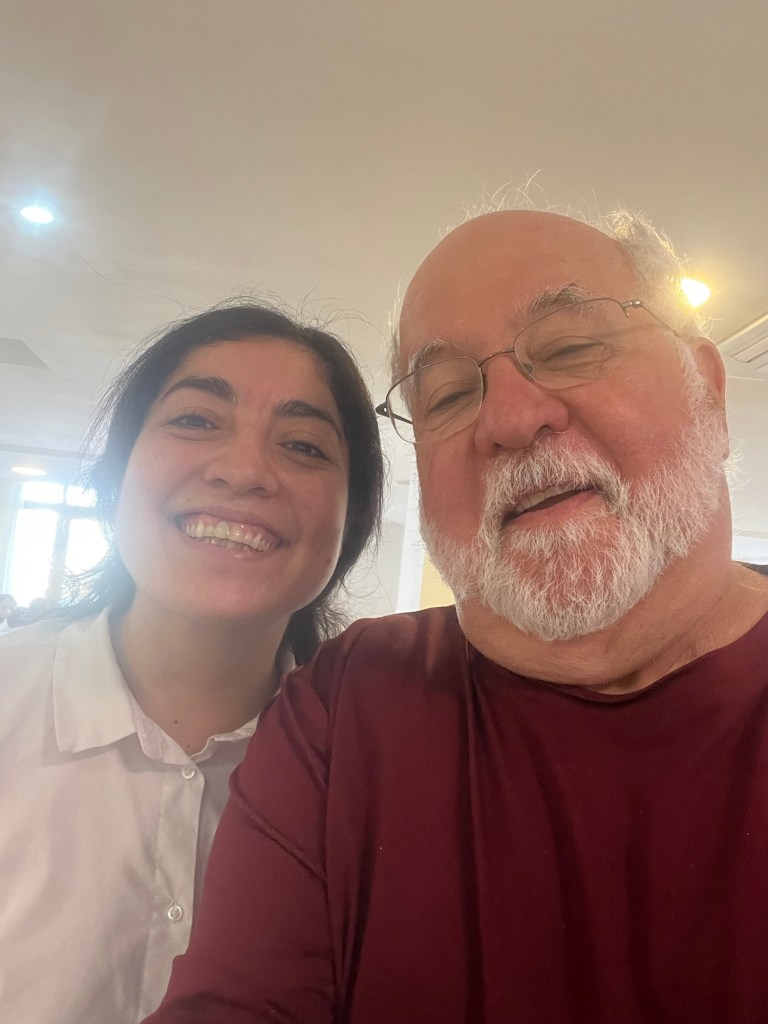
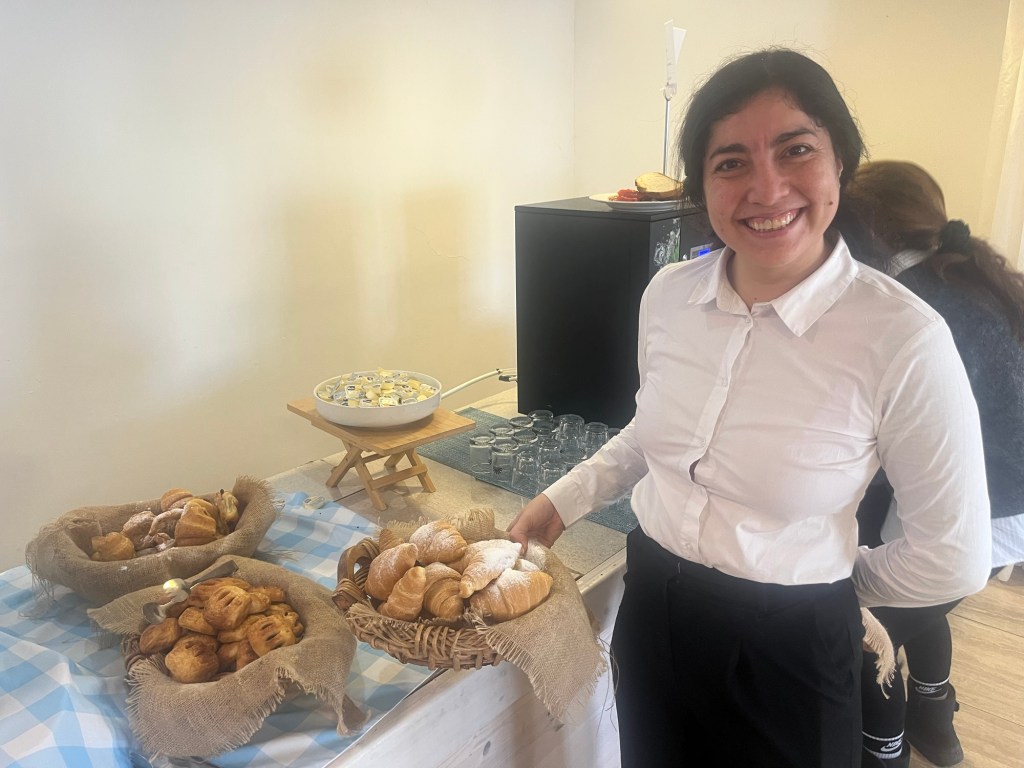
Stay tuned for updates. Today, we are exploring off-the-beaten-path places in Gozo with Dannae and her boyfriend, Claudio, both from Chile. Dannae (pronounced Donna) is one of the food service folks at our hotel here in Marsalforn. After almost two weeks here, we have bonded pretty tightly. She is delightful! Today is her and Claudio’s day off, so they took us on a tour of places in Gozo we would not otherwise see.
What we have been up to…
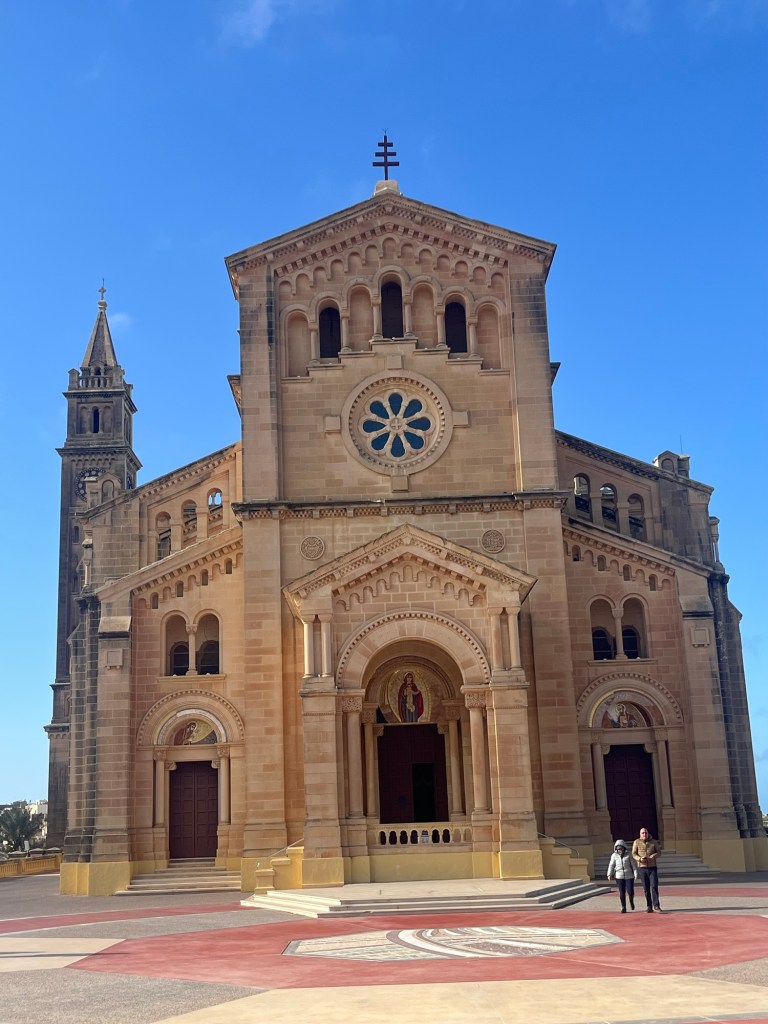
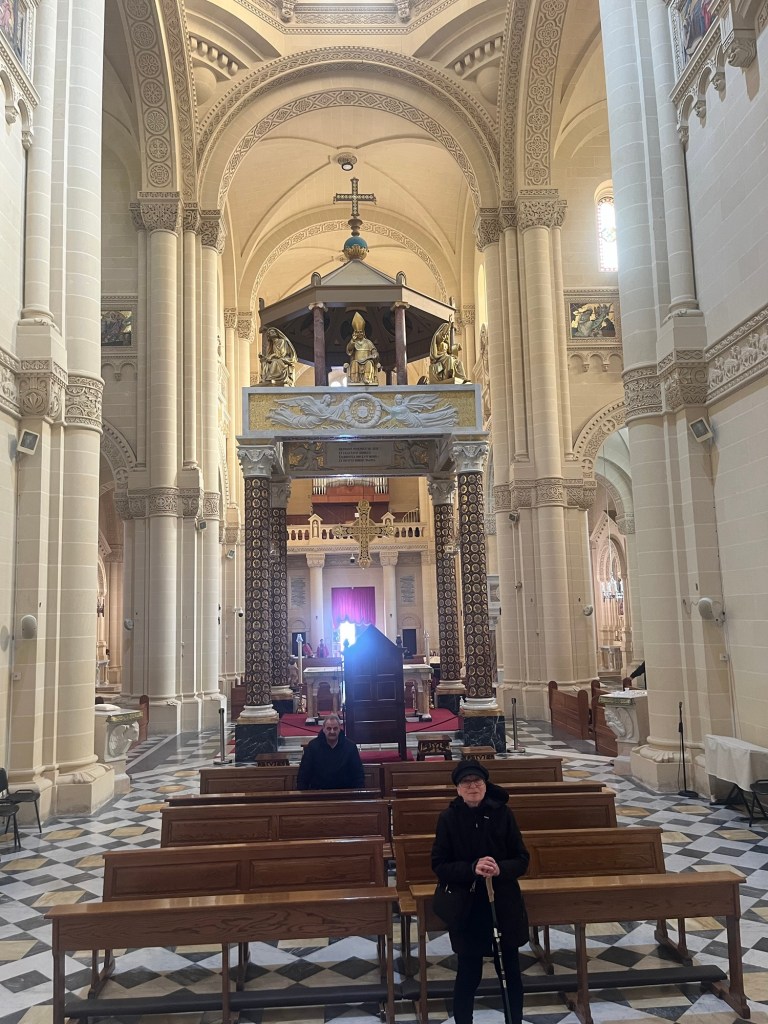
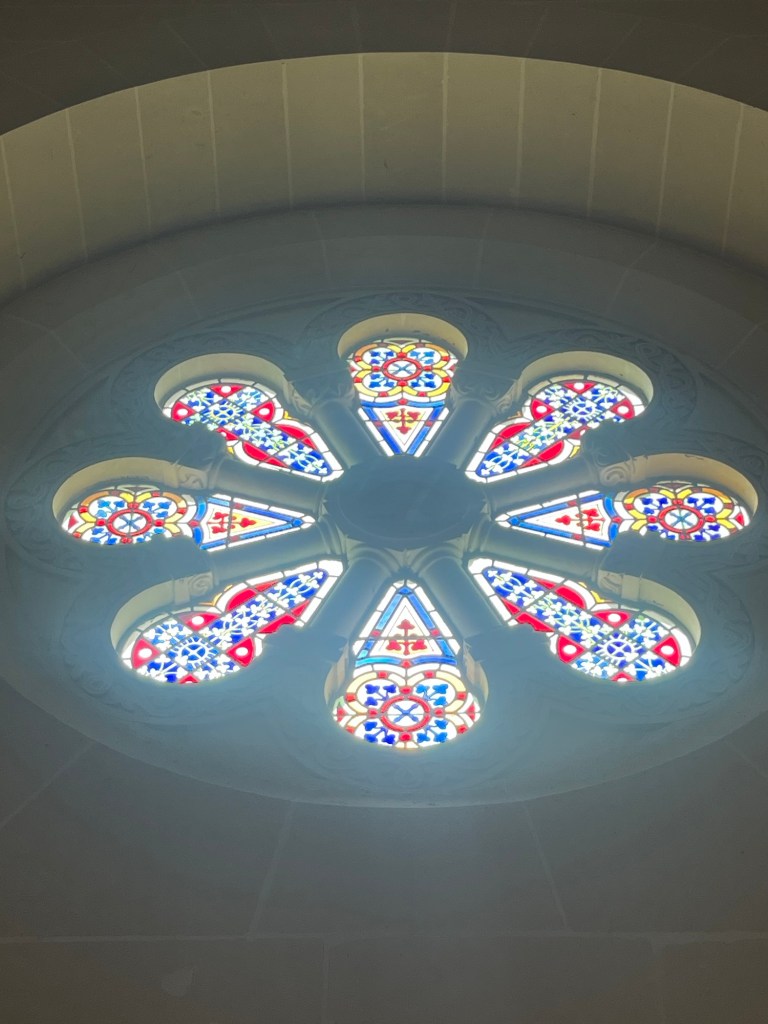
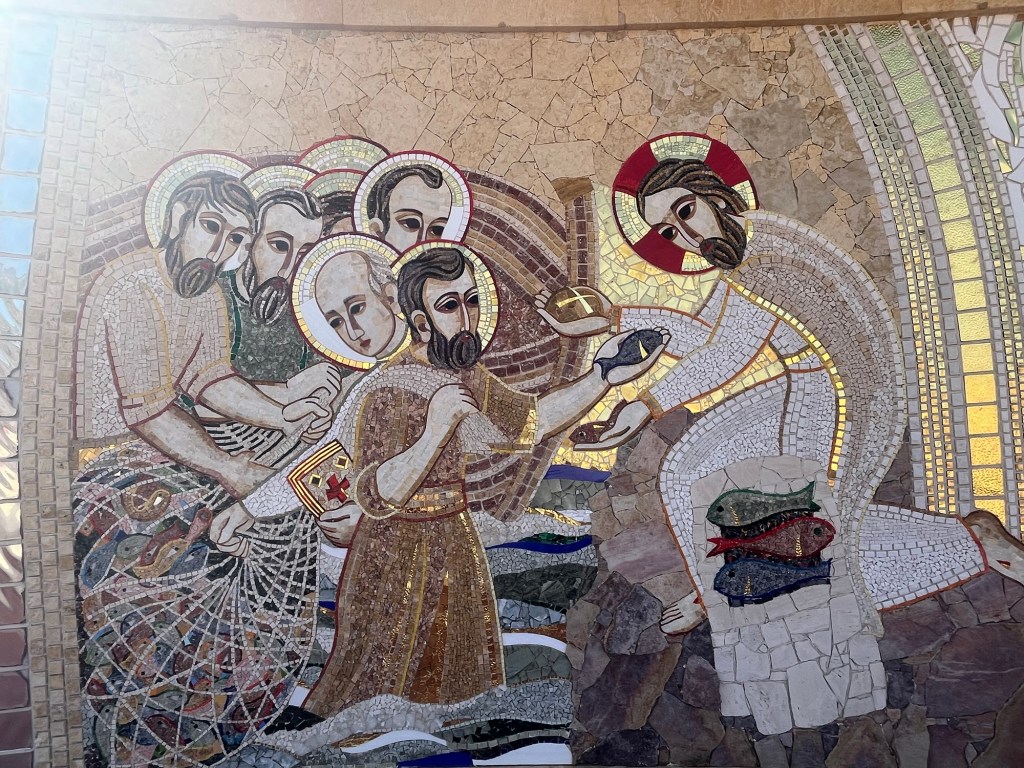
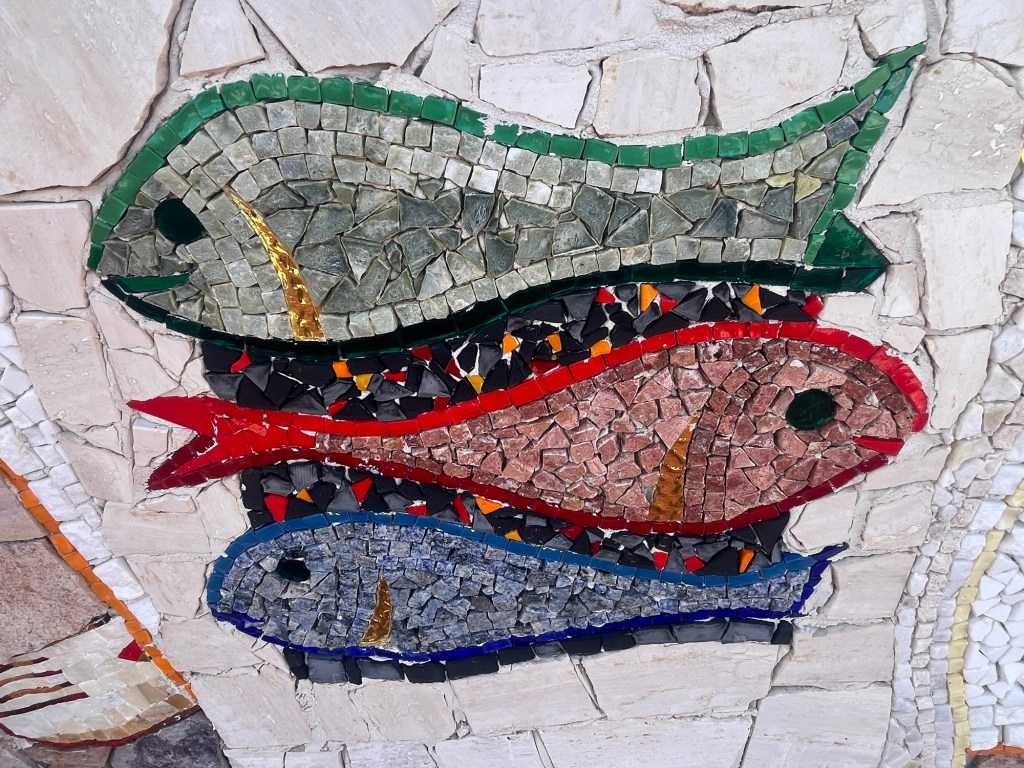
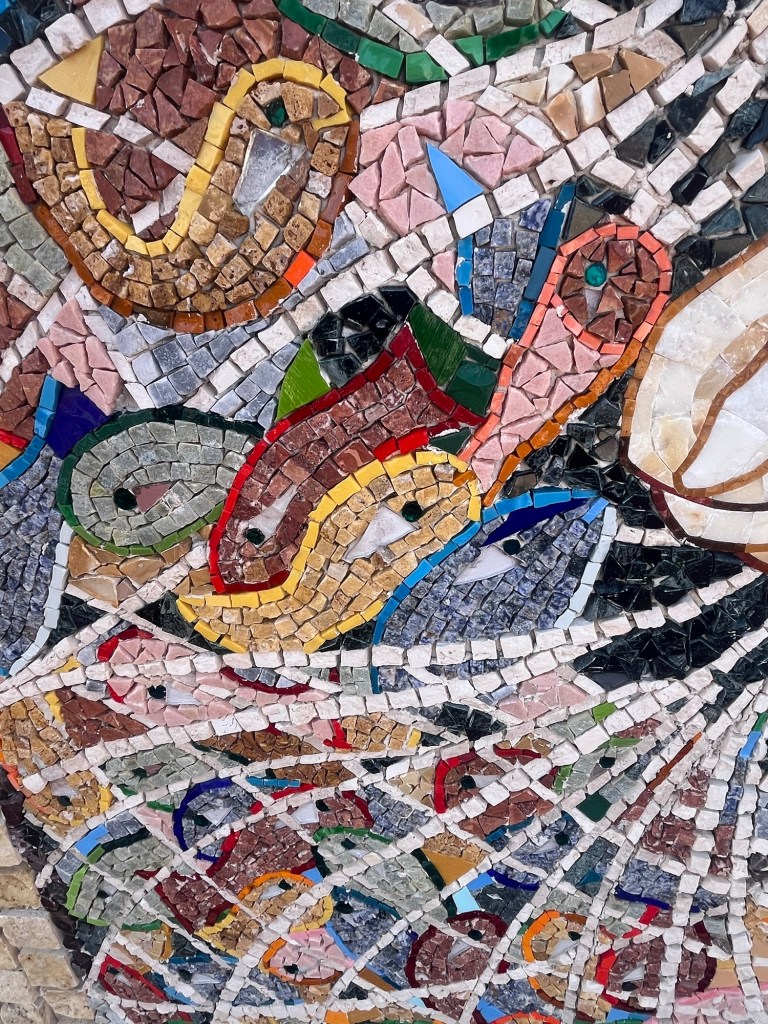
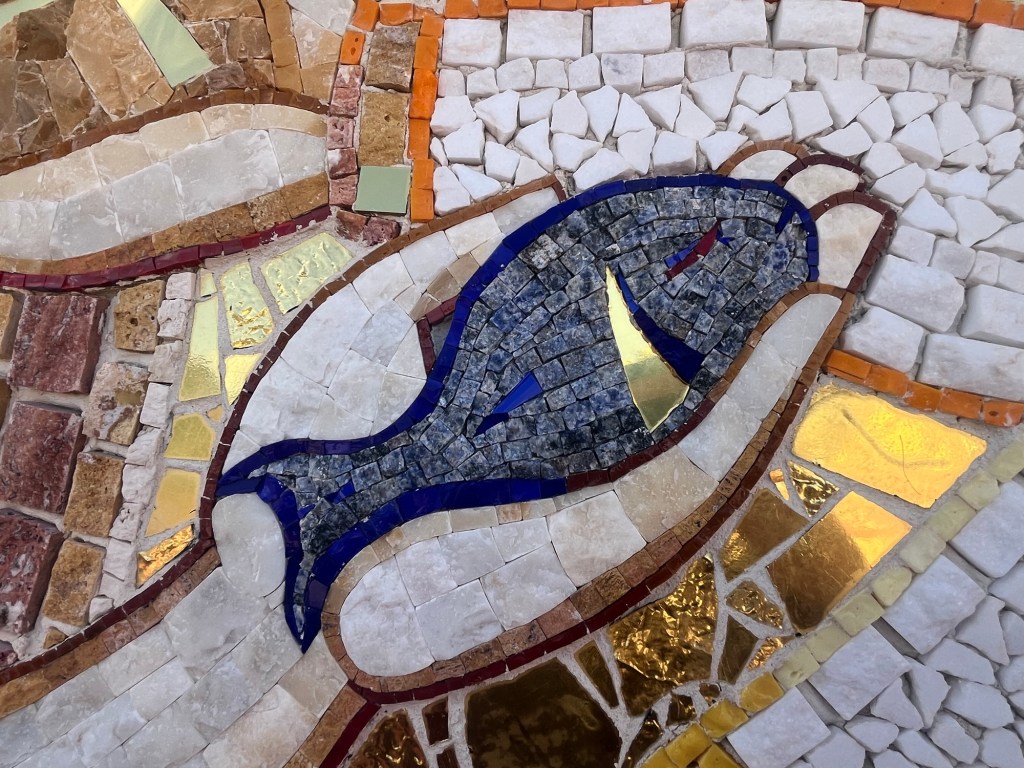
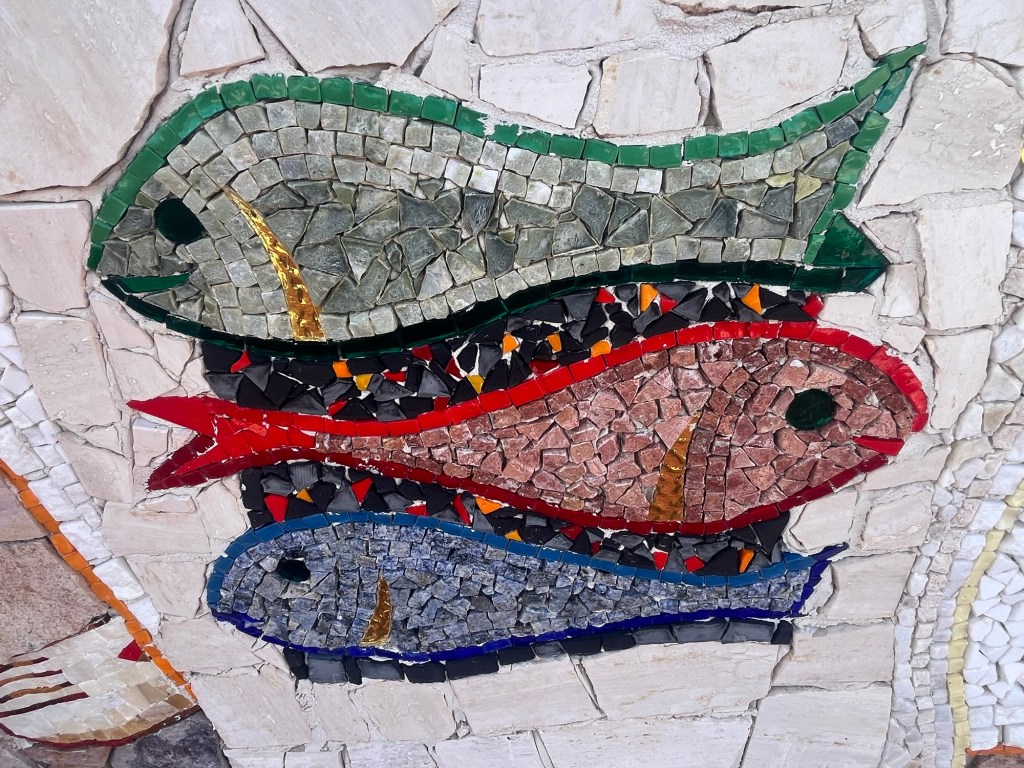
The Ta’Pinu Basilica in Gharb, Gozo. It’s a “basilica” instead of a “church” or “cathedral,” I learned, because the Pope said so. He said so because it is home to a whole gaggle of miracles. The mosaics are amazing. For those of you who don’t know, the dominant motif of our home in Vermont is fish. We are sure the mosaic fish images will find happy homes somewhere on our walls.
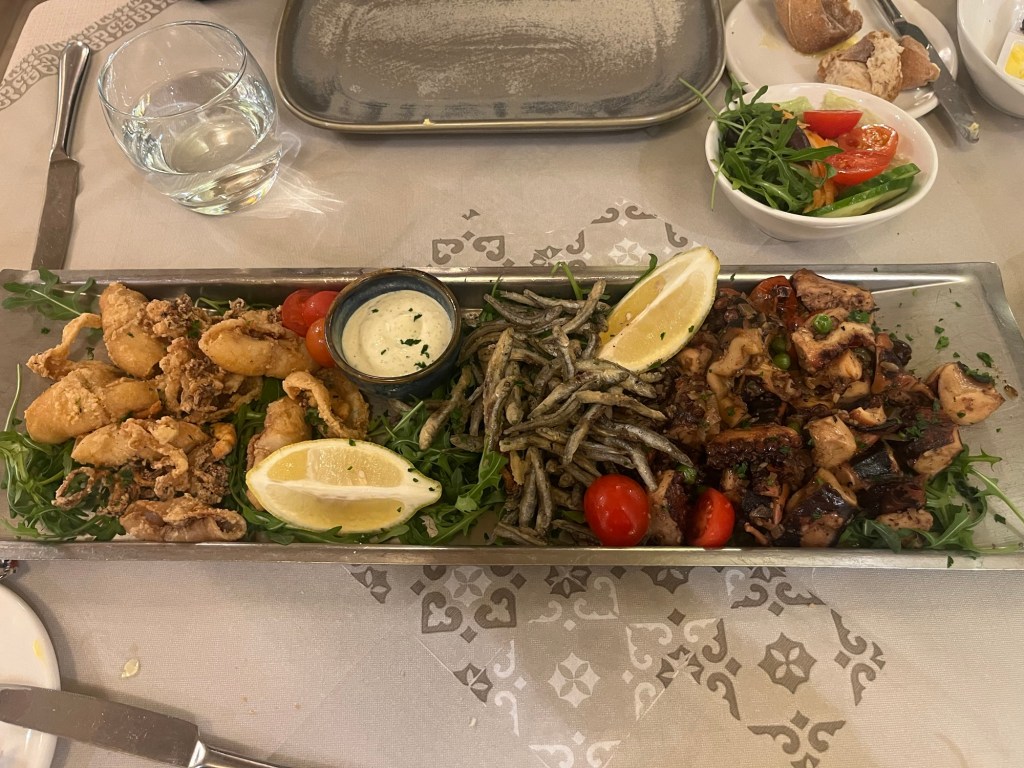
What a meal at Il Kartell in Marsalforn! Calamari, octopus, and a small, crispy smelt-like thing that was scrumptious.
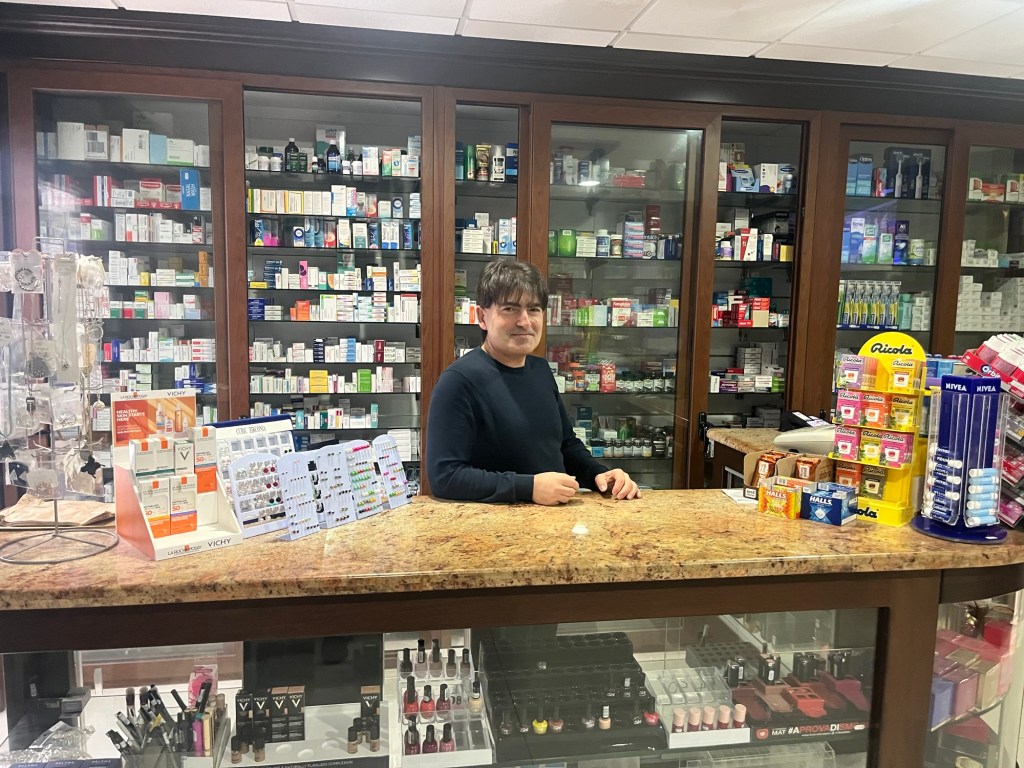
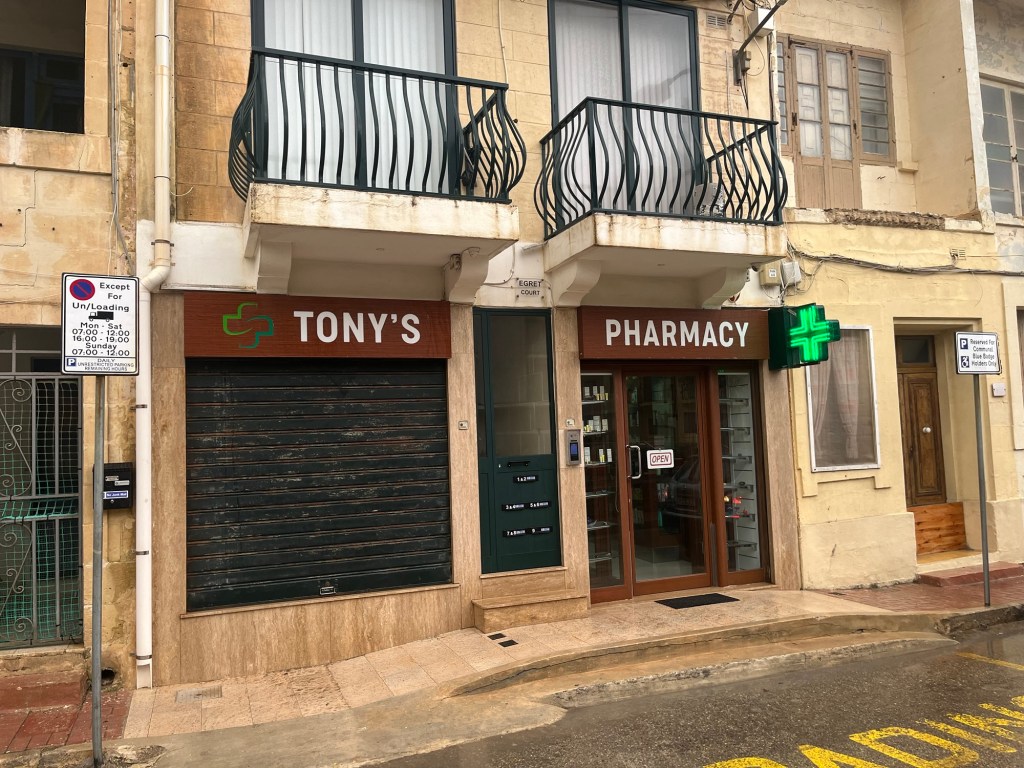
How wonderful having Tony the Pharmacist only one block away when Rebecca has been fighting a cold, cough, and bacterial infection. One of many Marsalforn sweethearts!
On the subject of Marsalforn sweethearts, we are spending the afternoon on Wednesday (today) with Dannae and her boyfriend Claudio exploring Gozo.
What a tempest: Mediterranean Storm Harry! Two-plus days of 65+-mph winds! Thank goodness for a comfy hotel room … with a view.
With the light at the end of the storm dawns a new day.
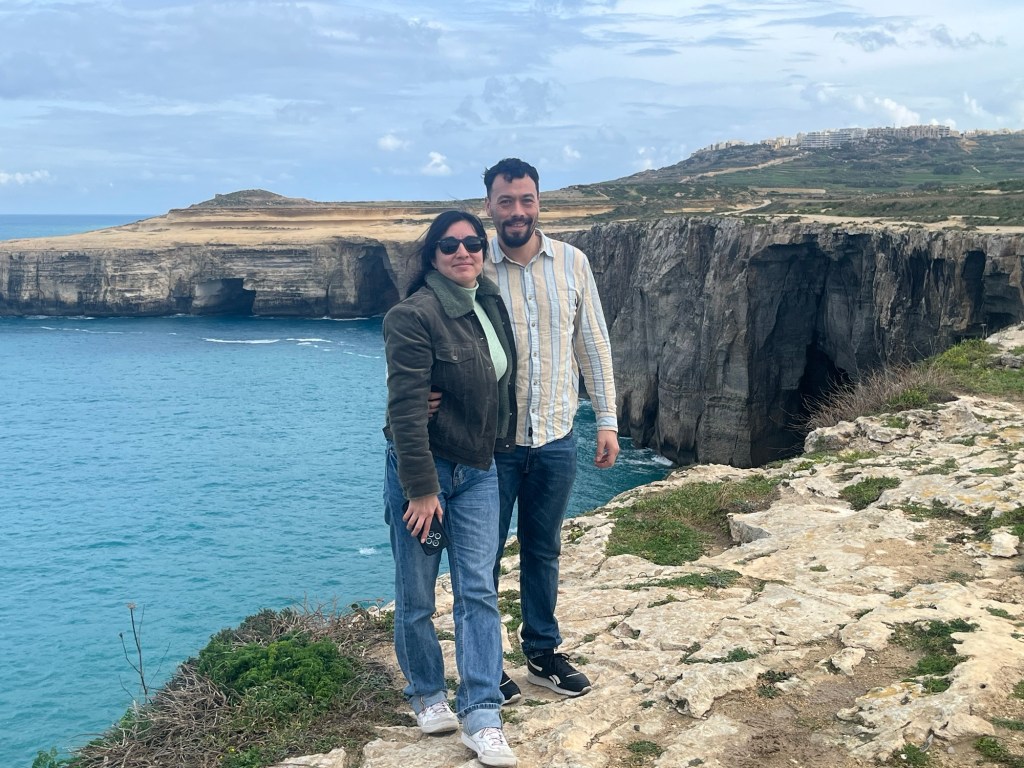
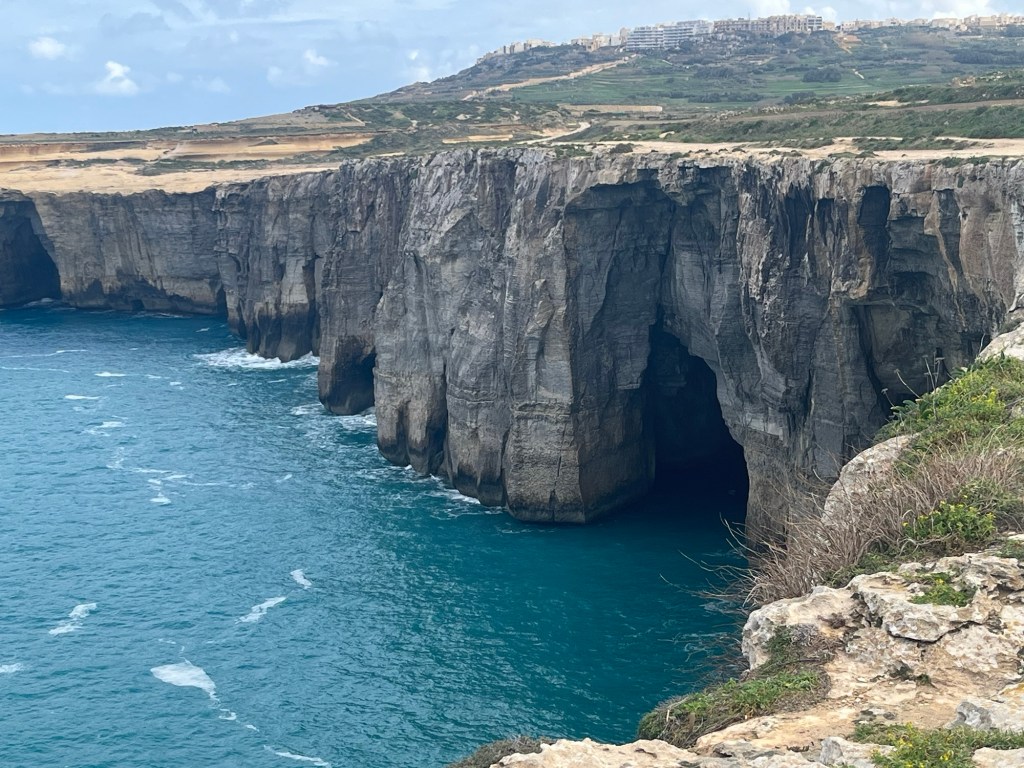
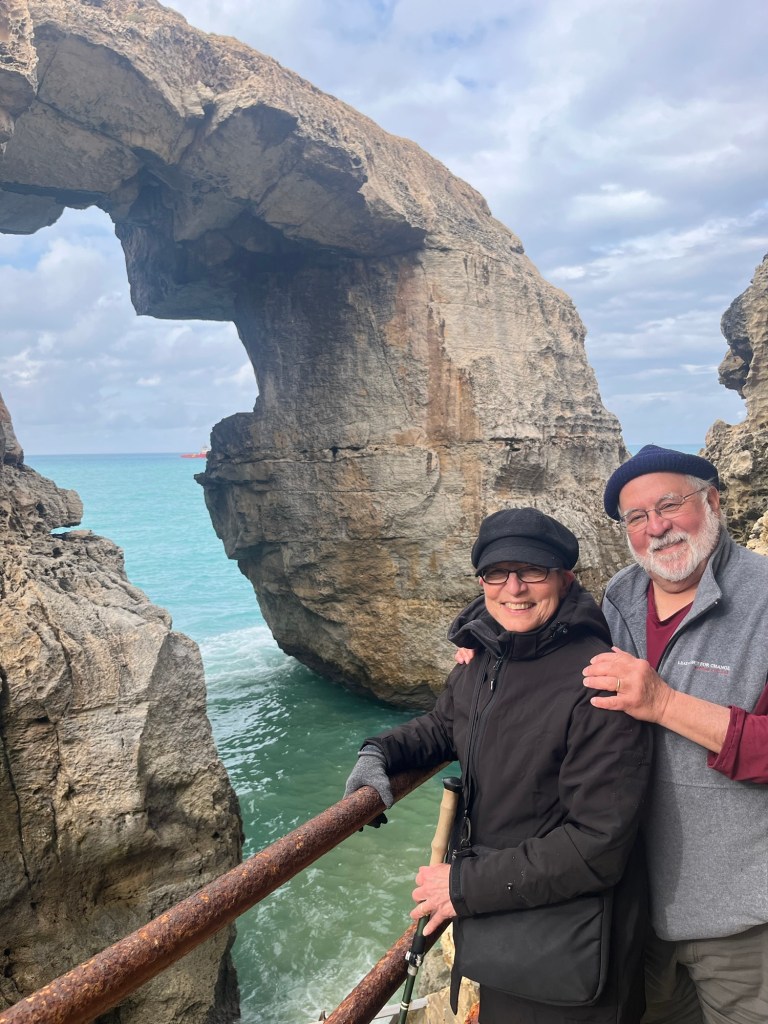
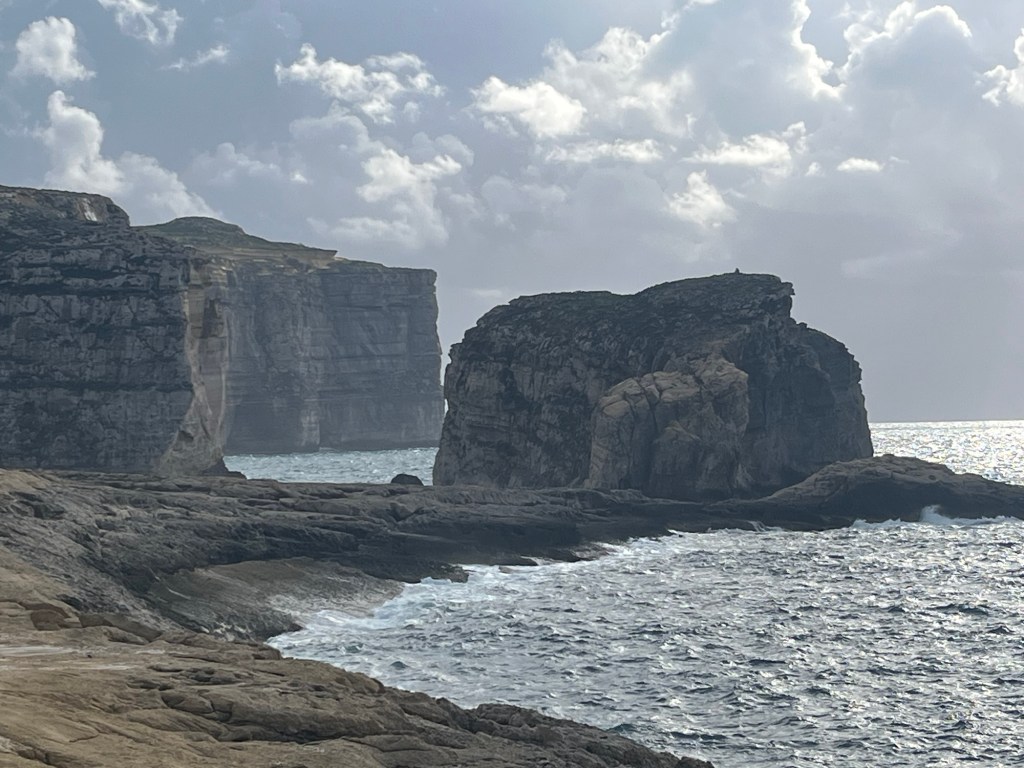
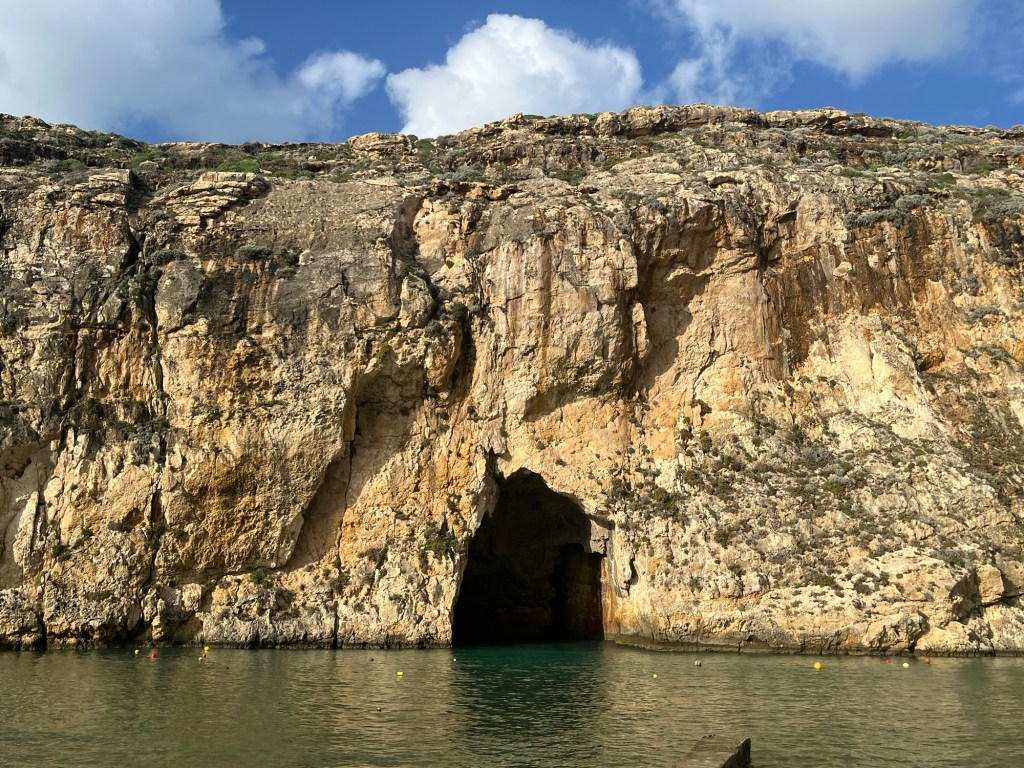
Today, Dannae and Claudio showed us sights we would otherwise have never been able to see, like “The Window,” “Fungus Rock” on the west side of Gozo, and endless limestone cliffs and caves.
Rebecca and I are insanely fortunate to have two fantastic homes: a city-mouse home in Watertown near Boston and a country-mouse home in Grand Isle, Vermont, on a magnificent little island in Lake Champlain.
Grand Isle pretty much defines simple living. We are surrounded by some of the nicest people on earth; we have everything we need at our fingertips: two family-owned groceries, a hardware store, a doctor, a real city — Burlington — 30 minutes away, and stunning beauty.
When we started planning this trip, we knew what we wanted, but we didn’t know how to describe it. We still know and we still don’t know how to describe it … except that we want a Mediterranean/European version of Grand Isle. (Googling “Warm, Mediterranean version of Grand Isle, Vermont” doesn’t work.)
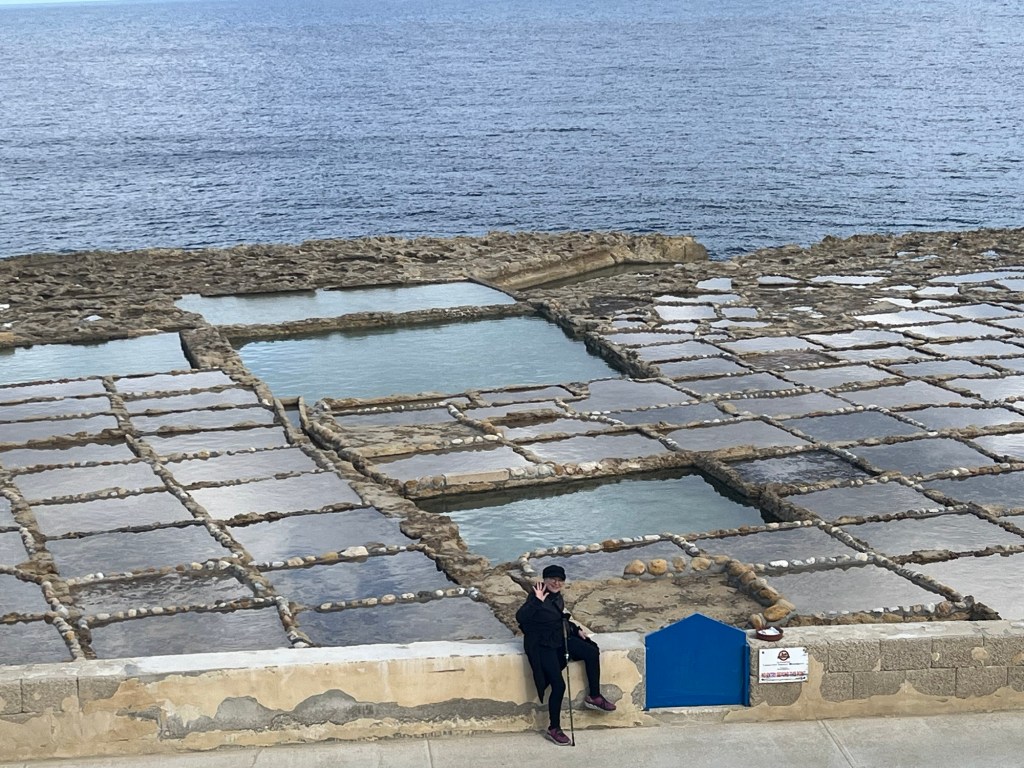
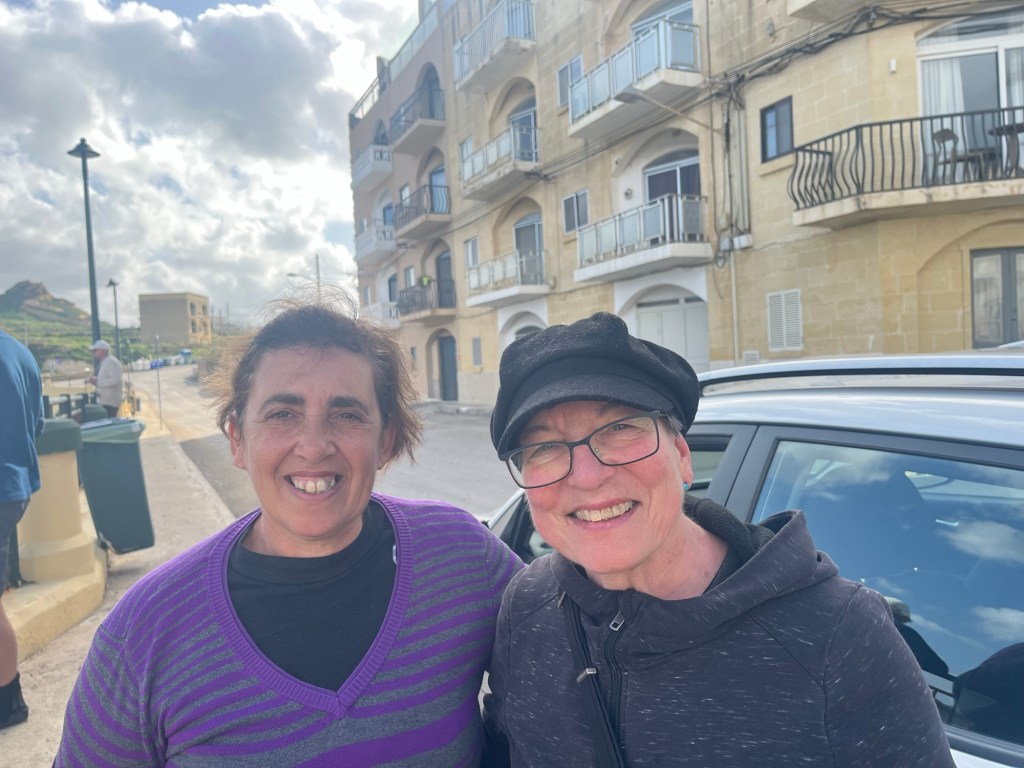
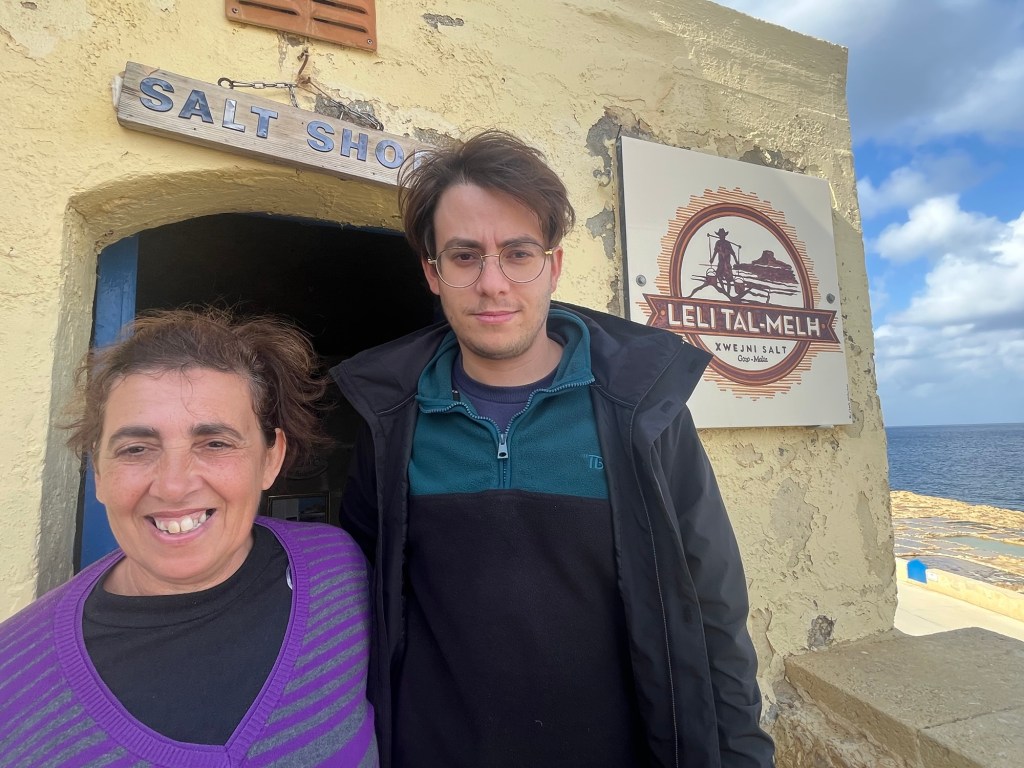
Two-plus weeks into the trip, we are batting 1000! Marsaxlokk in Malta and Marsalforn in Gozo have been idyllic. We have no idea how long we will be staying in Gozo, but I guess at some point, we will probably want to leave. Maybe. (Today, we rode the bus a few stops, walked a mile or so to visit a salt harvesting site by the sea, where we jawboned with the 6th-generation harvester, Justin, bought some Mediterranean sea salt, got a ride back to our bus stop from his mother, Josephine, stopped for an Indian lunch where we jawboned with a fun couple from Denver who were visiting with their 2-year-old son, returned to our hotel, and while I am writing at a table by the sea watching traditional fishing boats come and go, Rebecca is on a Zoom call with her girlfriends in Grand Isle. That’s it. All that’s left for the day is a cocktail to watch the sunset from our balcony, then figuring out where to eat supper. Will it be Italian, seafood, Indian, Thai, or traditional Maltese? (It turned out to be Chinese.) Adjusting to the pace seems to come pretty naturally to both of us … a very short learning curve.
So here’s the challenge … for which we need your help!!!! Where do we go in Sicily and then southern Italy that will compare to places like this? We know we will spend a few days in Ortigia near Syracusa (my cousin Cooper would be pretty upset if we didn’t), but beyond that, nothing is firm. Nicosia in the east? Gibellina in the west? Santa Maria la Scala north of Catania? Enna in the center of the island?
Damn. Do you see what I mean? This is really hard work. Please help as best you can. We’re counting on you!
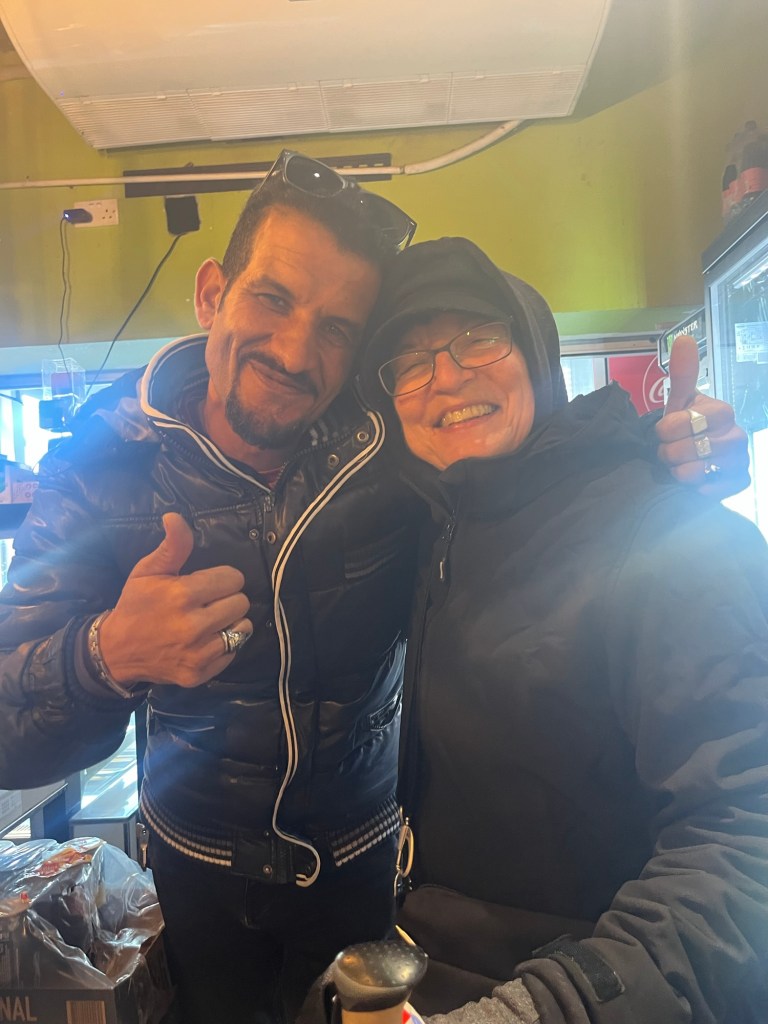
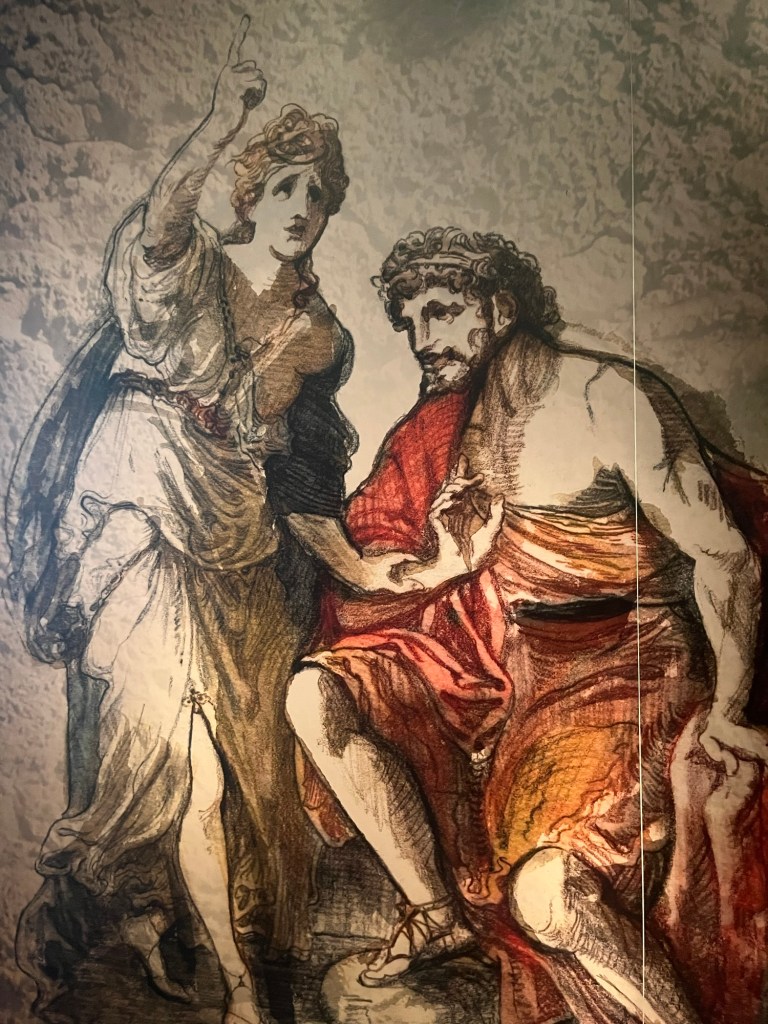
The brownish building is our hotel in Marsalforn, the Calypso. Gozo is thought to be the mythic spot where Ulysses shipwrecked and was held captive by the seductress Calypso, where he stayed for seven years before being released by Zeus to return home to his wife Penelope. The sea views are from our room. The gentleman with Rebecca was our first human encounter in Marsalforn outside of the hotel. I went to the local convenience store, “Popeye’s,” to buy Kleenex for Rebecca. This guy — Youness from Morocco — appeared out of nowhere and insisted that he pay the €1. He could not have been nicer.
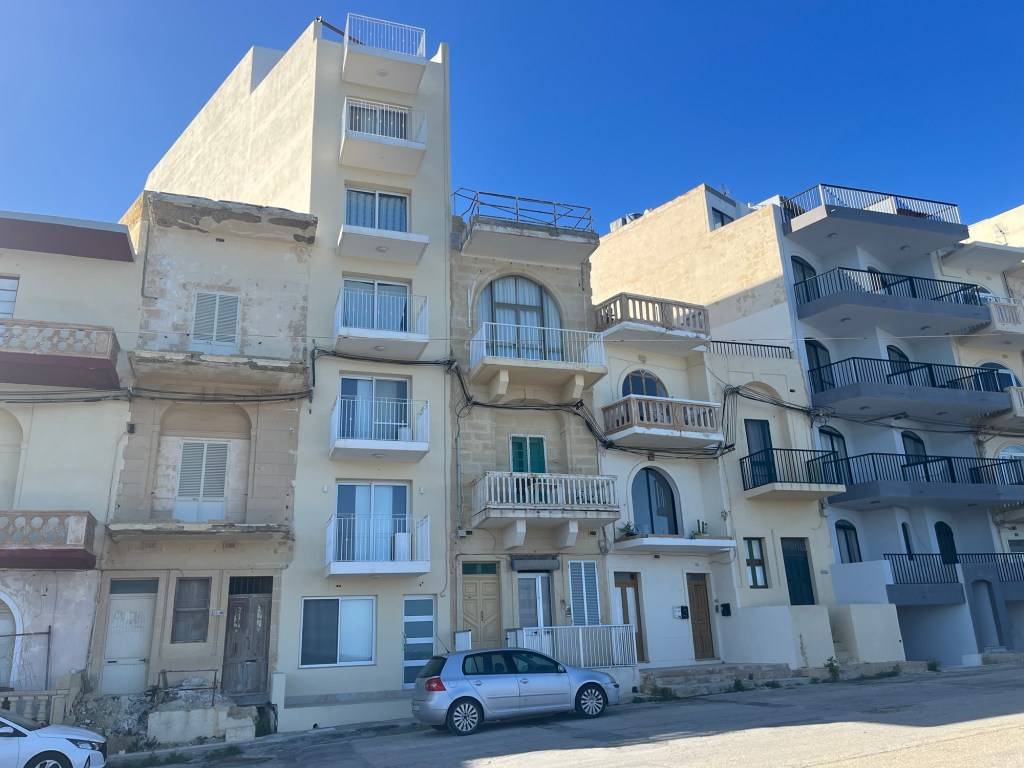
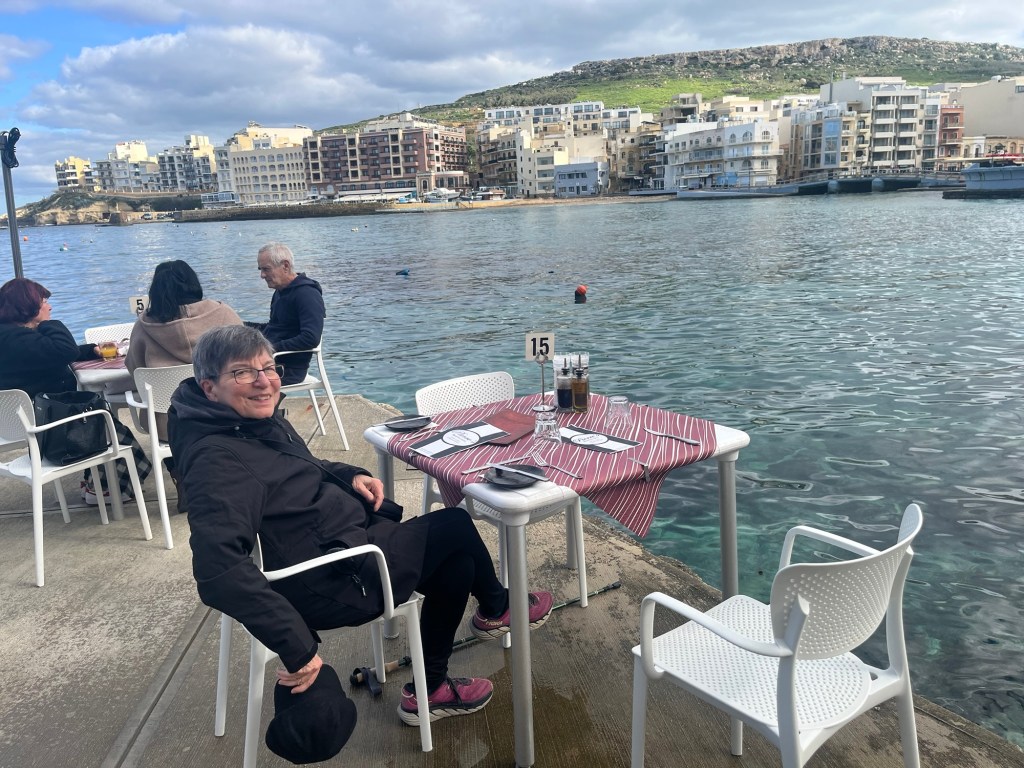
The view from across Marsalforn harbor. The buildings are typical Maltese housing.
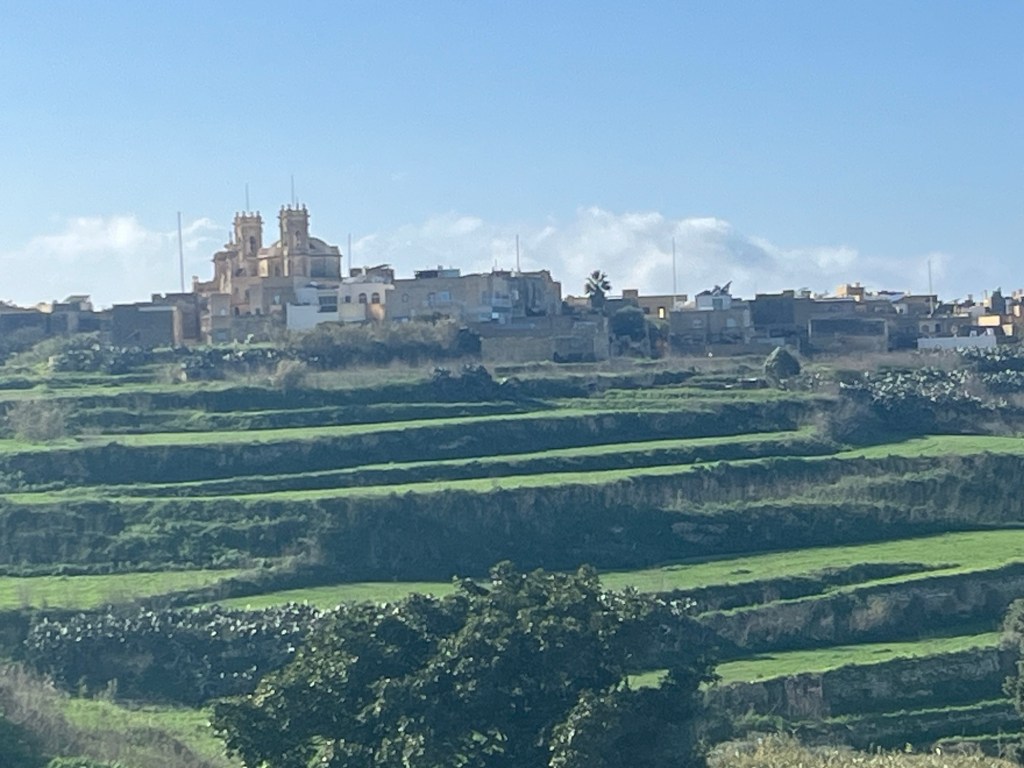
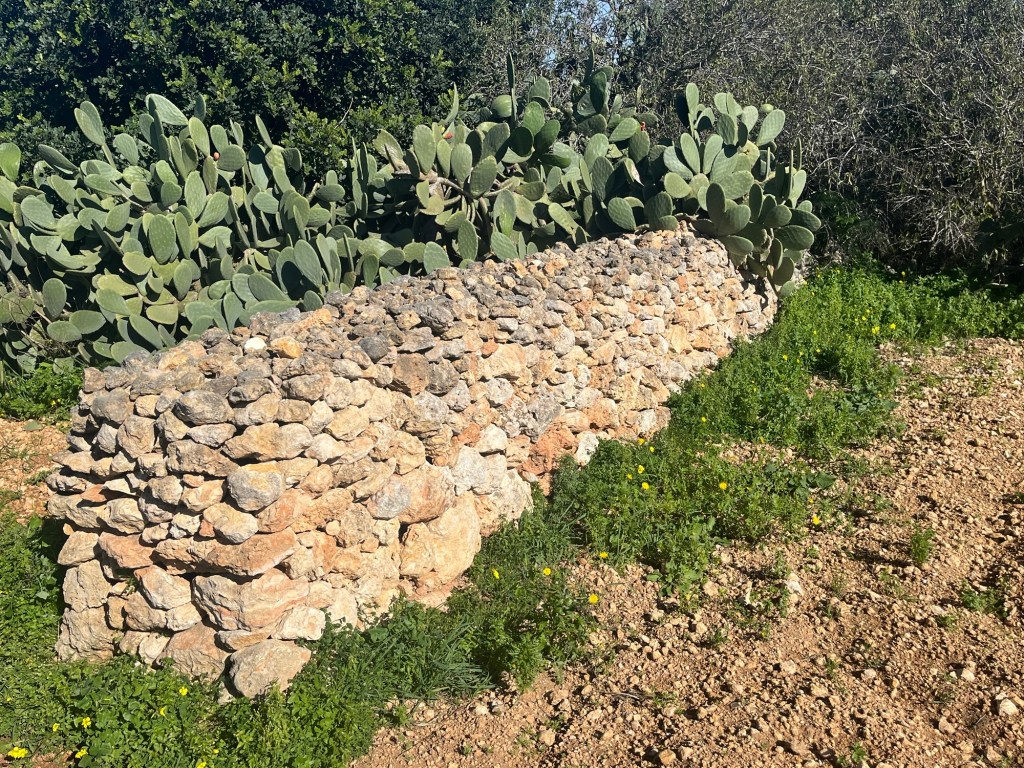
Typical Maltese terraced hillsides, rock walls, and lots and lots of prickly pear cactus.
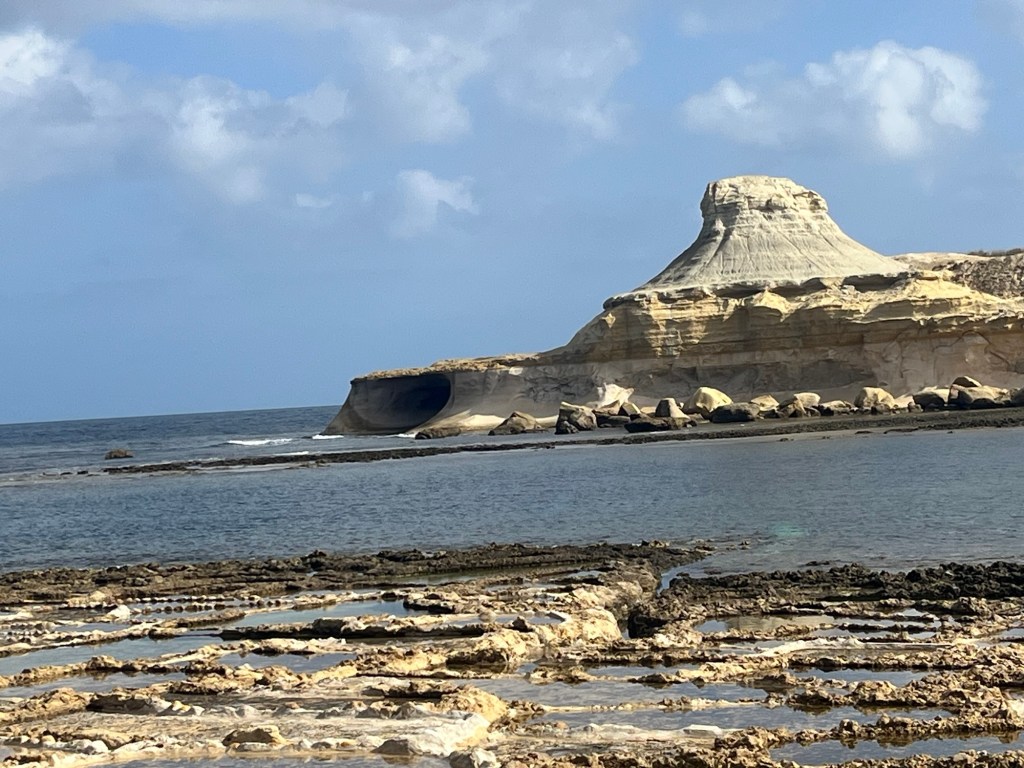
We hiked up to the “salt pans” just above Marsalforn Harbor where Mediterranean Sea salt has been harvested for hundreds of years. Justin, a 6th-generation salt farmer sold us our sack of salt. His mother, Josephine, was leaving on an errand as we left. She insisted on driving us to a nearby village so we would not have to walk the whole way.
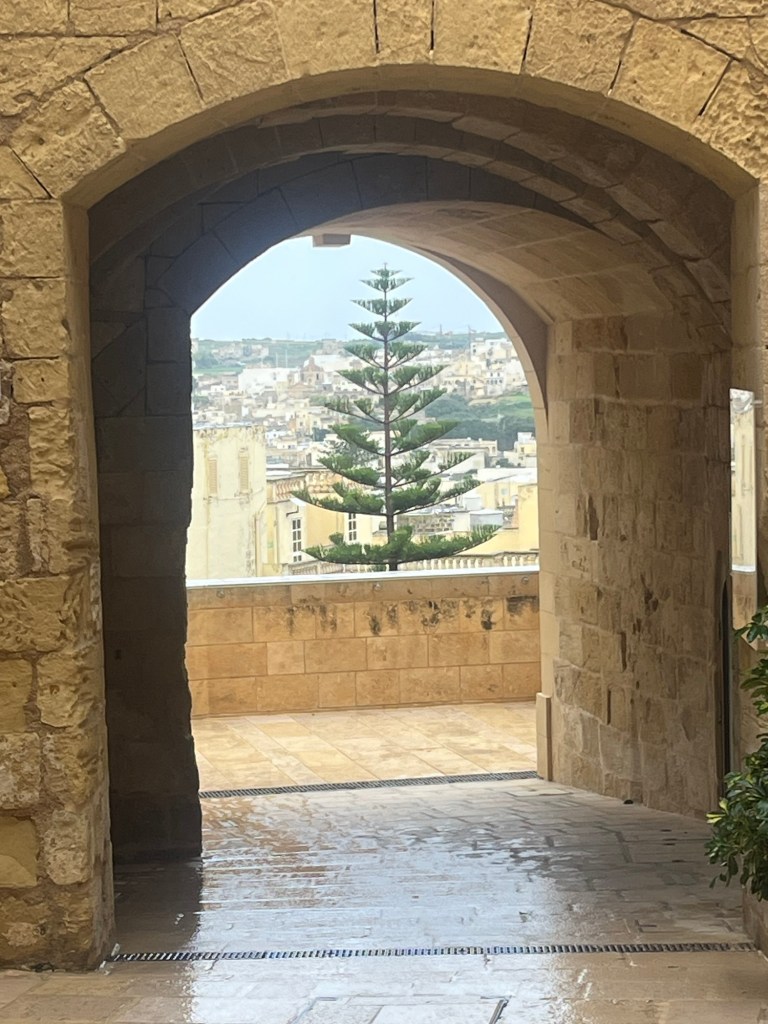
Scenes from Victoria, Gozo. An art installation at the theater, an image from the Citadel, and an archway from the Citadel. The Citadel has been a center of civil and religious life … as well as home to many … for over 2,000 years. A few elderly couples still live there, but the Citadel as a home is on the way out.
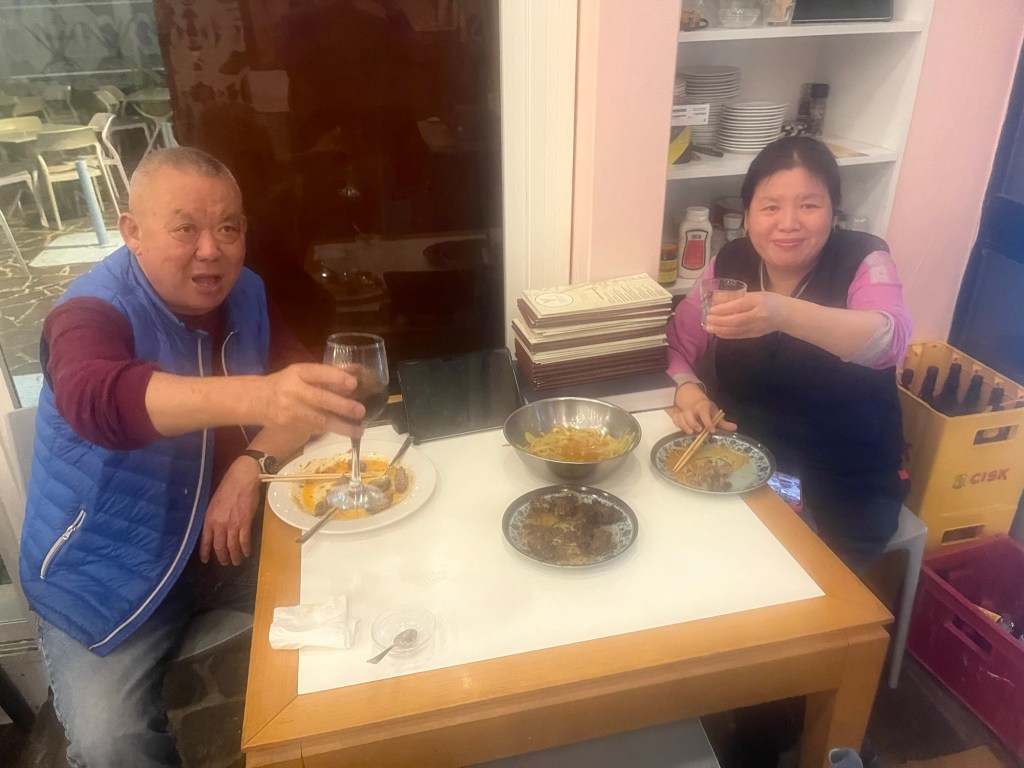
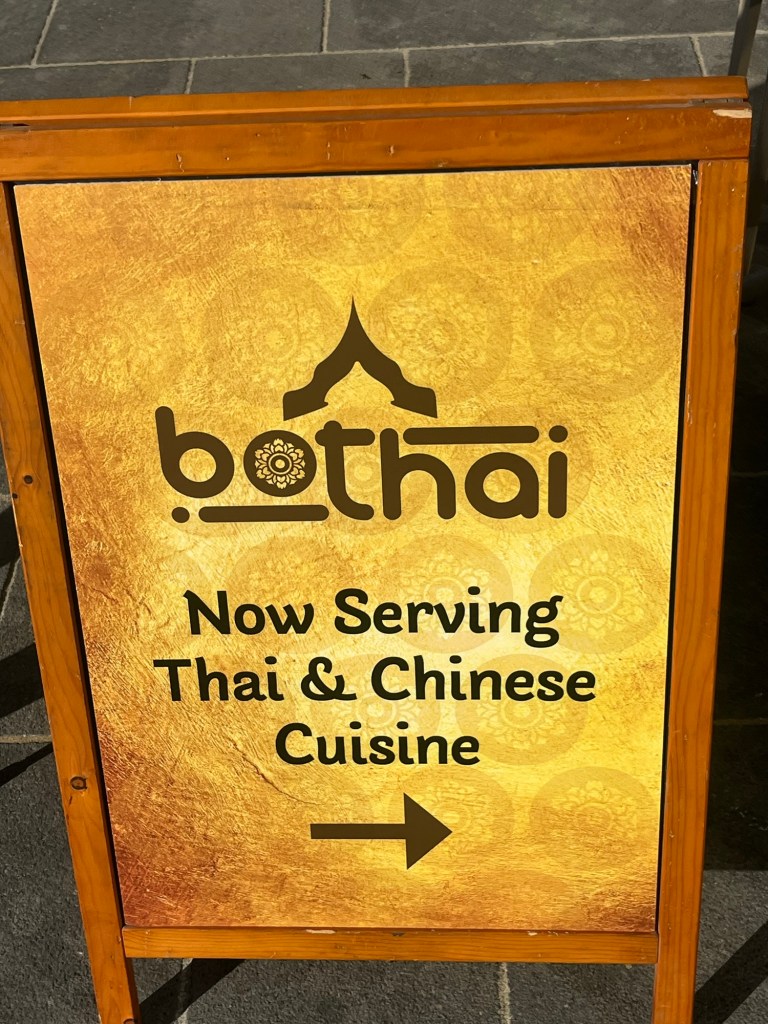
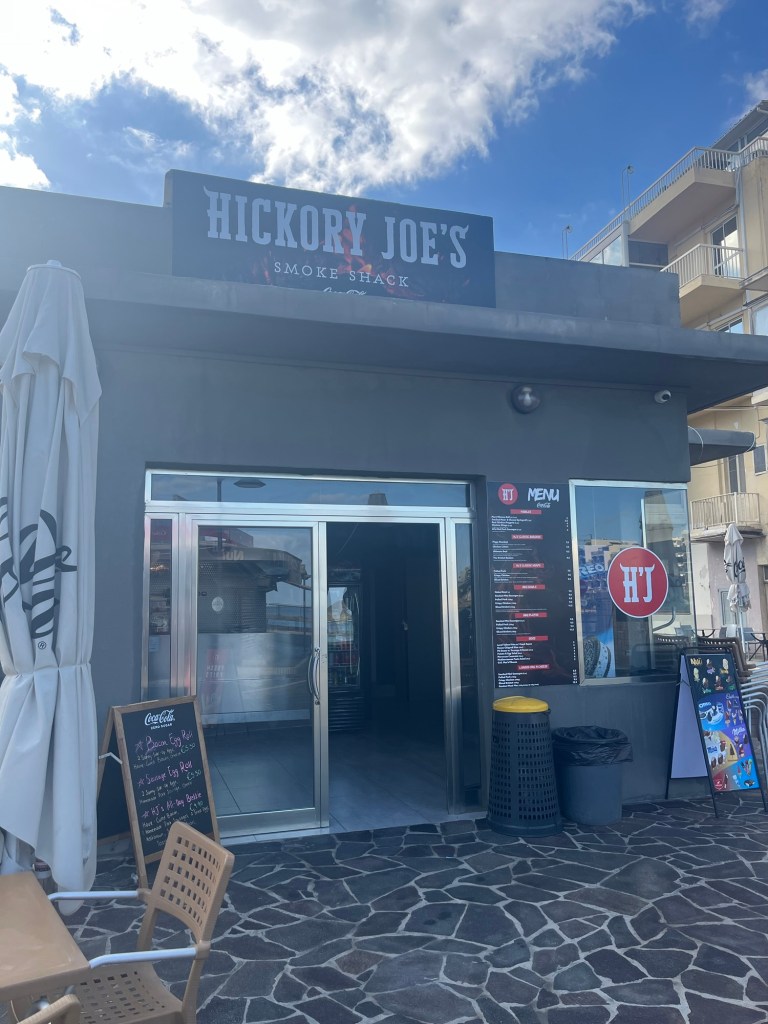
OMG the food has been great! Jimmy and his daughter Vicky run the local Chinese restaurant, “Yummy Yummy.” Could there be a better name for a Thai restaurant than “bow tie”? Il-Kartell is the go-to seafood place in town. Tomorrow night, we are putting ourselves in the hands of the owner, Paul, and just saying, “Feed us.” Stay tuned on that one. We even managed to find a local BBQ joint and enjoyed some pulled pork and cole slaw the other day. Not great for Arkansas or North Carolina, but damn good for Marsalforn!
And BTW, Paul and his family know Sicily well and have recommended Enna. I expect we will start there and then make our way to Ortigia for our first two stops. But we are far from making any commitments until we hear from you!
I’ve always wanted to visit the Egyptian pyramids because they are about the oldest human-made things I was aware of. I never thought of visiting the antiquities of Malta — including the Hal Saflieni Hypogeum and Ggantija — because I had never heard of them. They are about 1,000 years older than the pyramids, and about 1,500 years older than the start of construction of the Great Wall of China and the construction of Stonehenge. They are from the Stone Age, specifically the “neolithic period,” when humans had learned to work with pointed tools. The Hypogeum (hypo gee-um) is a ~6,500-7,000-year-old burial chamber, and Ggantija (gee-gan teeya) bills itself as the oldest free-standing structure in the world built with stones that weigh up to 50 tons.
Fortunately for us, we know local peeps in Malta: our friend David’s cousins, Sam and Alan. They gave us two pieces of insanely good advice:
1) Get our “Tallinja Cards” before our trip. We did. With them … at a total cost of $30 each … we have unlimited travel on Malta’s expansive bus system. So far, we have spent about $15 on Ubers — one ride from the airport because our bus did not run for a couple of hours on New Years Day, once to get home from a remote village when Rebecca felt crappy and the evening cold had set in, and once to ensure we got to the Hypogeum on time. Malta’s bus system rocks!
2) Get our tickets for the Hypogeum well before our trip. They go on sale three months ahead of time. We bought ours the day they went on sale. It felt a bit extreme, but it was definitely the right thing to do.
We visited the Hypogeum on January 7 and paid €20 each for tickets. The earliest available last-minute tickets were for January 29, and they cost €50 Euros each.
The Hypogeum is one of the oldest human-made structures on earth, started about 4,500 BCE. To protect the fragile limestone and ensure that the atmosphere does not get acidic from too much carbon dioxide, Heritage Malta allows 10 people per hour into the site 8 times each day. Eighty people a day. That’s it. You lock your cell phone and belongings in a locker before entering. No photos.
I had expected it to be some sort of “place,” and it sort-of is … but not really. From Marsaxlokk to Malta’s capital city of Valletta, we took the #81 bus. It went through Paola, home of the Hypogeum. There is a Hypogeum stop on the system … Hypogeia … but the #81 does not stop there. I asked 10-or-so different people what stop to get off for the Hypogeum, and I got at least 5 or 6 different answers. Not only did nobody really know, most folks had no clue what I was talking about. Imagine getting a response like that when searching for Stonehenge or the Pyramids! That’s why we took an Uber instead.
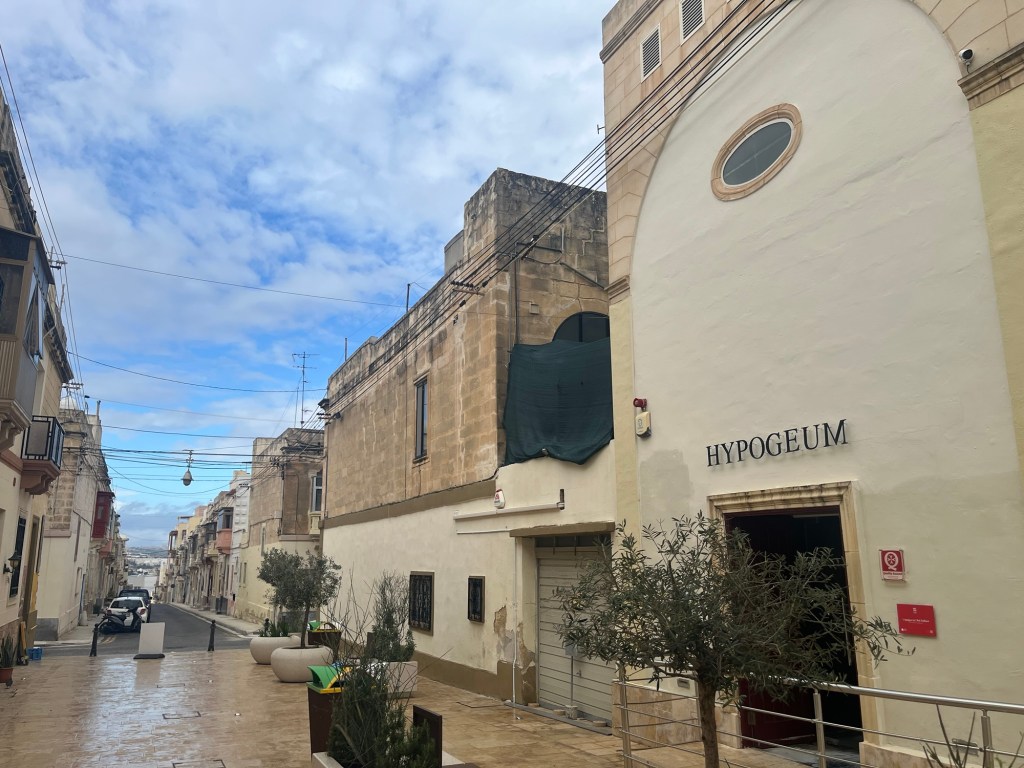
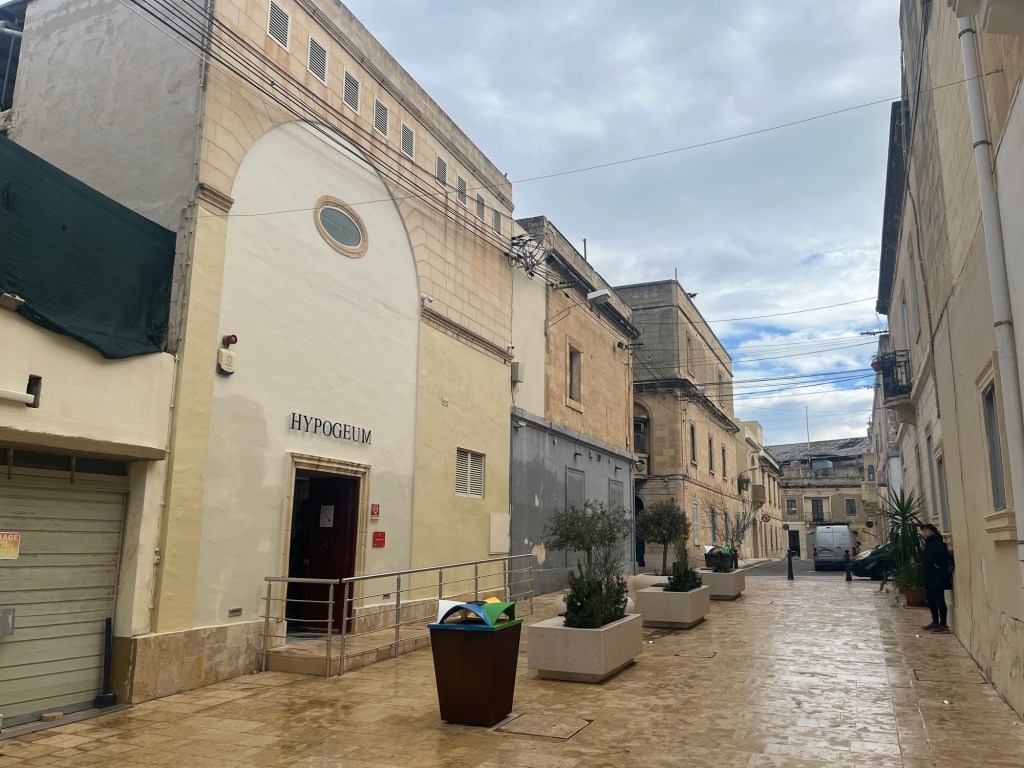
Here is my take on it. First, it is almost invisible from the outside. It is in a block of traditional Maltese “homes” —- a continuous limestone facade with doors and balconies, but nothing really resembling a free-standing house. The front of the building says “Hypogeum,” but there is no other signage. Once inside, the visitor area is about 20-feet wide with a small shop selling trinkets and a few t-shirts.
This is Paola, the neighborhood of the Hypogeum. It is the antithesis of a tourist trap. Not even many Maltese know it is there. No one could tell us the closest bus stop.
At the top of the hour, a guide calls the ten waiting visitors into a small room where we locked up our possessions, put little plastic bootie protectors over our shoes, and received a box on a necklace set to the language of our choice that narrated the next 45 minutes as we walked down a ramp, through a few “rooms,” and then walked back up. That’s it. Simple but powerfully magical.
No one knew the Hypogeum existed until 1902, when a construction crew building homes broke through into its chamber. When first discovered, the skeletons of an estimated 7,000 people lay inside. But because of the natural moisture and the ravages of time, most of the bones turned to powder when touched. Excavating, exploring, and stabilizing the site took decades of painstaking work.
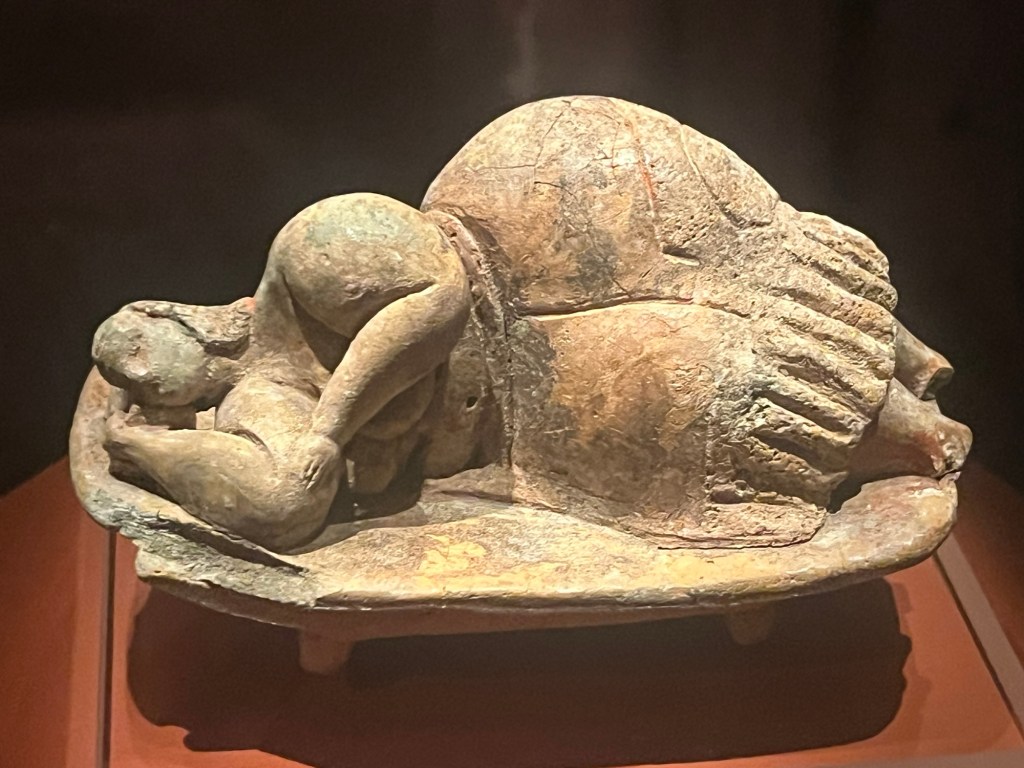
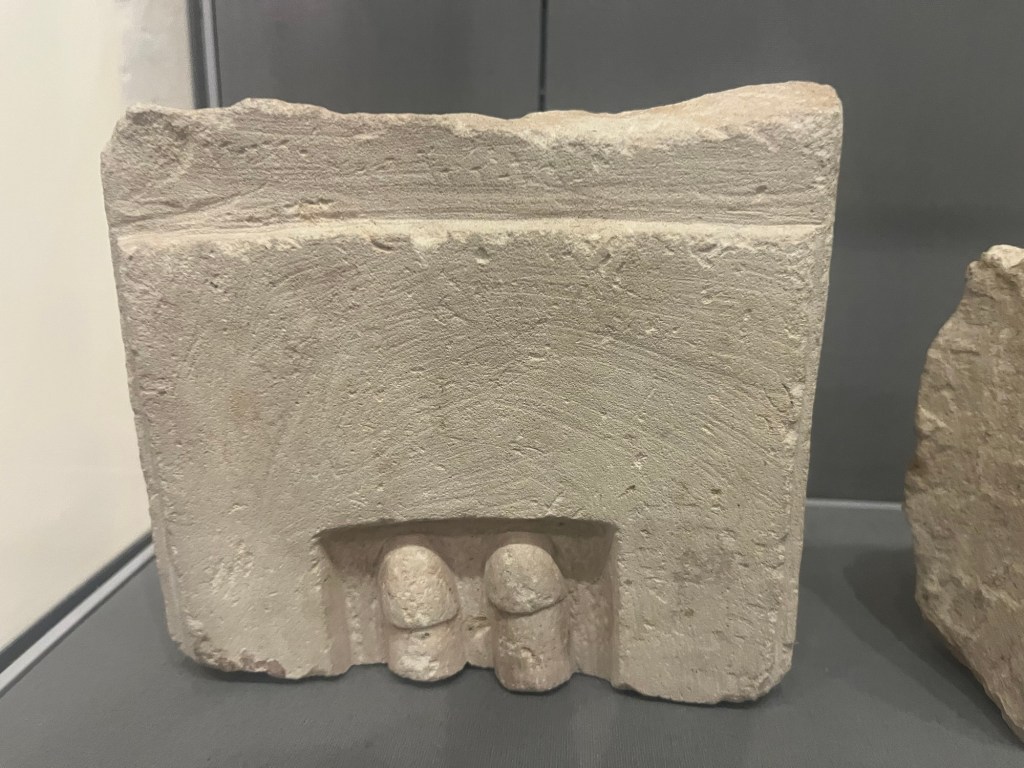
“The Sleeping Lady” is among the most famous – and most intact – artifacts from the Hypogeum. And of course, the collection includes no shortage of fertility tributes, including a pretty nifty collection of stone genitalia.
Among its many mysteries, rock caverns underground are pitch dark. There were no tell-tales signs of soot on the ceilings when the Hypogeum was found. How did the ancients negotiate the darkness or create light without smoke or soot? Just one of many imponderables.
As I try to describe the experience, I am at a loss for words. I am not even sure what we saw. Here is what I do know: It viscerally linked past and present. The people who built those chambers were everyday human beings, just like us, born several thousand years earlier. Their patience, perseverance, and skill with tools is indescribable. They carved magnificent pieces of art and room-sized chambers with the most pre-historic of tools. Doing so did not take years or decades or lifetimes. It took centuries of one generation after another fulfilling some sort of dream or mission.
The only other place Rebecca and I experienced something similar was at the Effigy Mounds National Monument near McGregor, Iowa. The builders moved dirt one load at a time until they had constructed mounds in the shape of local animals, like bear and deer. Today, those shapes are visible from the air, but appear only as unidentifiable mounds from ground level. Imagine spending a lifetime working on a task that has no beginning and no end, but that engages an entire community, basically forever.
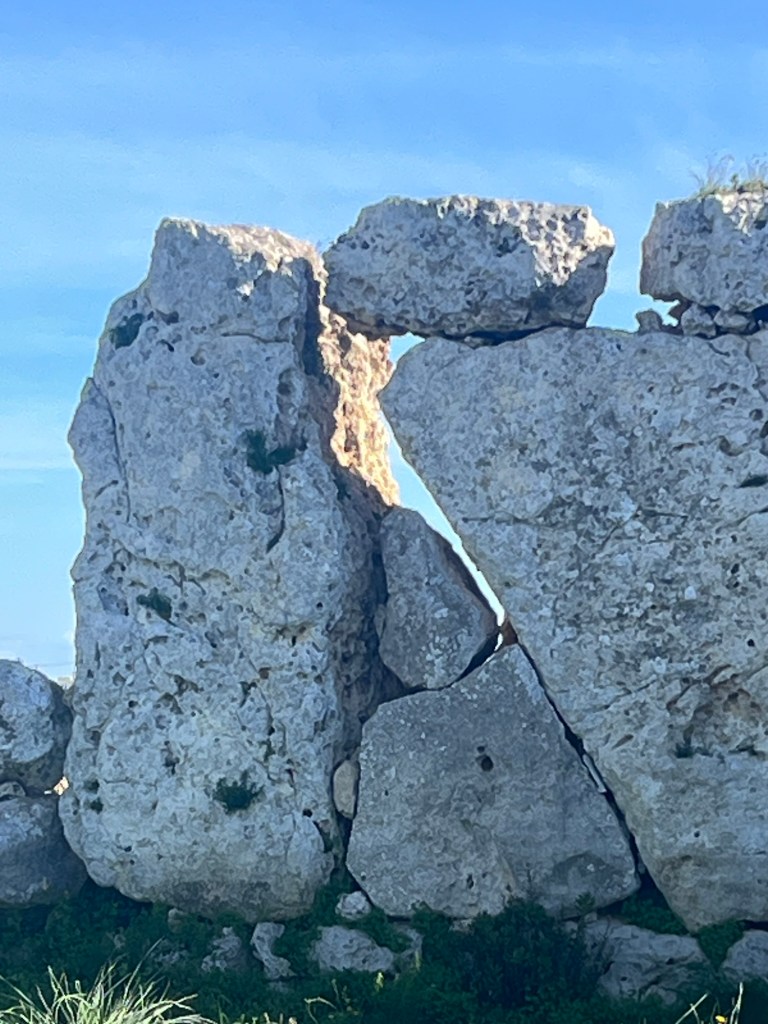
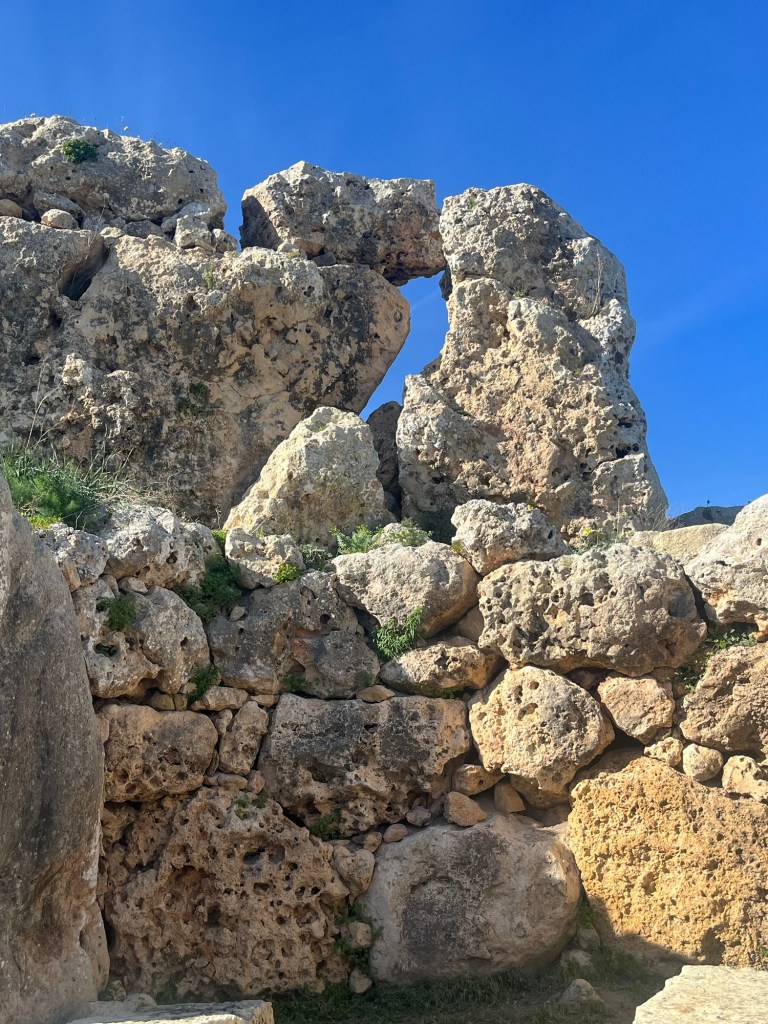
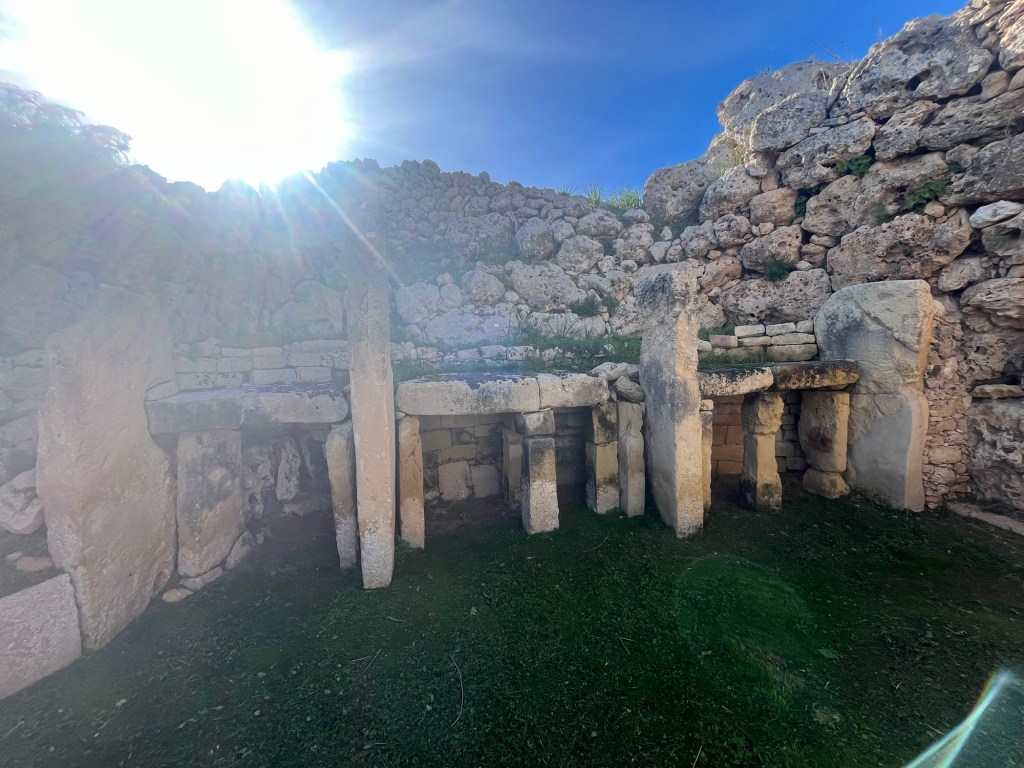
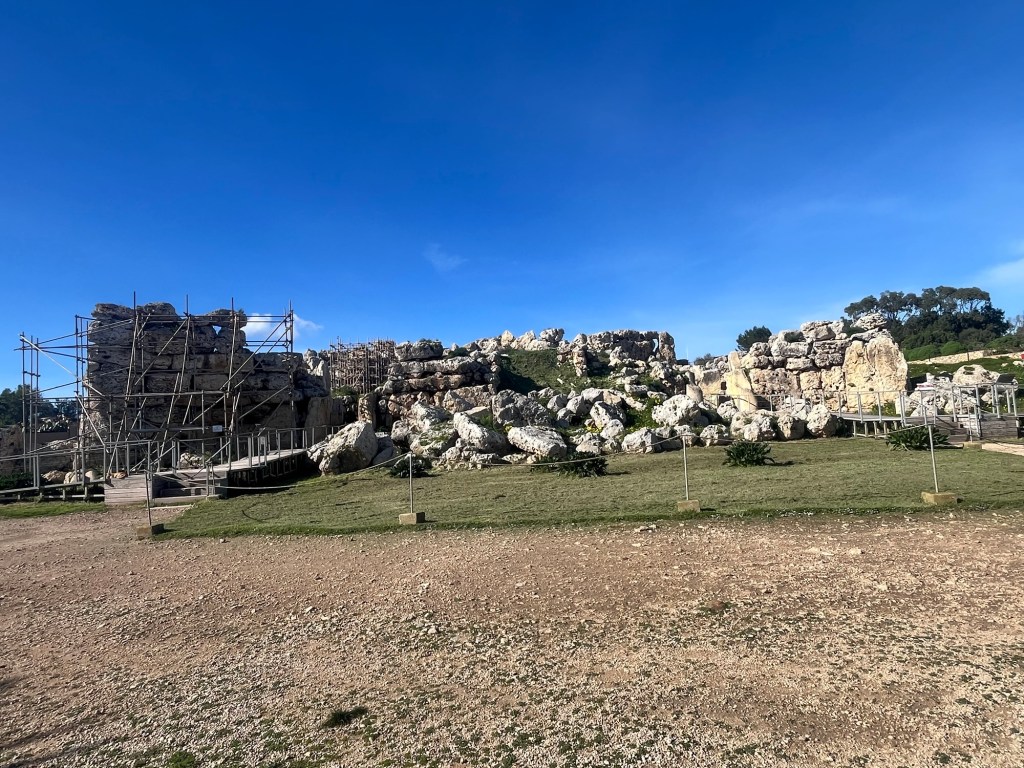
Ggantija is in Gozo, the westernmost island in the 3-island Maltese Archipelago, and a short ferry ride from the island of Malta. This shot shows the southern wall of Ggantija, with the terraced hillsides typical of Malta and Gozo, and the Mediterranean Sea in the background.
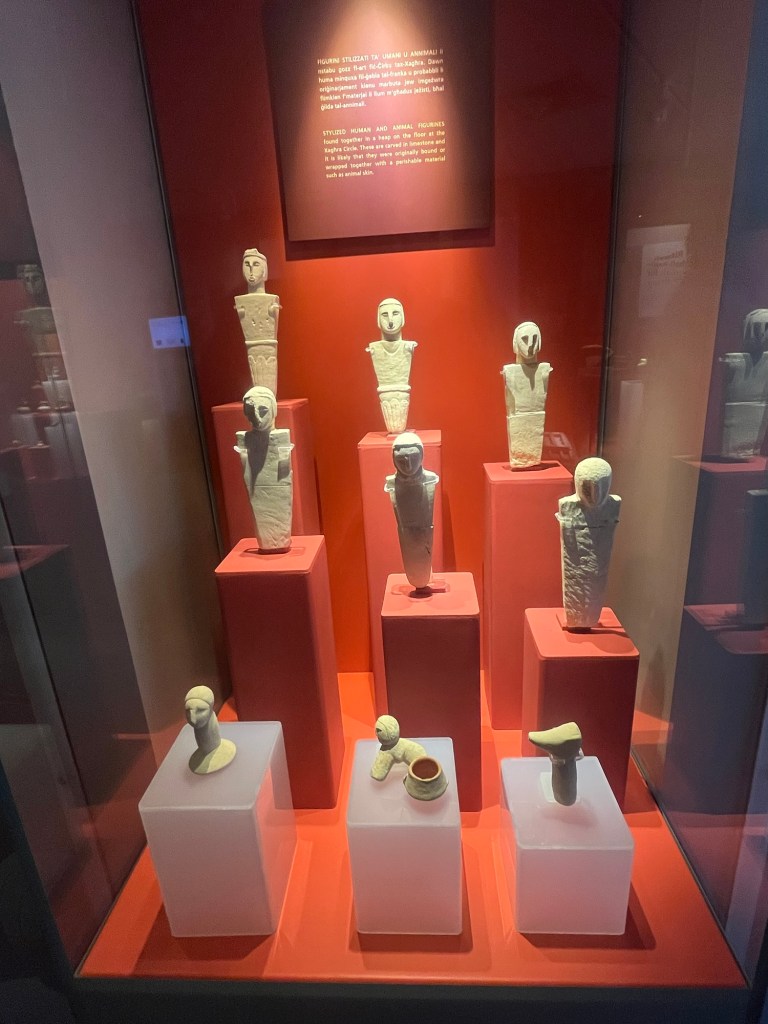
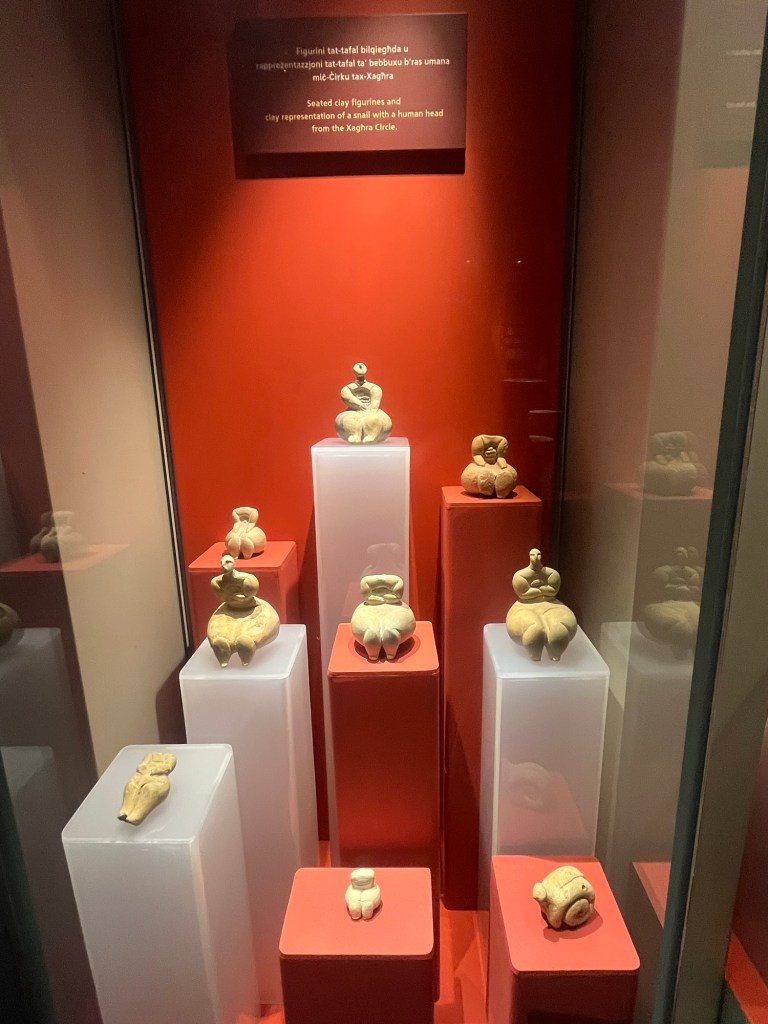
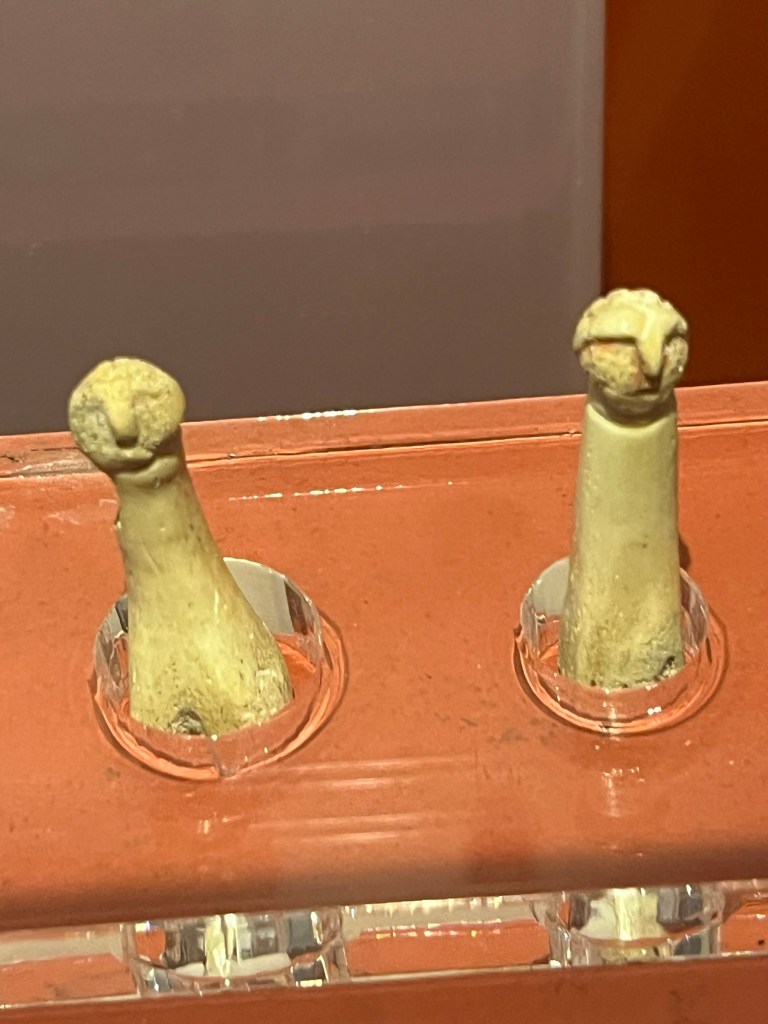
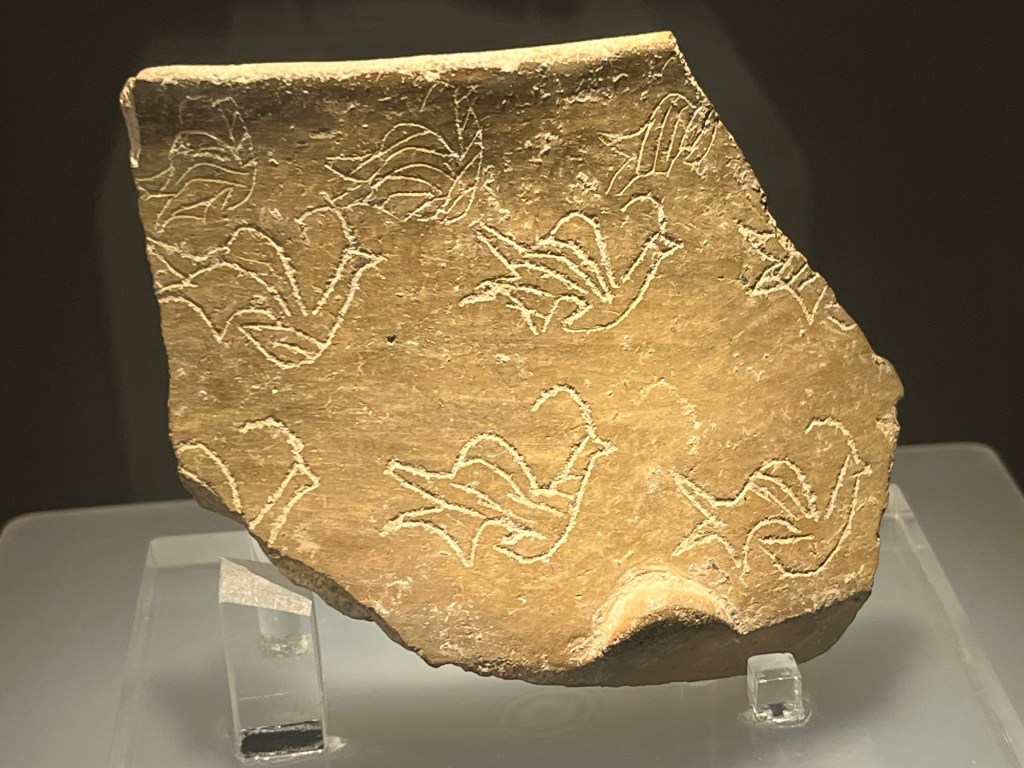
Artifacts from Ggantija carved from stone, carved into pottery, and two heads carved from the foot bones of cows.
First, a refresher: We are in Marsaxlokk Malta. Regardless of what you might think from the spelling, Marsaxlokk is pronounced marsa-schlock.
We are here because we wanted to escape the New England cold, and since we are not Florida types, our idea of a good escape is to go someplace we’ve never been where we might have a good adventure or two. This year, we decided on southern Europe, where it is warm for us but off-season to the rest of the world.
We did not know the first thing about Malta … except its weird location in the middle of the Mediterranean between Tunisia and Sicily. I Googled “quaint fishing villages in Malta.” Marsaxlokk popped up, so I Googled how to pronounce it.
I learned that Marsaxlokk is famous for its Sunday open air fish market. We reserved a room in a guest house right at the site of the market and left home on a Wednesday (12/31) so we would have ample time to deal with travel delays and getting acclimated before Sunday. It was one of very few planned destinations.
So now: How to make Kenny happy in one step? Answer: Set him loose in an open-air fish market in a Mediterranean fishing village on a Sunday morning.
Today is Sunday. Last night, I told Rebecca that I wanted to be in bed before 9:00 and wanted to set an alarm for 6:00. She asked if I was crazy. I asked if she wanted to join me for a very early morning stroll as the fish mongers were setting up. She declined. I compromised and set the alarm for 6:30. She slept.
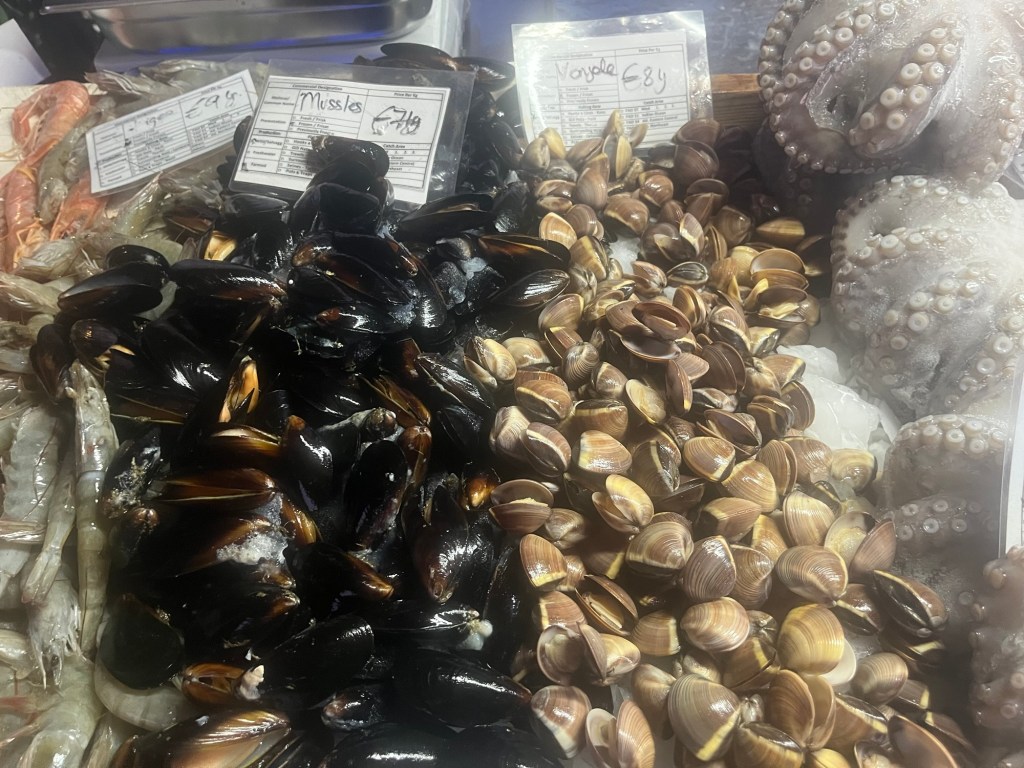
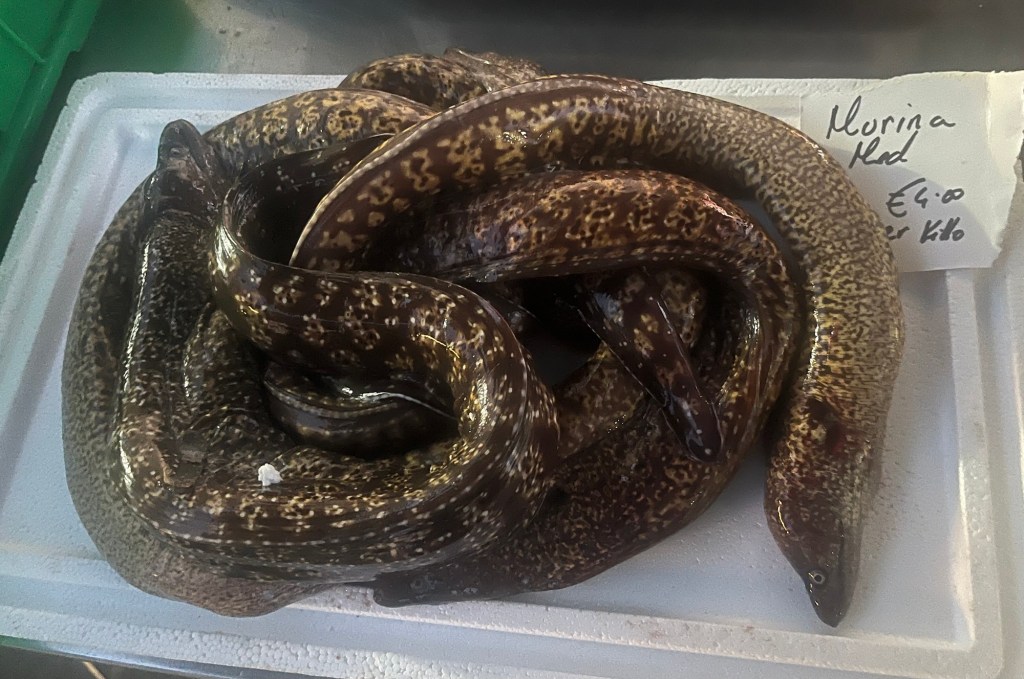
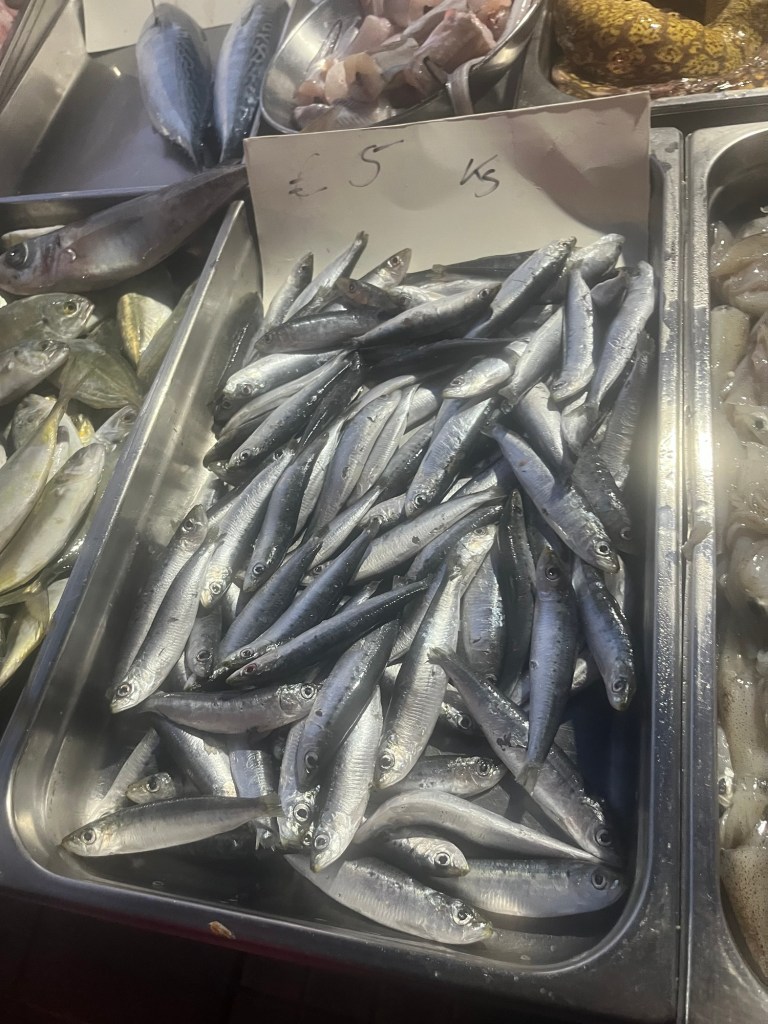
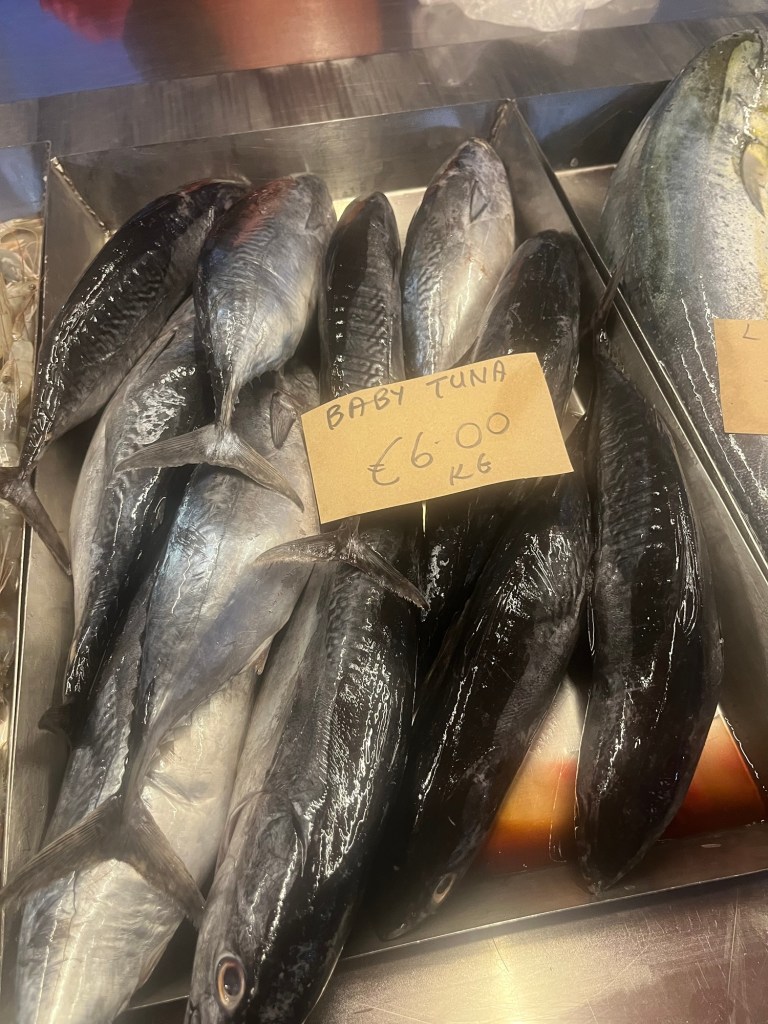
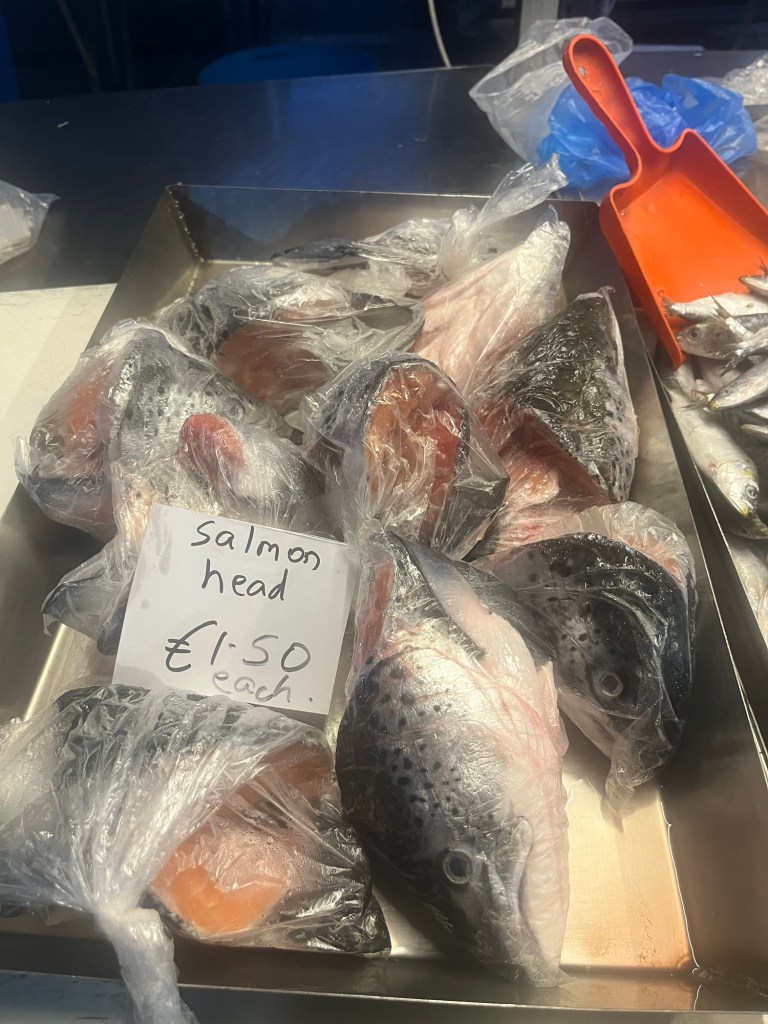
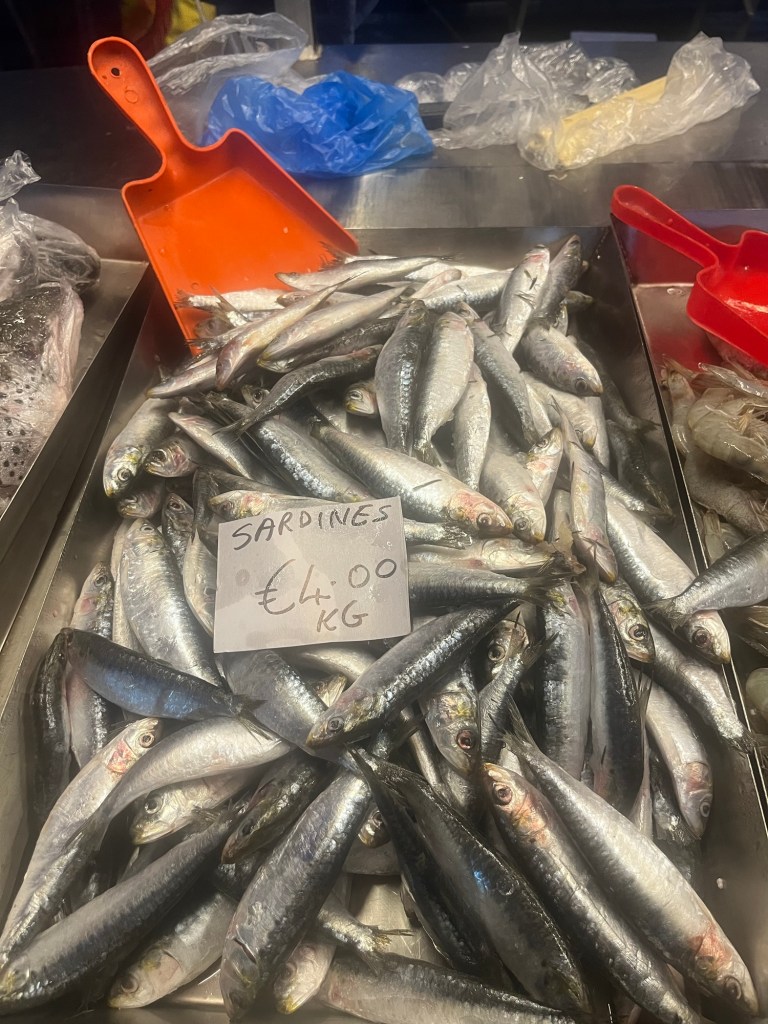
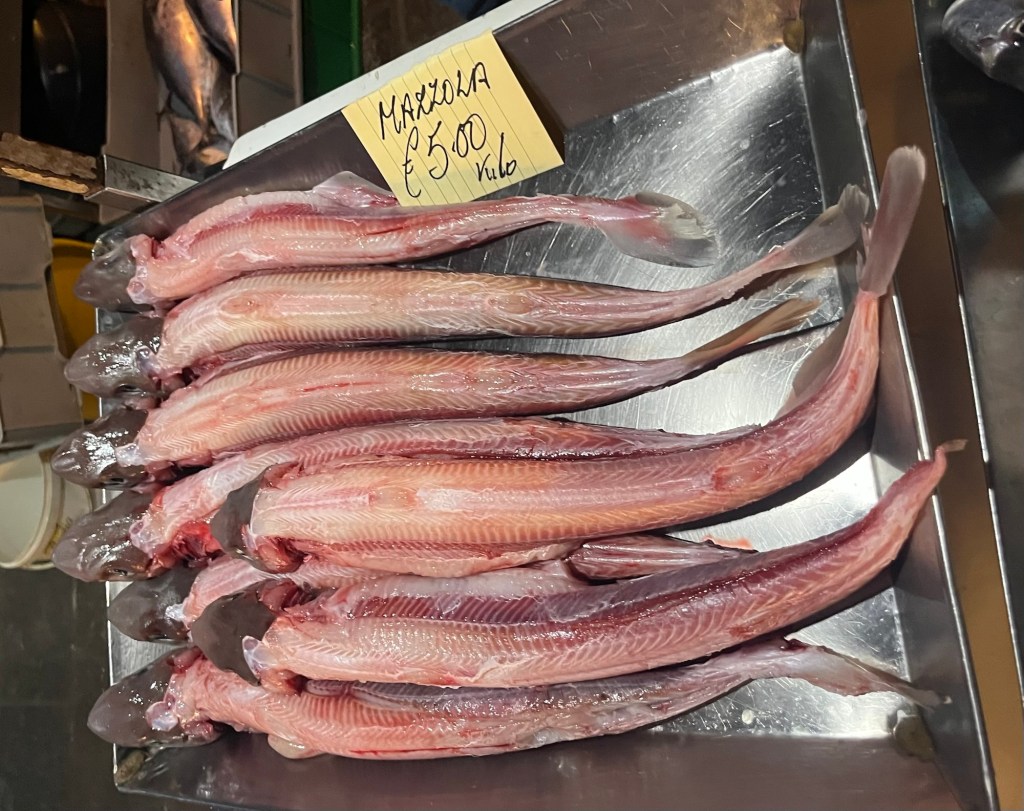
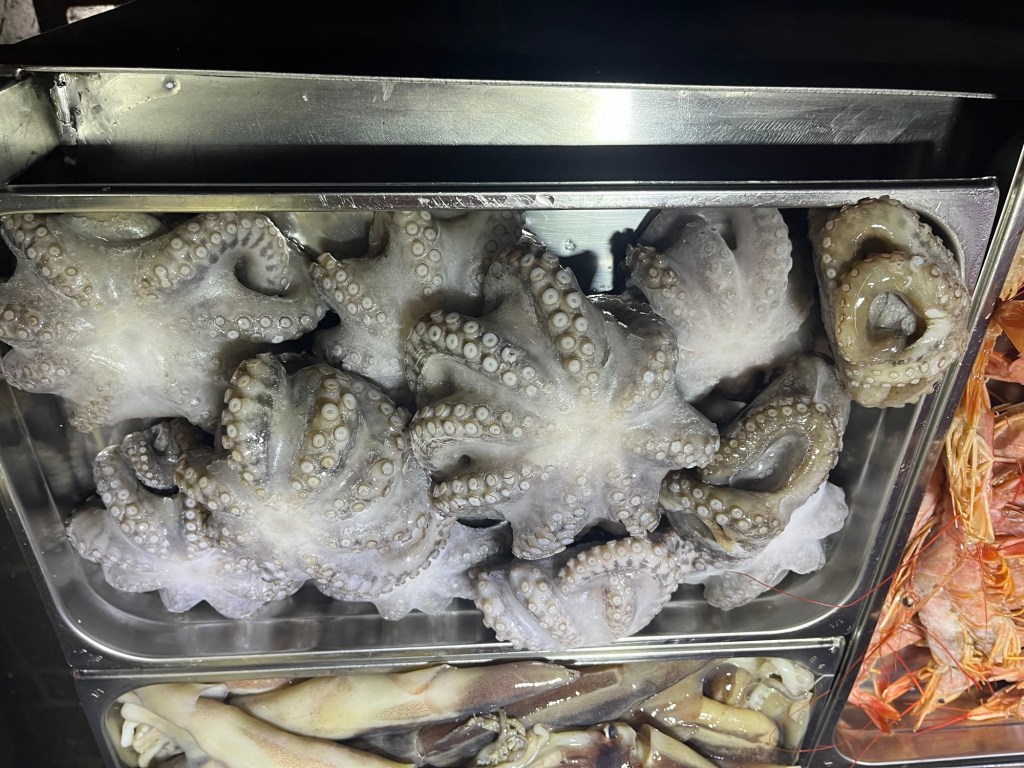
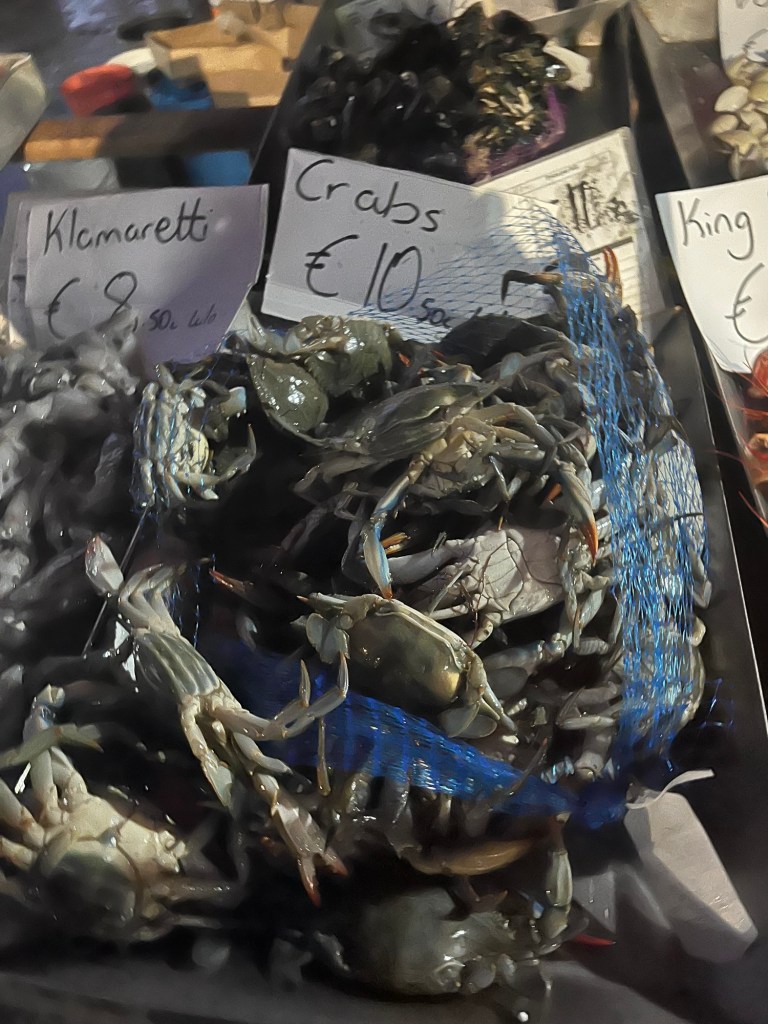
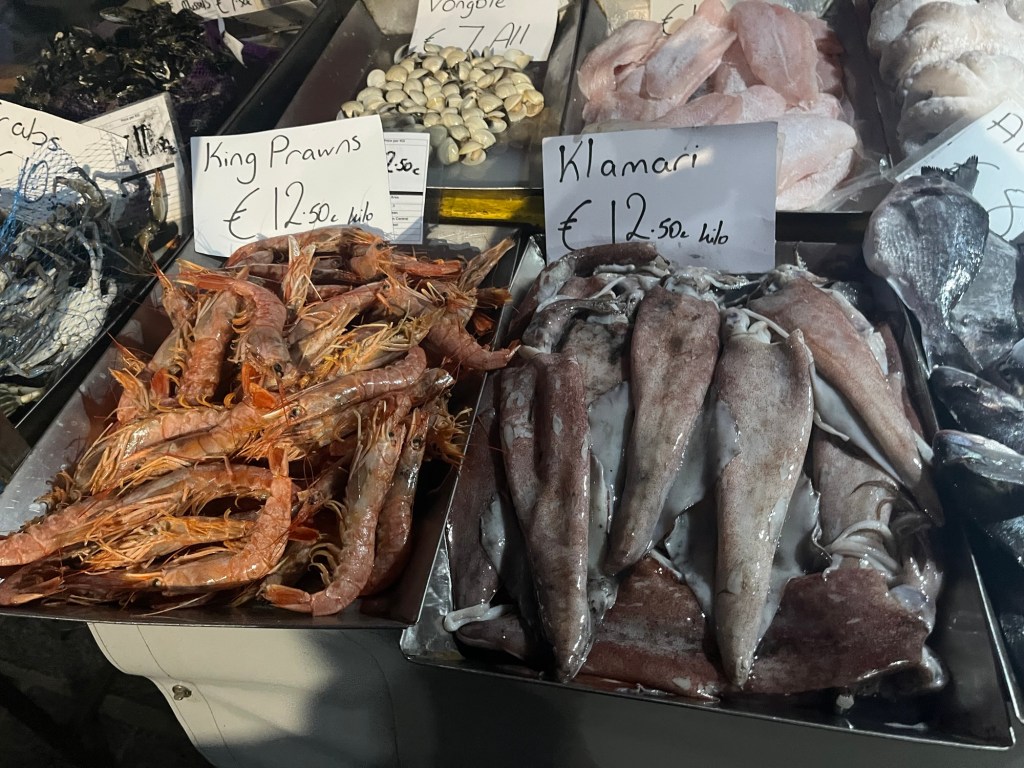
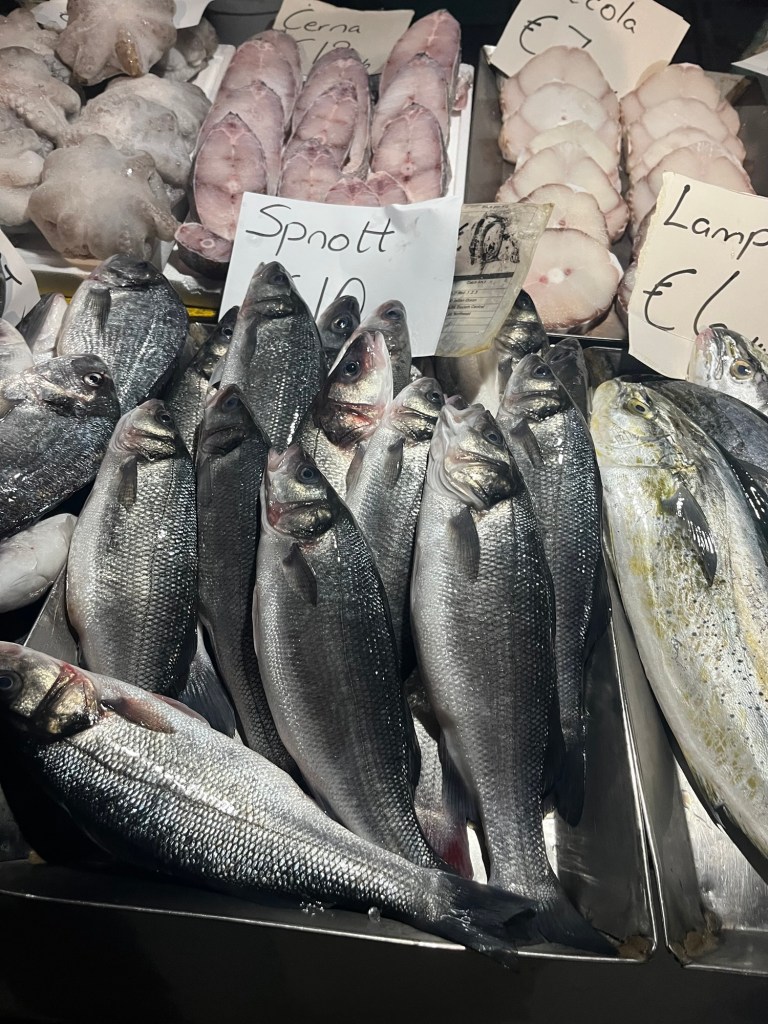
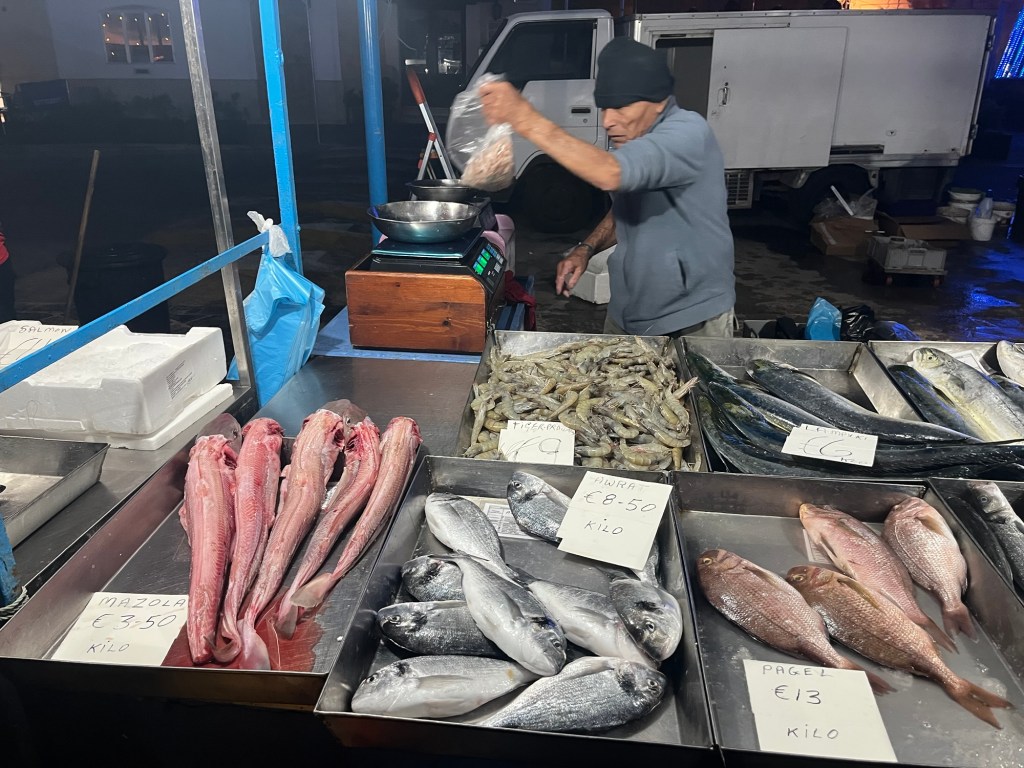
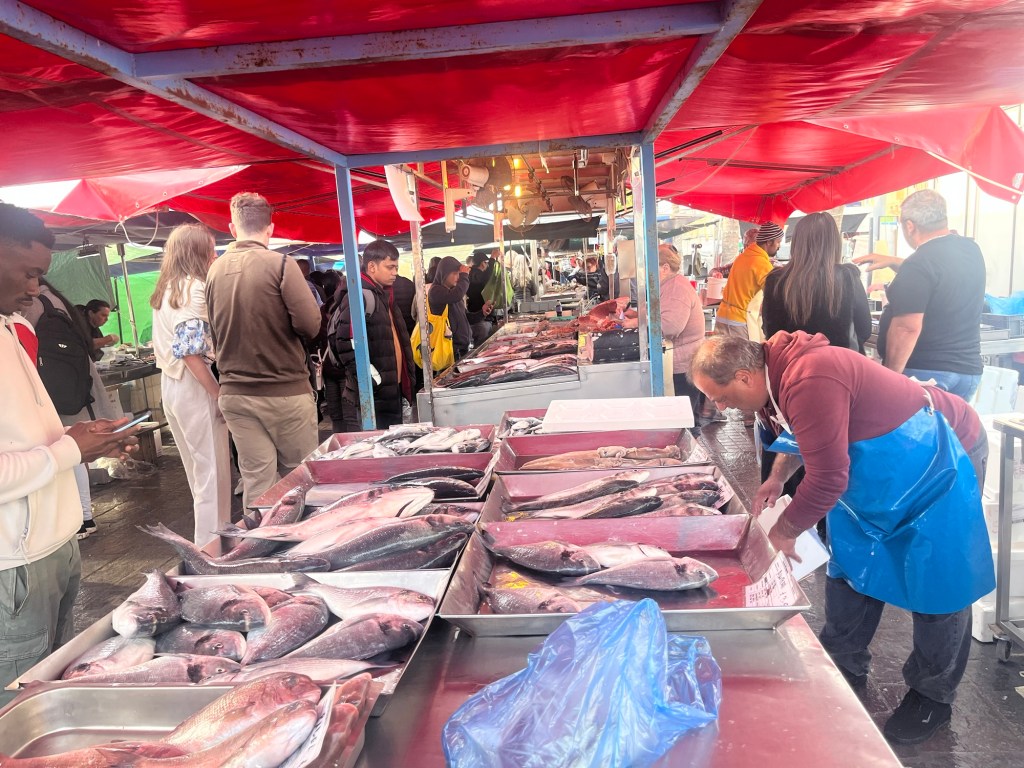
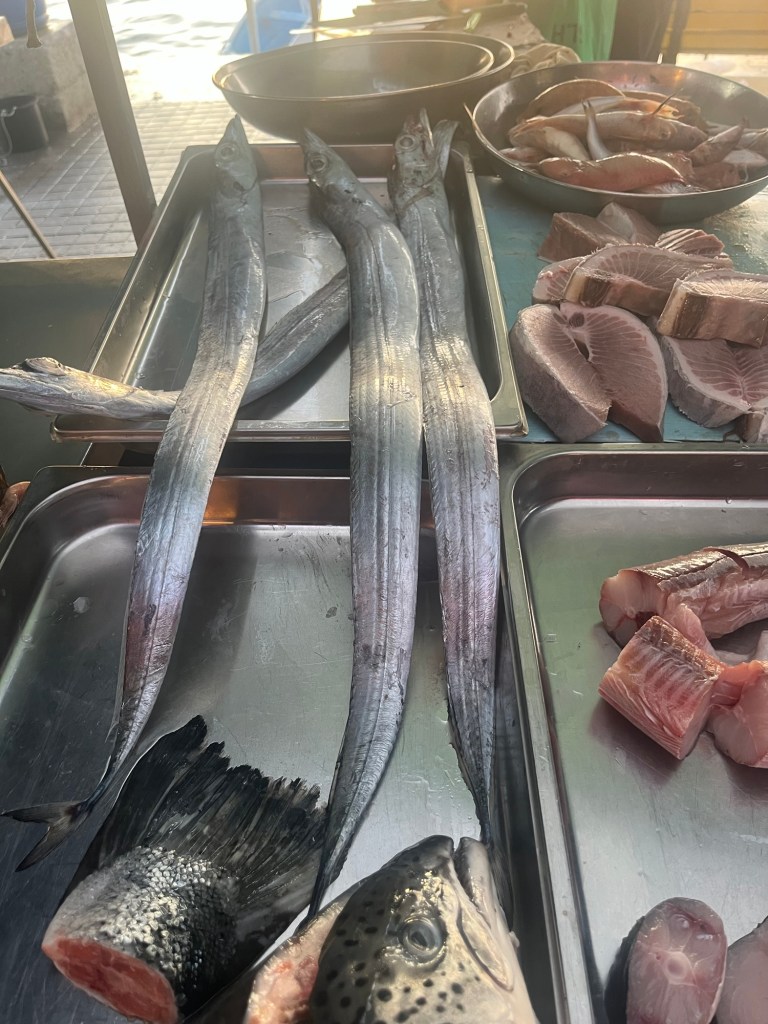
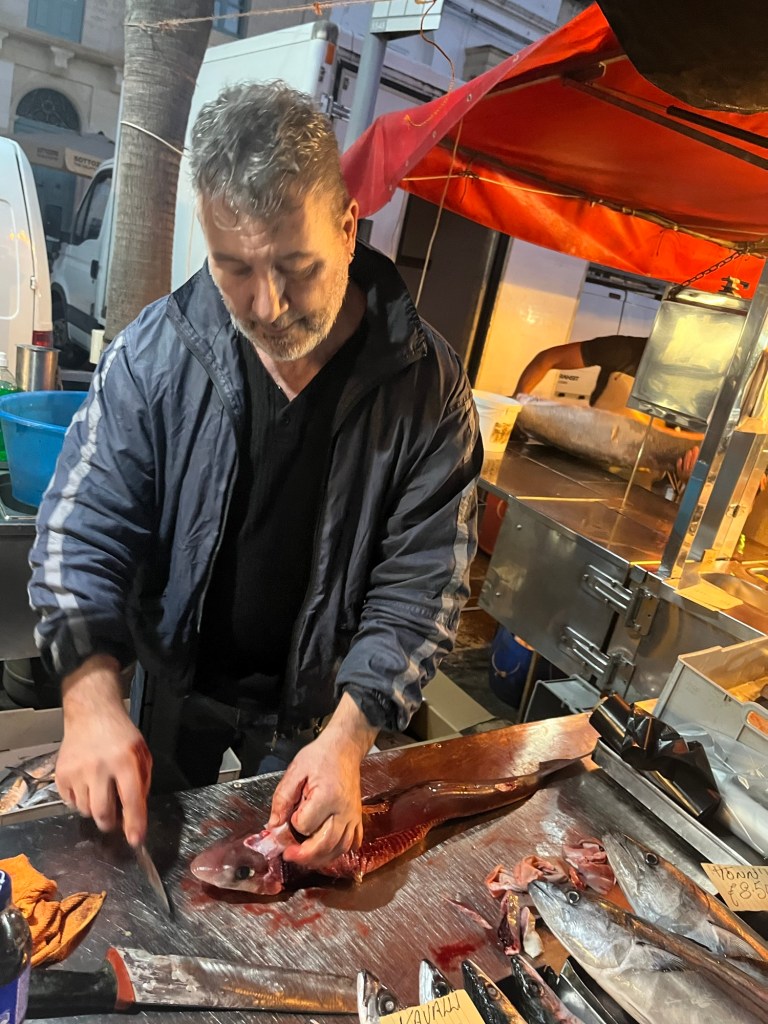
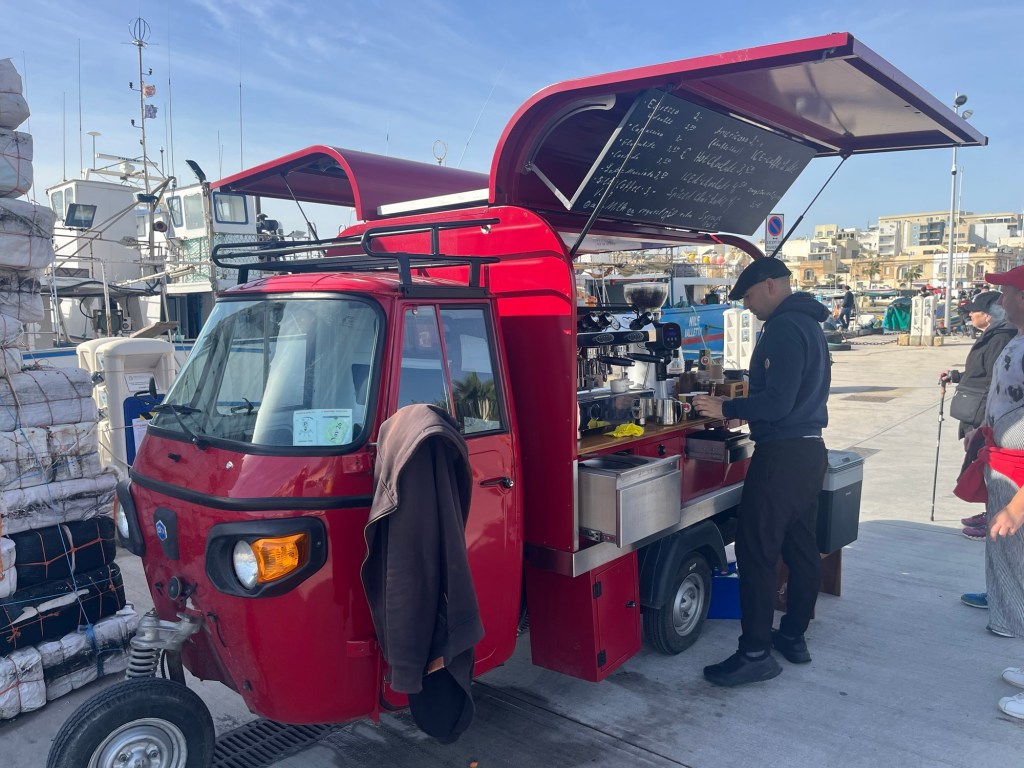
It was all I hoped! At 6:40 this morning, the fish mongers were in place, probably 20 different stalls. Some of the fish were frozen, like most of the octopus, and some was imported, like the swordfish and Norwegian salmon. But most of it – sea bass, eels, shrimp, mollusks, lampuki, (mahi mahi), sardines, mazzola (dog fish), crabs, etc., etc., etc. – were fresh out of the water. Fishing boats lined the wharf along the harbor.
Like everyone else in Malta, the fish mongers could not have been nicer. I watched a monger named Mike skin and prepare mazzola. Later I met his wife, Rumina, who is the primary fish cleaner, and his lovely daughter Mariah, who is a talented graphic designer (who happens to hate fish but helps out her parents at the market every Sunday … and I know she is talented because she showed me pictures of her work). If they hadn’t been so busy, I could have spent the morning with them, but their hands never stopped moving. I plan to stay in touch!
I am sorry we have no cooking facilities in our guest house. I wanted to cook and eat everything …. just like the young Nepalese man standing next to me at one of the stalls who was buying a kilo of this, and kilo of that, and a few kilos of other fishes. I asked if he owned a restaurant. He doesn’t. He just loves fish curry and stocks up every Sunday.
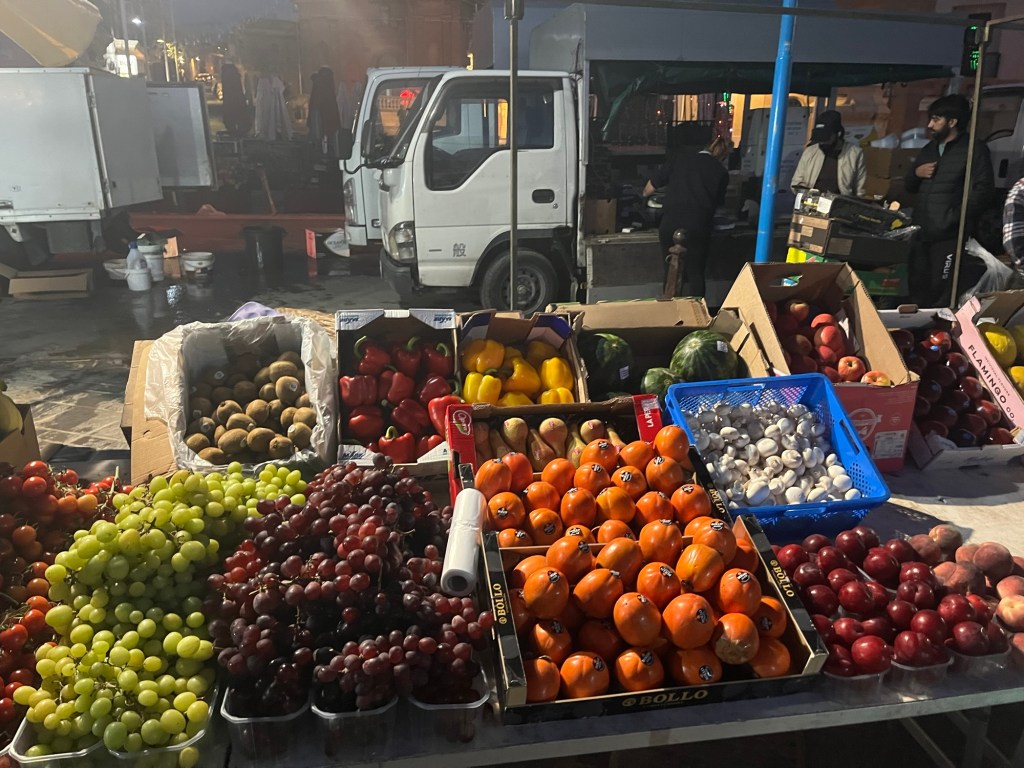
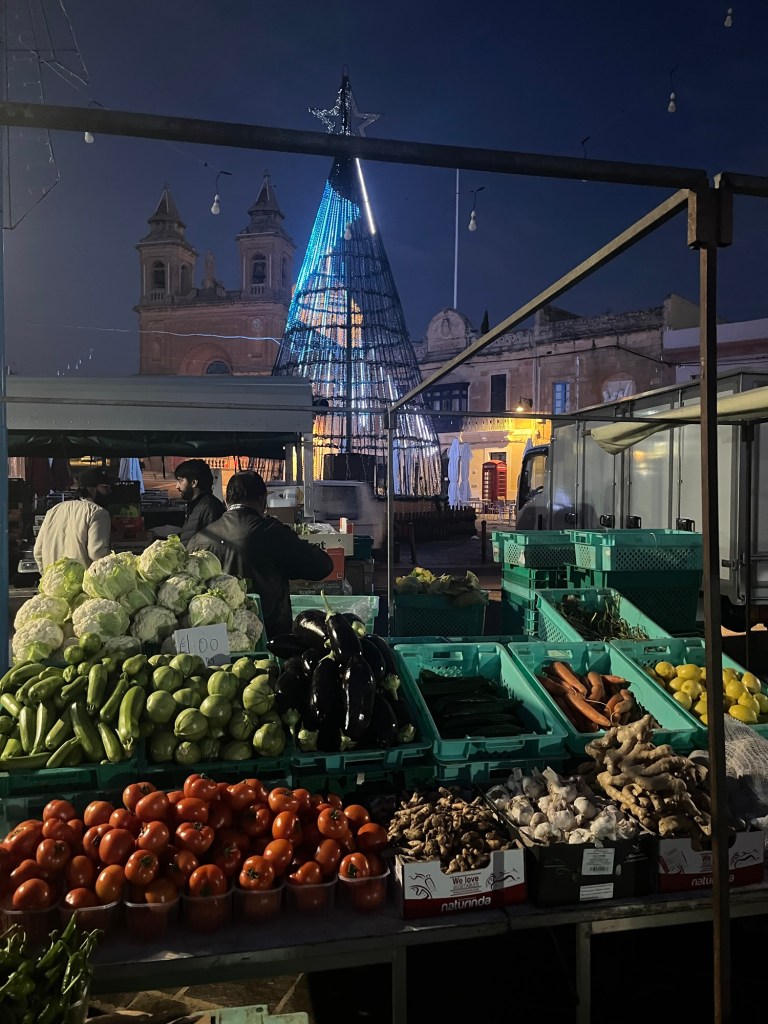
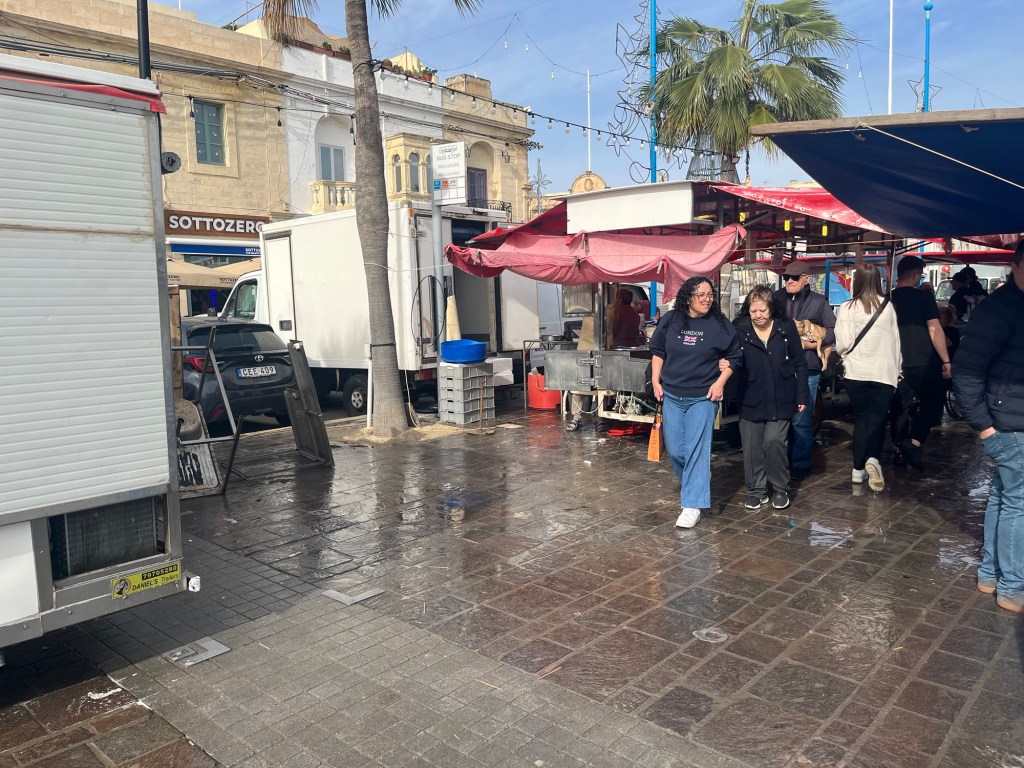
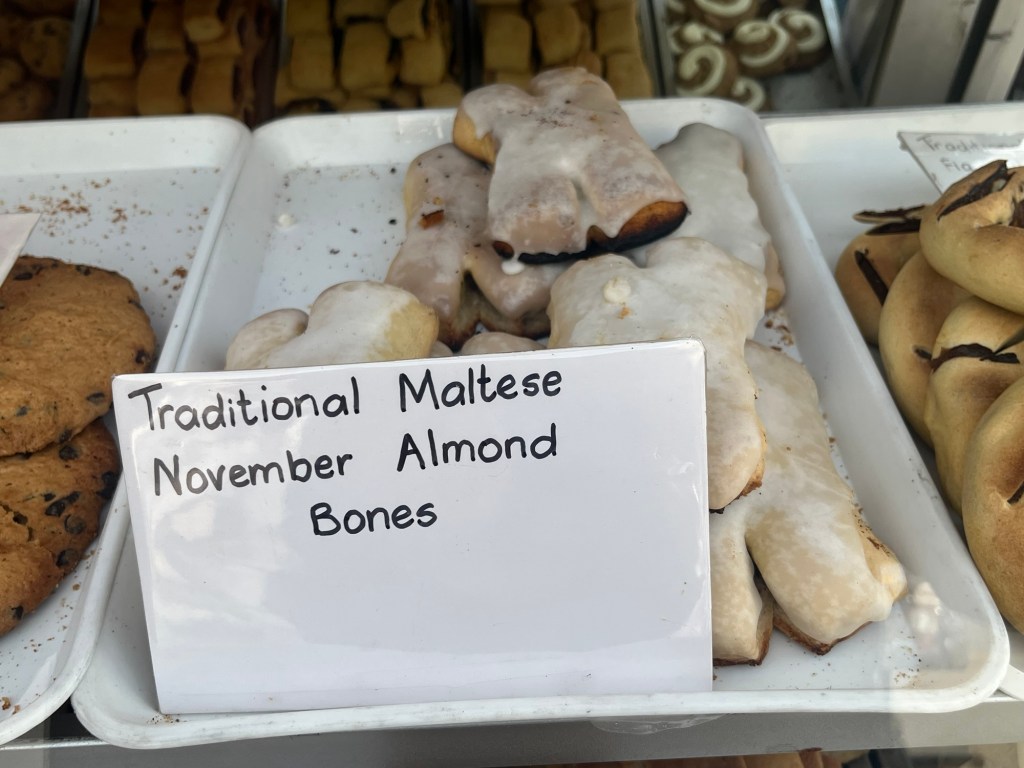
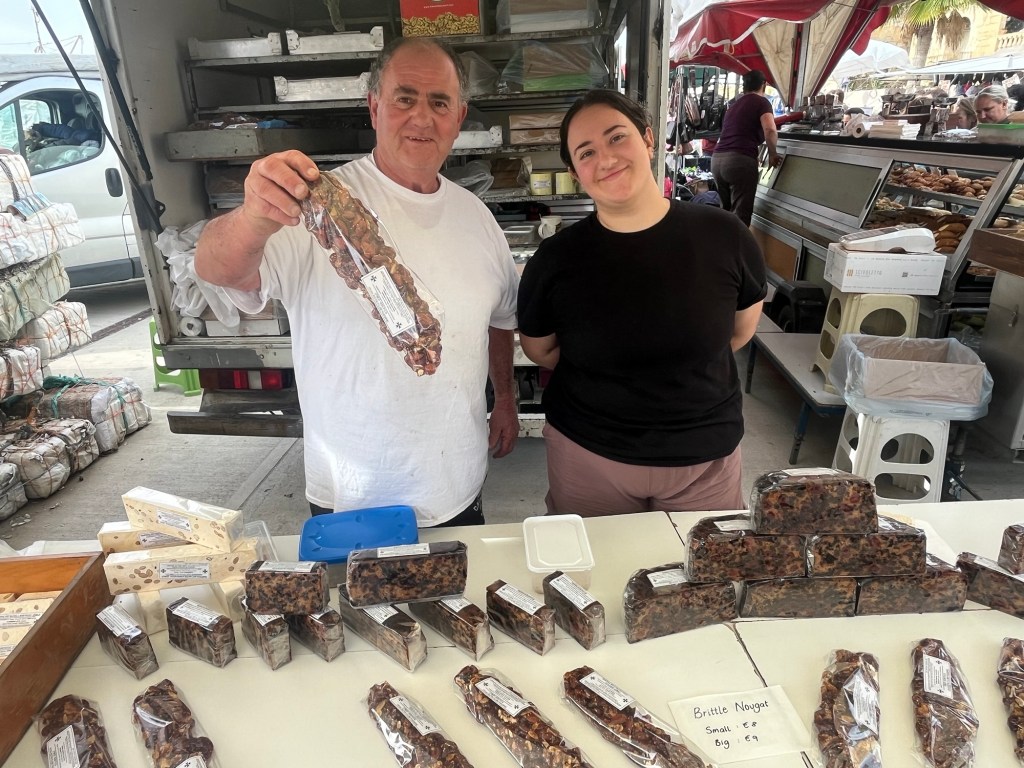
By 7:30 or so, the market was getting crowded. The beautiful displays of fresh fish had been picked over. Every surface had some sort of sign of fish entrails. The crowd of visitors was growing quickly. By 9:00, the crowd was thick. Other vendors hawked every sort of tchotchke you can imagine, from playing cards to underwear. The baked goods were unbelievable. It is now 12:40. I am headed back out to experience the end of the market. 1:20: One stall has a few fish left; the others have either vacated or are washing the last of their containers. The crowd remains thick. I think some of the tchotchke merchants are still arriving and setting up.
All-in-all, a splendid morning. Enjoy the photos….
Dawn breaks over the Marsaxlokk Sunday market….
My new friends … Mike, Rumani, and Mariah Grech…
By 12:30, the fish mongers are cleaning up and disappearing…
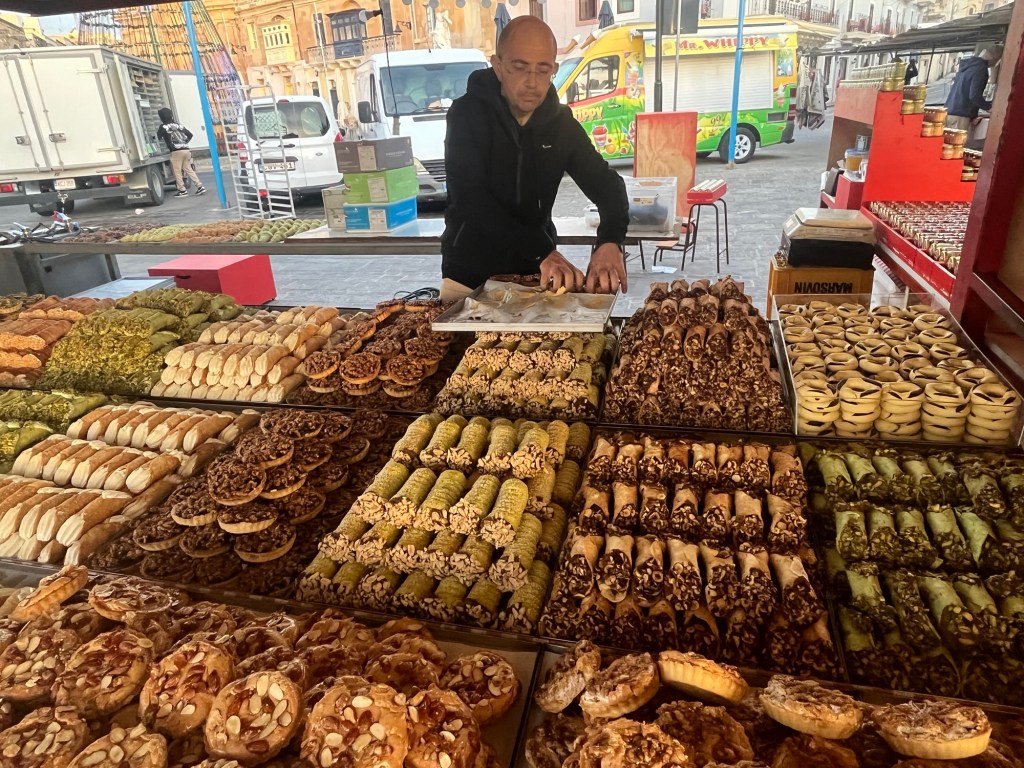
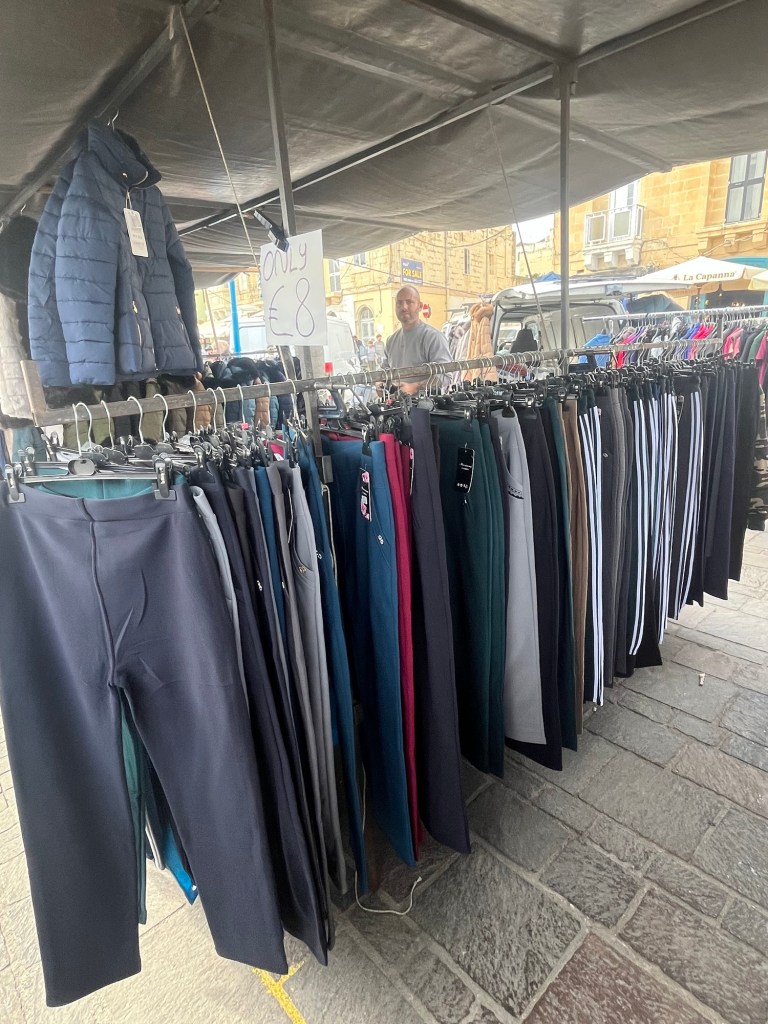
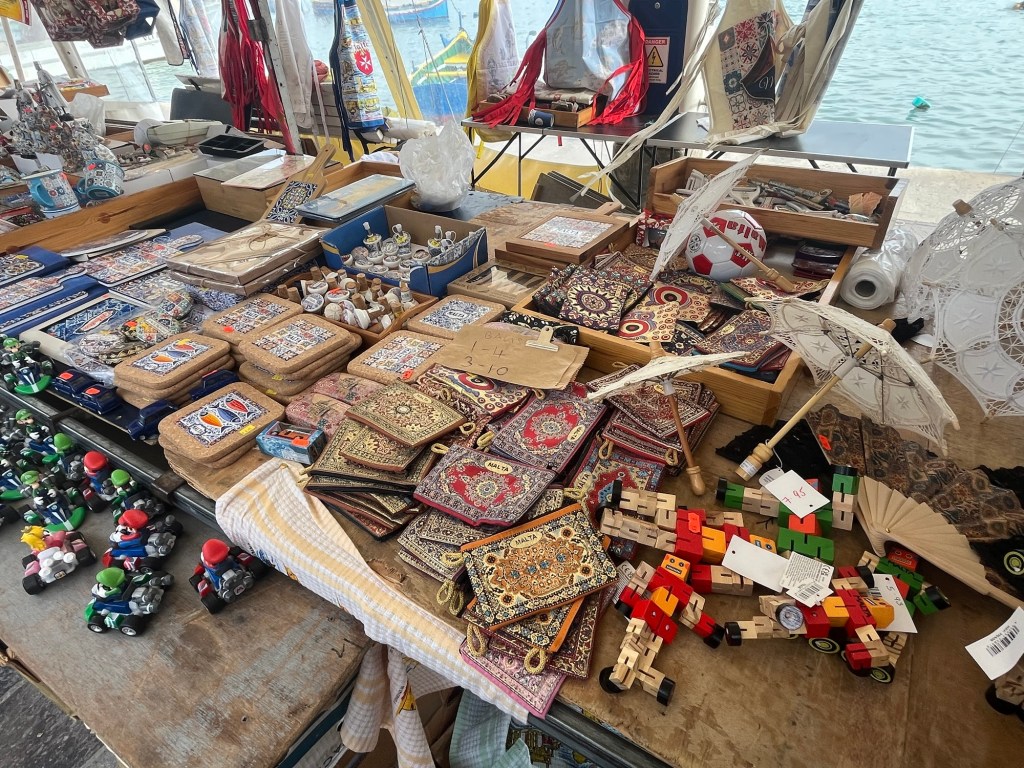
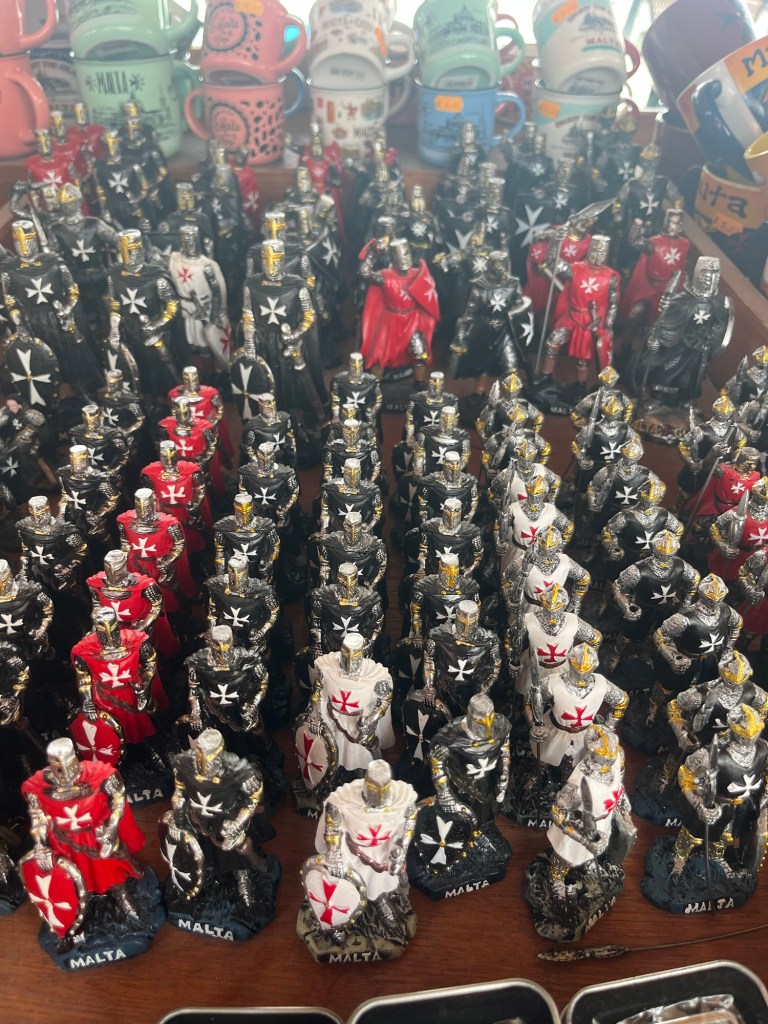
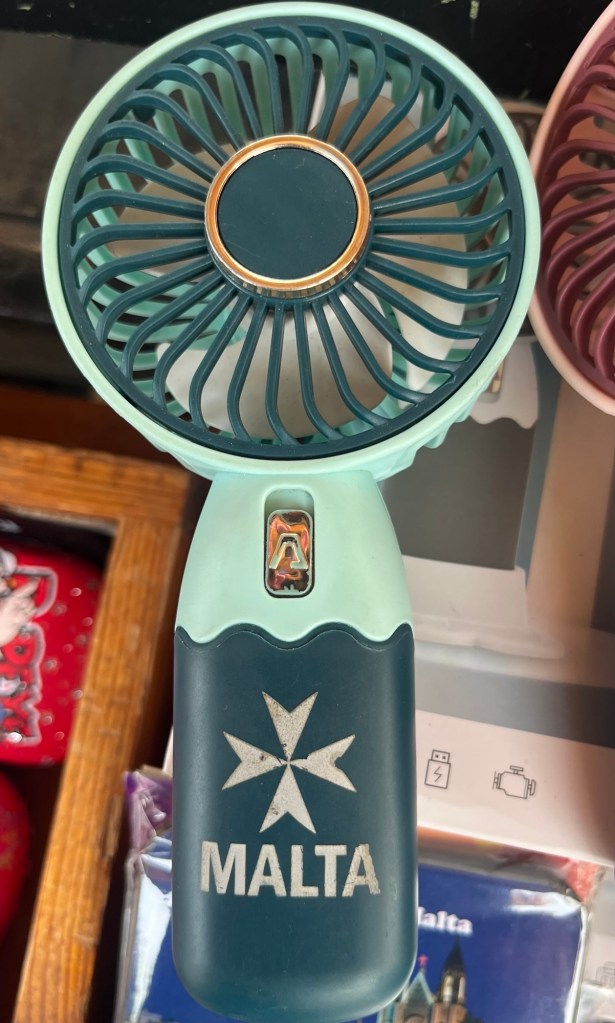
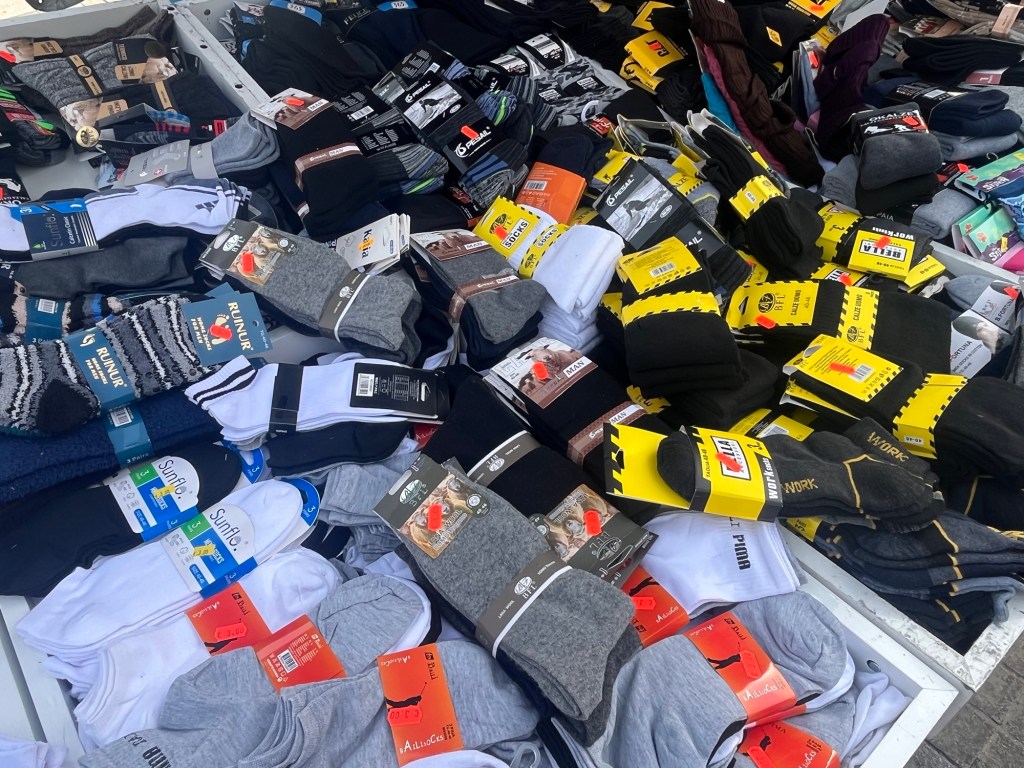
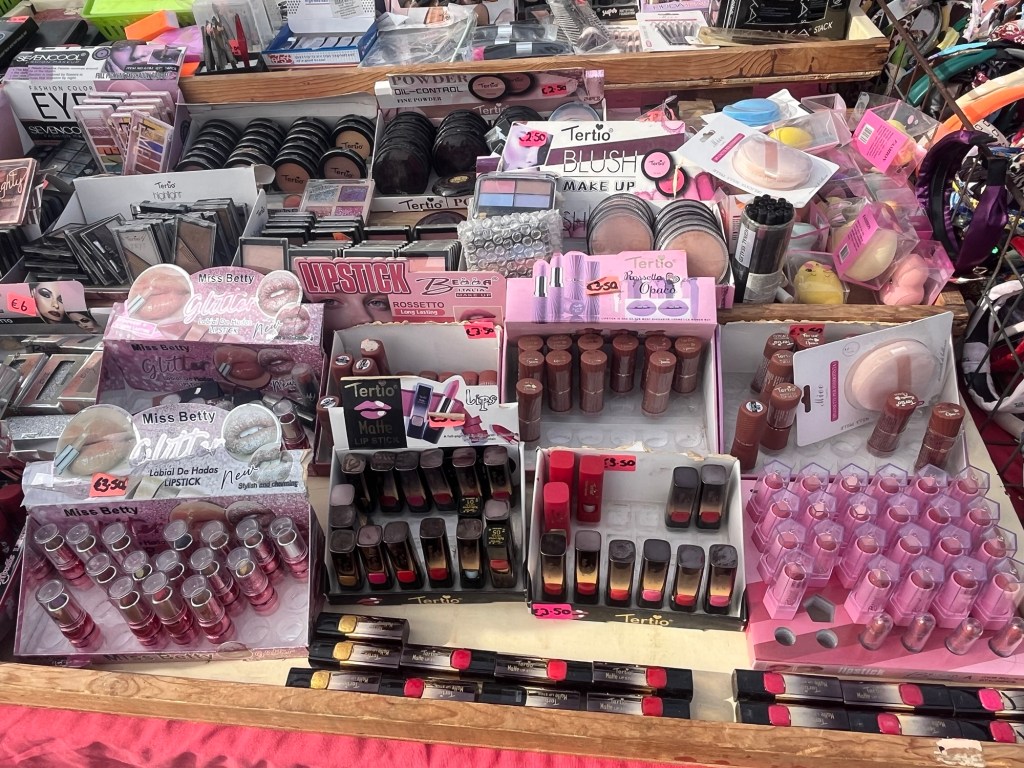
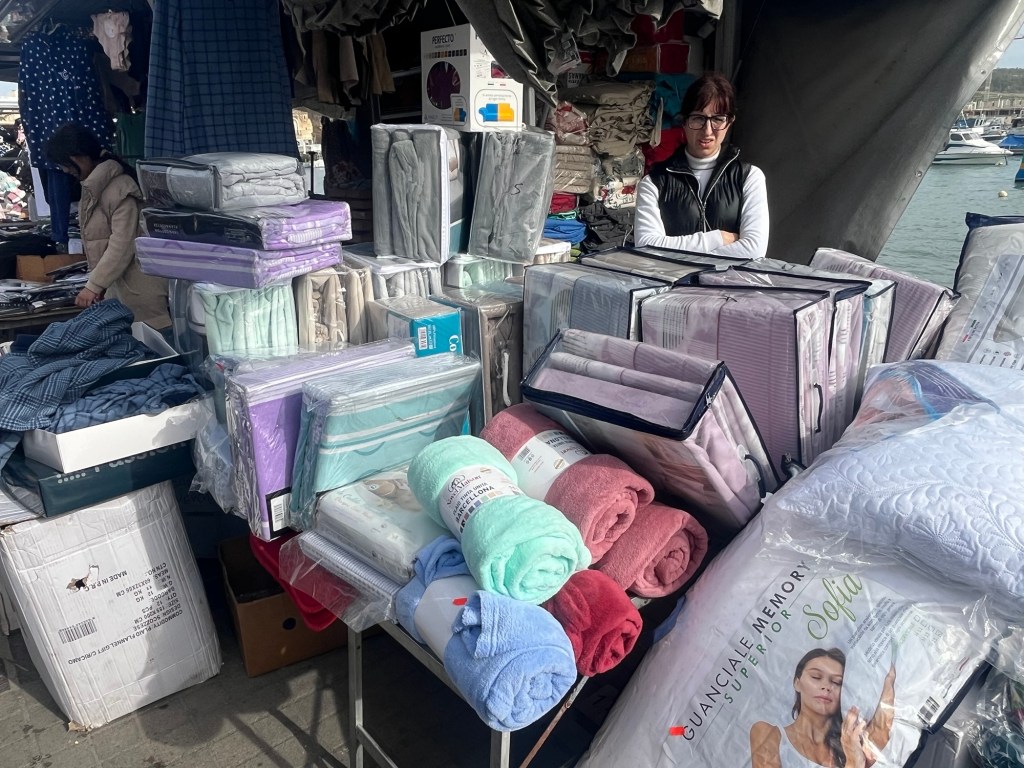
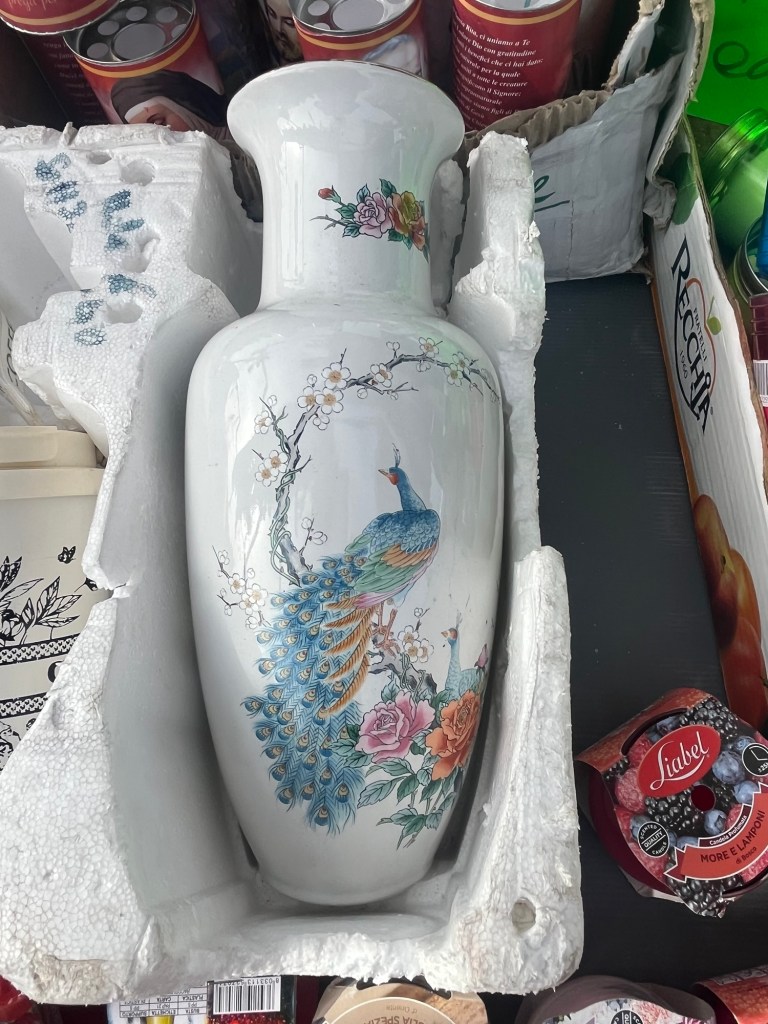
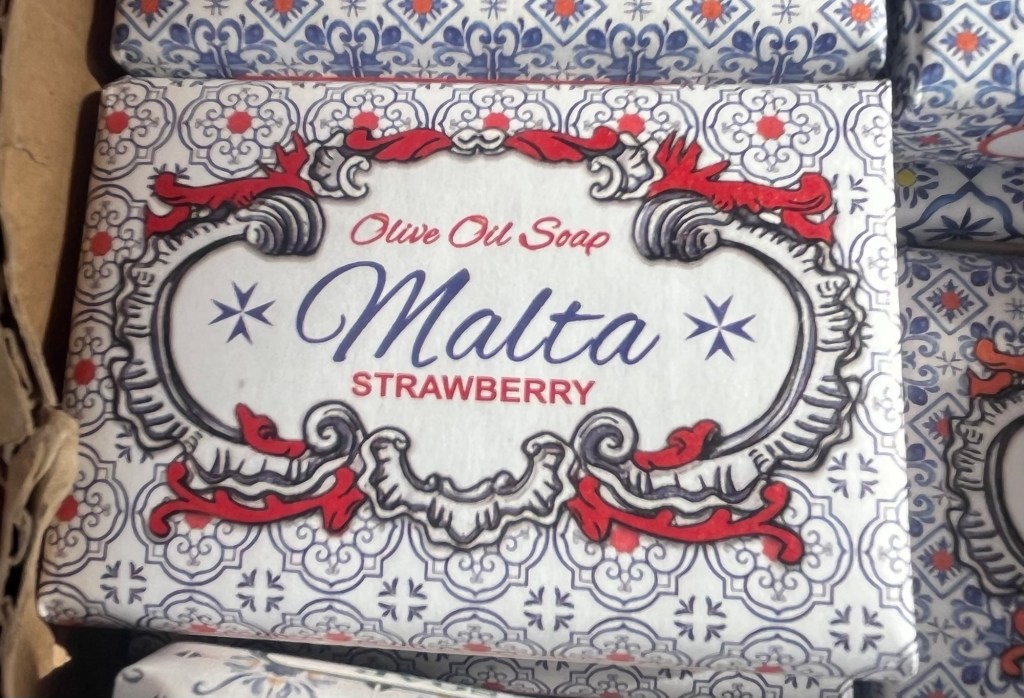
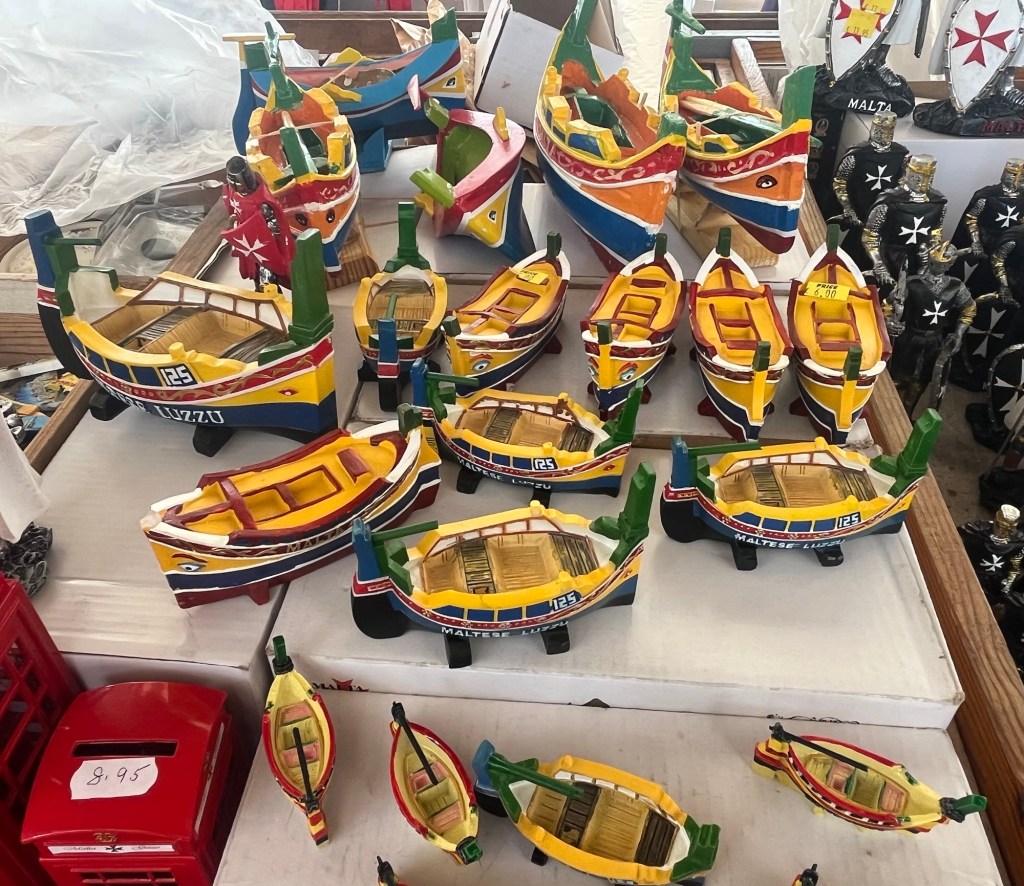
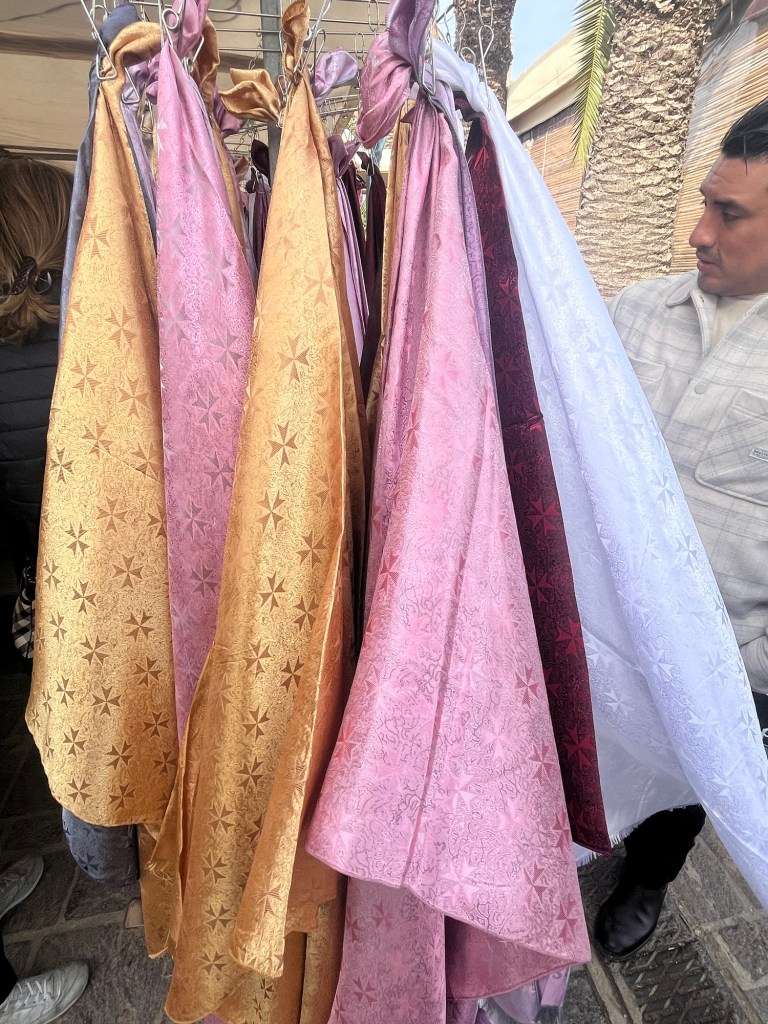
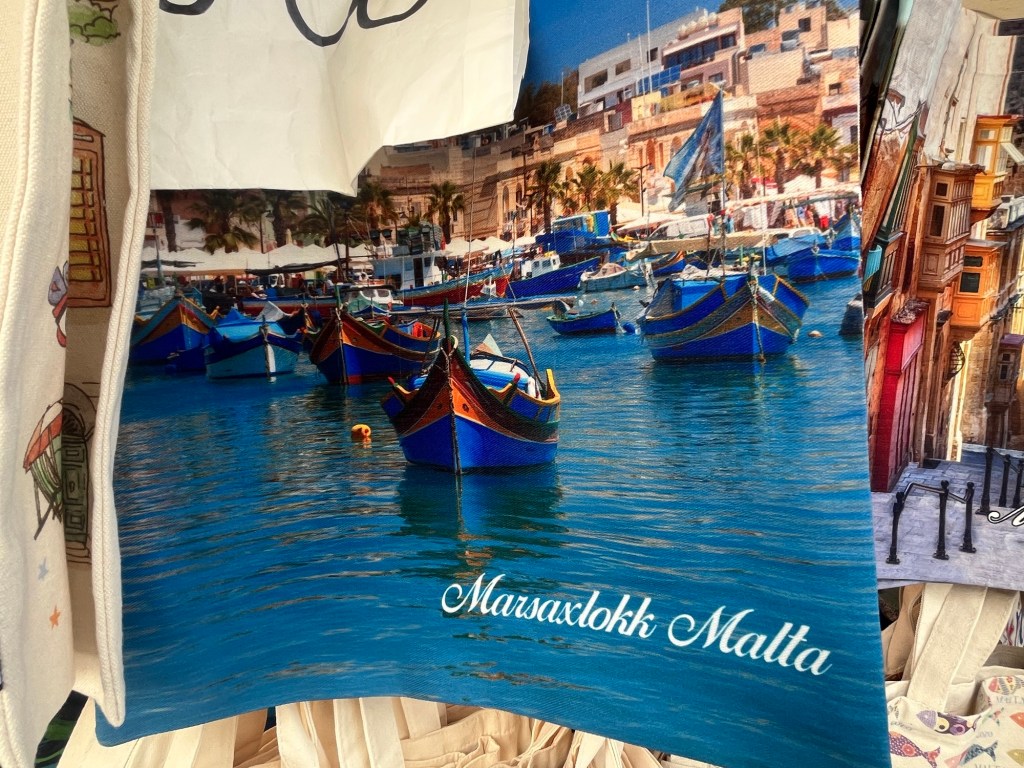
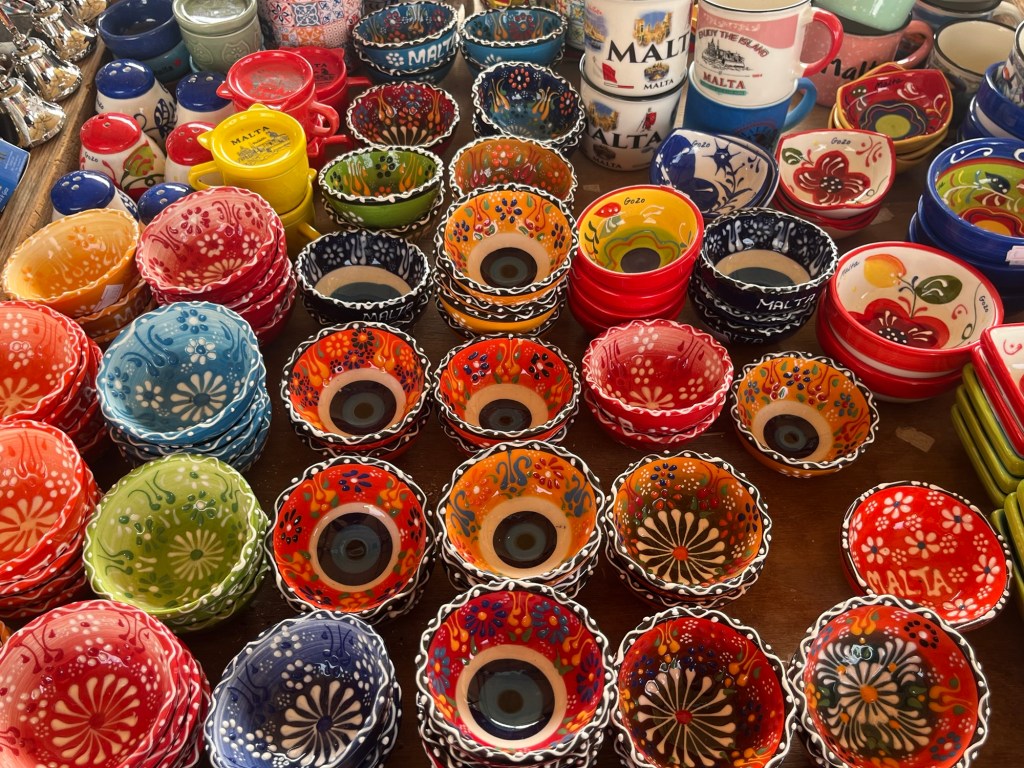
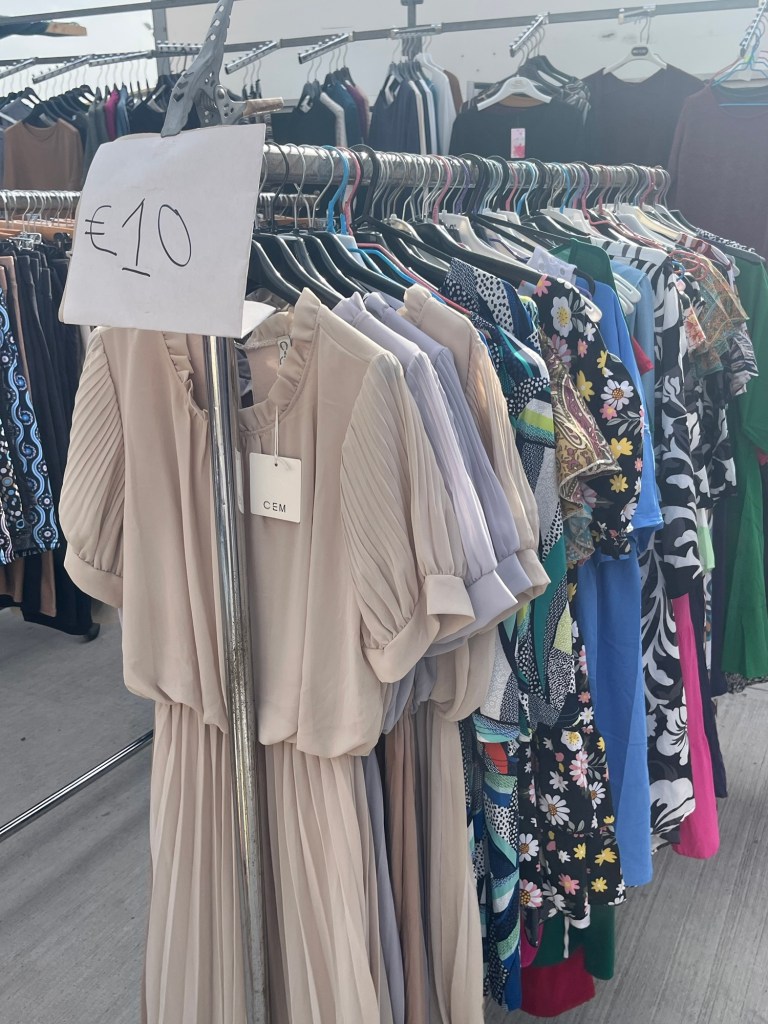
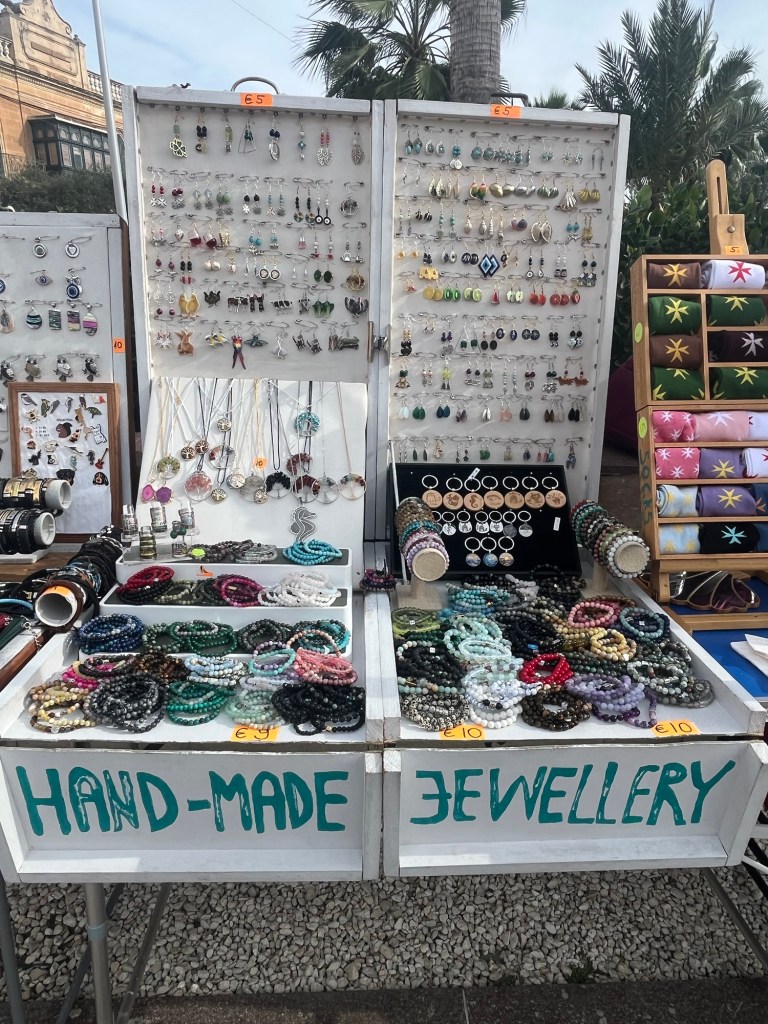
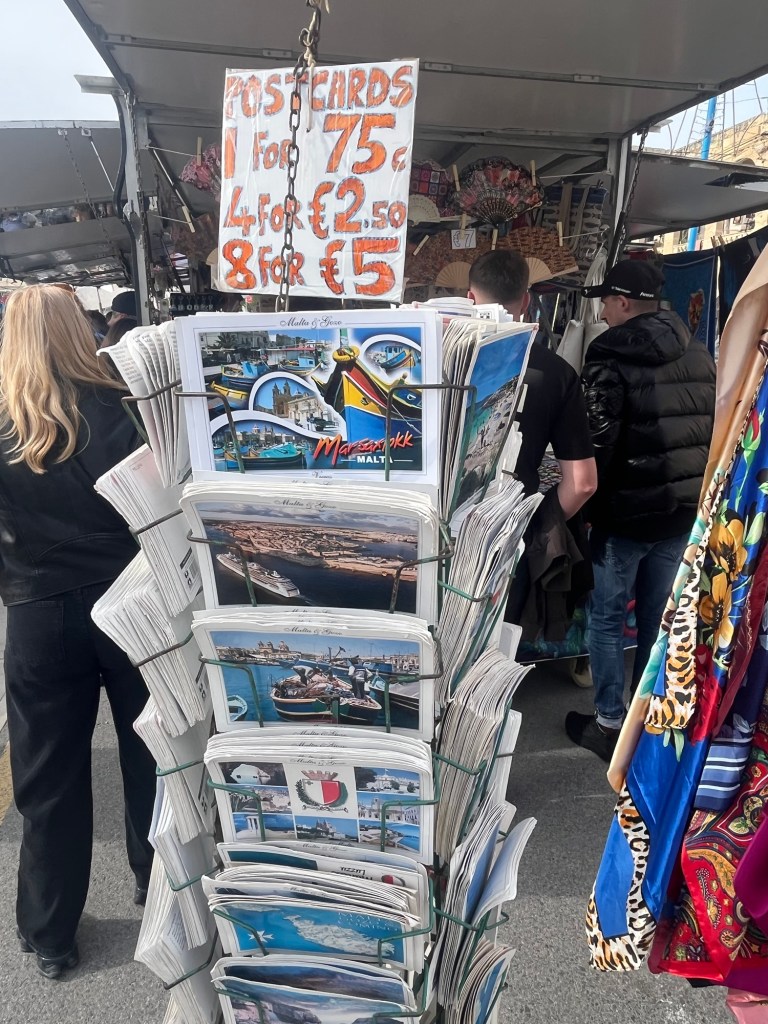
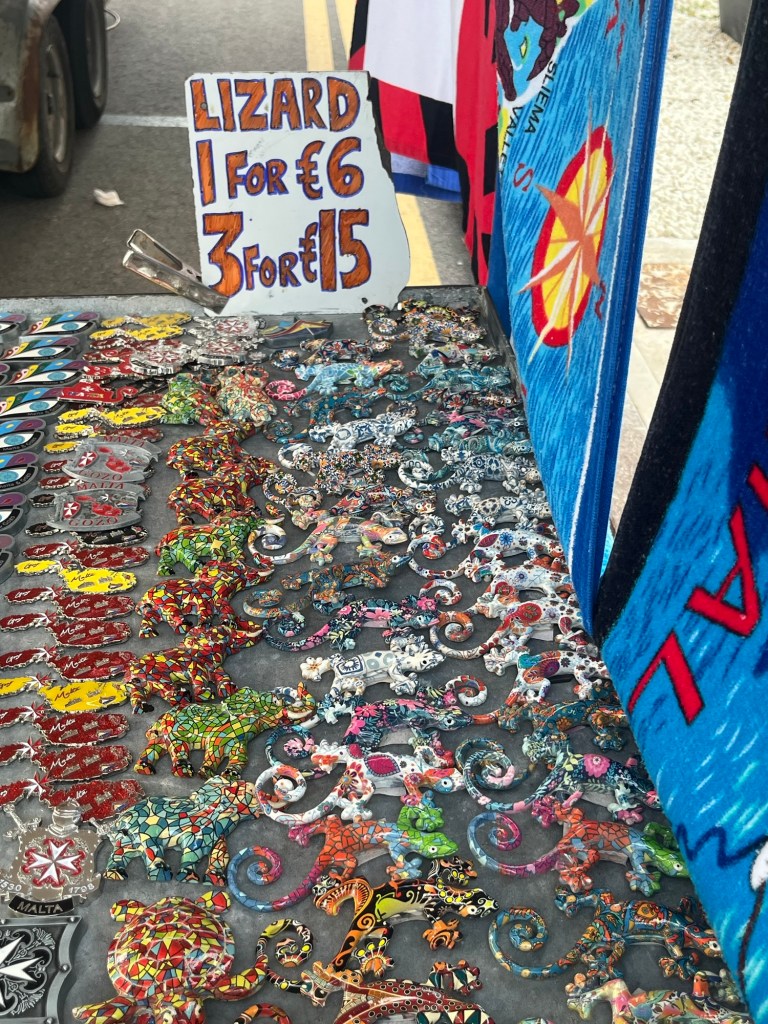
But even after the mongers are gone, you can still buy every imaginable kind of tchotchke, from underwear to clothing to accessories to toys to magnets to Maltese knights to fans to socks to more underwear to soap to bedding to Christmas tablecloths to shopping bags to aprons to cosmetics to Chinese vases to Maltese Cross silks to honey to baked goods to more underwear to lizards to post cards to jewelry and even a 4-in-one survival bracelet with a fire starter, a knife, a compass, and a whistle (which I damn-near bought).
That’s All Folks. See you again when the next story rears its head.
Traveling for 18 hours is hard work. Airplane seat designers must delight in demonic sadism, creating seats that are as unsuited as possible for sleeping … and we upgraded to the just-short-of-first-class seats. Like the seats, the so-called “pillows” were designed for maximum discomfort, and the “blankets” not only provided no warmth, they were also too small and kept sliding off. Fortunately for us, the “economy plus” section was empty, so we had plenty of horrible pillows and inadequate blankets to plow through. I think we opened six of those silly bags they give you with pillows and blankets and a bunch of other supposedly helpful stuff like lotions, cloths for cleaning glasses, and lip balm … just the comforts you are longing for when trying to grab, at best, 5 or 6 hours of sleep. Plus, we shared a cabin with the obligatory guy with apnea who kept making desperate vomiting-like sounds before drifting off again. On the glass-is-half-full side, we had no crying babies or unexpected health emergencies, both of which are standard fare for those of us who have flown way-too-many red-eyes. And the sad thing is that it was probably as good as we could have hoped for. Unlike leisurely road tripping and long trips by rail, overnight airplane travel is never about the journey; it is only about the destination.
Now that we have been here for almost a day, 11 hours of which we spent sleeping, it seems that the destination is making the travel miseries worth it. From all initial impressions, Malta is a pretty cool place, and our choice of starting the adventure in Marsaxlokk was a good one. (Time will tell, of course.) And in case you are wondering, Marsaxlokk is pronounced Marsa-schlock.
Part 2: Being Here
I have planned this trip for months … which is amazing since we have nothing really planned except our first four nights in a guest house. (And they have welcomed us to stay longer, which we’ll probably do.) We don’t know how long we’ll stay or where we’ll go from here. We do know that we plan to limit our travels to Malta, Sicily, and southern Italy … unless we don’t, which we will know as soon as it happens.
My first thoughts for winter travel were to spend the winter in Crete. The idea never resonated with Rebecca. For some inexplicable reason, however, Malta did. Check out Malta on a map. It is in a holy-crap-that-is-really-the-middle-of-nowhere location, in the Mediterranean between Sicily and Tunisia. It is one of the smallest countries in the world by both population (575,000) and land area (319 square kilometers), but it is the ninth most densely populated country in the world. By contrast, Grand Isle County Vermont, where we spend most of our time, is larger by land area by almost 50% (515 square kilometers), but has just over 1% of the population, at 7,500 people. For 150 years, from 1814 to 1964, Malta was a British colony, so English is one of its two official languages (along with Maltese) and people drive on the wrong side of the road. Plus, it is a wealthy and safe place where people take great pride in being nice. As countries go, it is proving to be incredibly easy to be in.
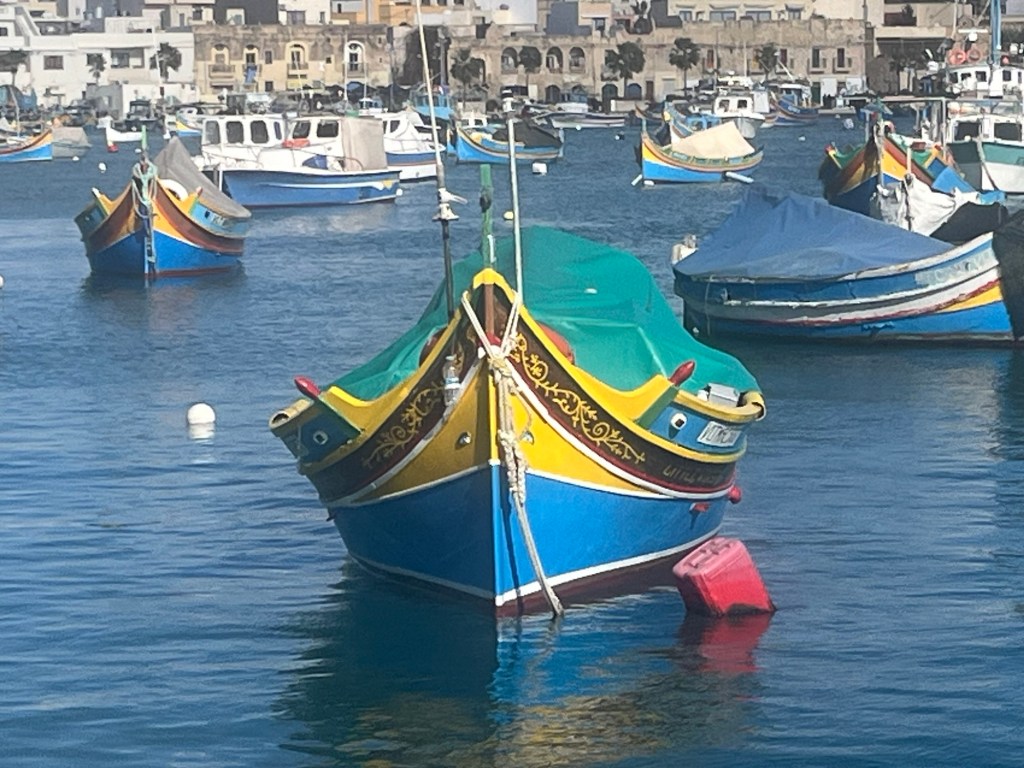
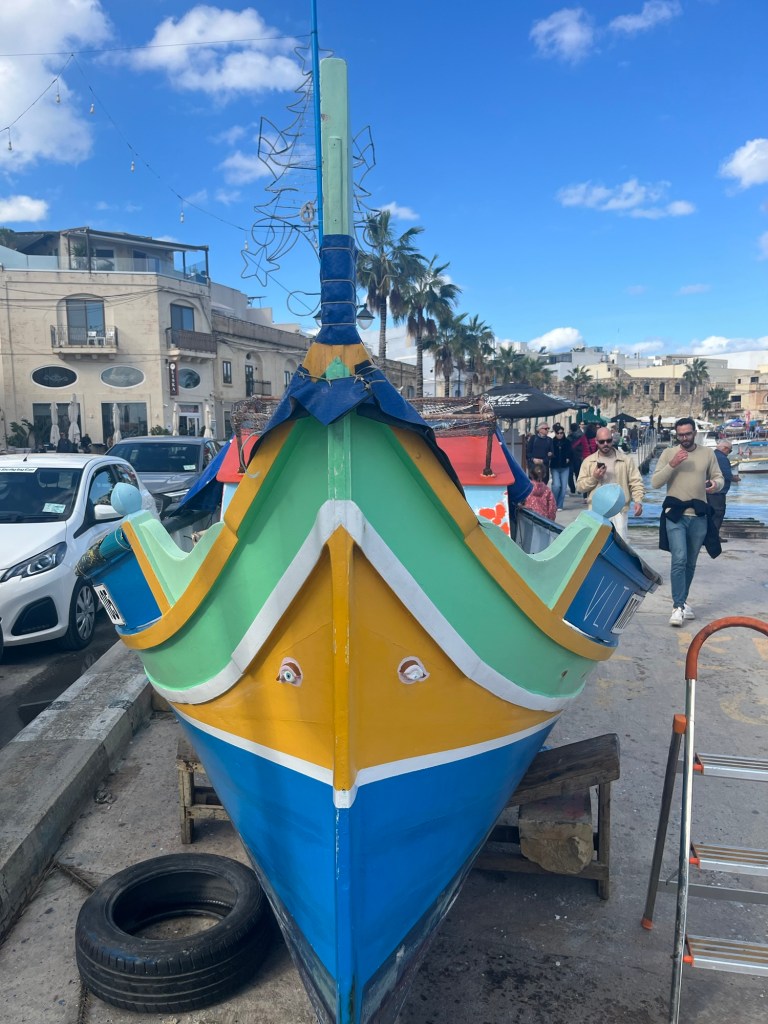
Once we agreed on a place, I Googled “quaint fishing villages in Malta.” Marsaxlokk topped the list. (Then I Googled how to pronounce Marsaxlokk since the spelling provided no hint whatsoever.) I learned that Marsaxlokk is not only known for its traditional Maltese fishing boats, called “luzzus,” but also that it has a year-round open air fish market every Sunday throughout the year. Stay tuned. Today is Friday; we still have a bit of a wait to experience the fish market.
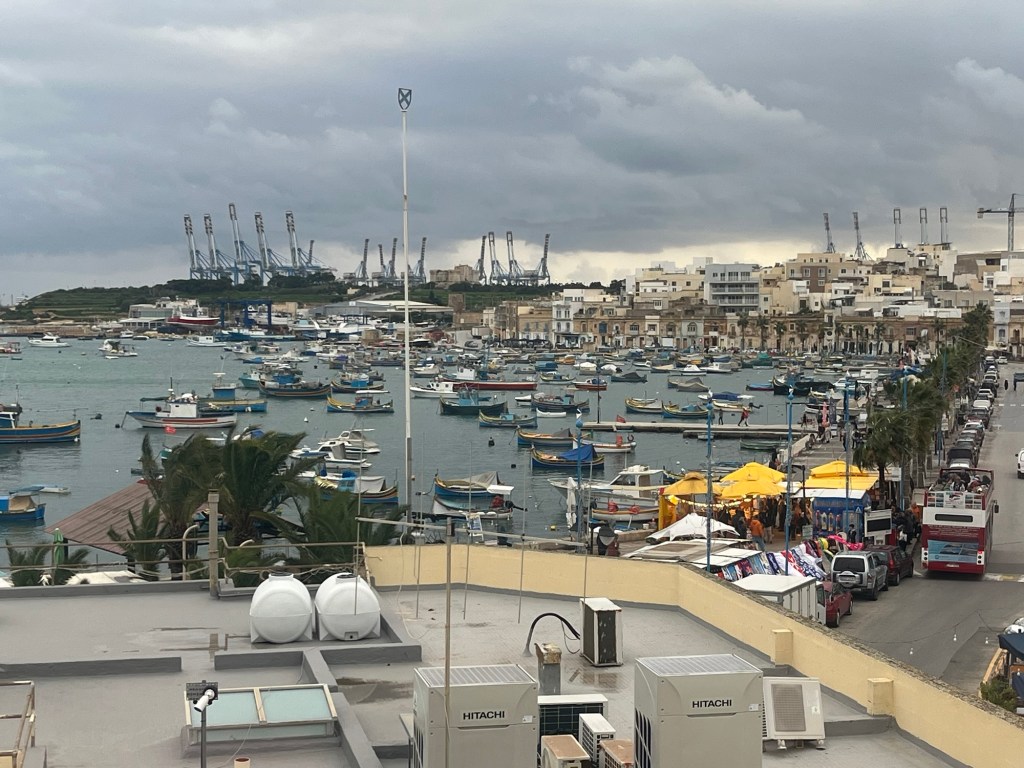
Yesterday, we marveled at the harbor and ate an amazing meal along the waterfront. Today, we wandered the waterfront and took pictures. The jury seems to be pretty clear: Marsaxlokk was a perfect choice! It is everything we had hoped it would be. Enjoy our first morning of photos!
The view from our room
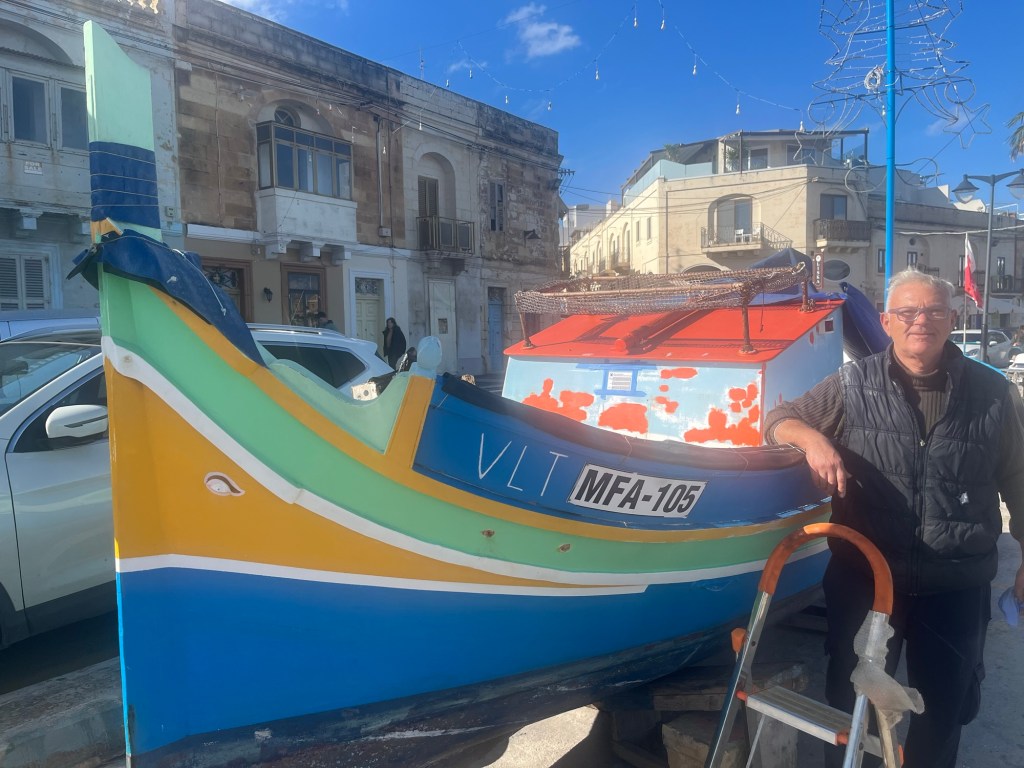
Traditional Maltese luzzusand Noah, a 3rd-generation fisherman































 myinnersociologist