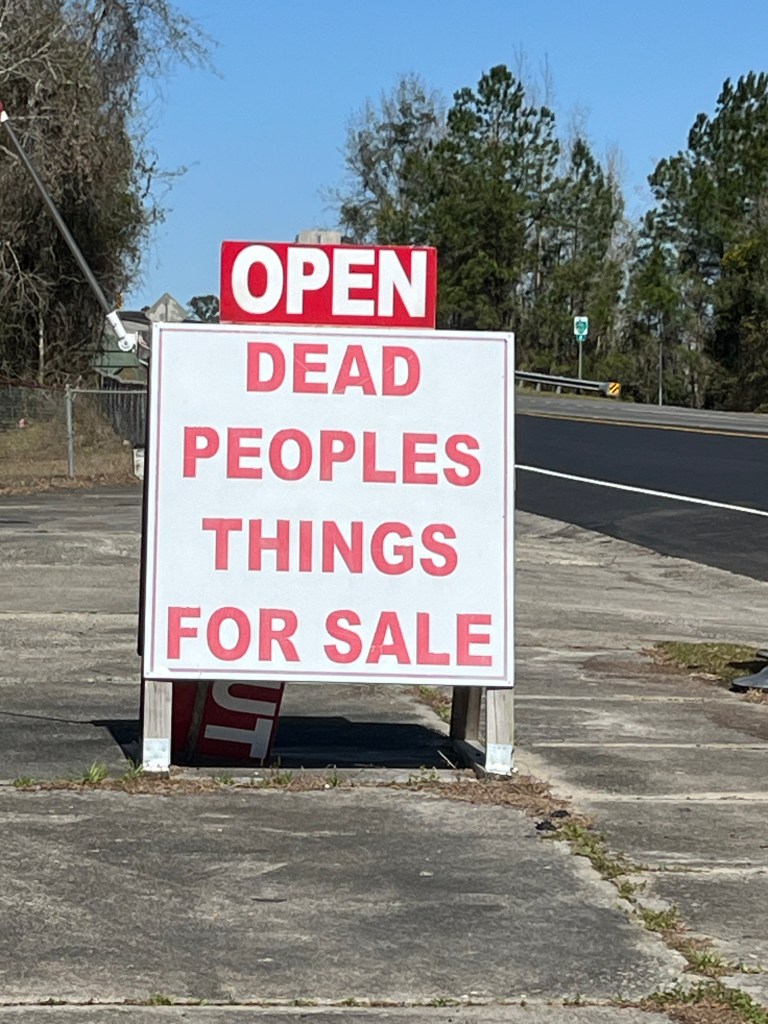
So we’re comfortably toodling along on Route 17, the road closest to the coast through most of South Carolina and Georgia. We’re one town from Florida, about to pass through Woodbine Georgia. I’m not sure I have ever heard of Woodbine Georgia. Then we saw the sign:
Damn, I thought. That is the best sign I have ever seen for an antique store. Could it actually be an antique store? If it was, I wanted to send the picture to my good friend Rene in Grand Isle who owns and runs the “Den of Antiquity,” which I believe is the antique store against which all antique stores should be compared. So I turned around.
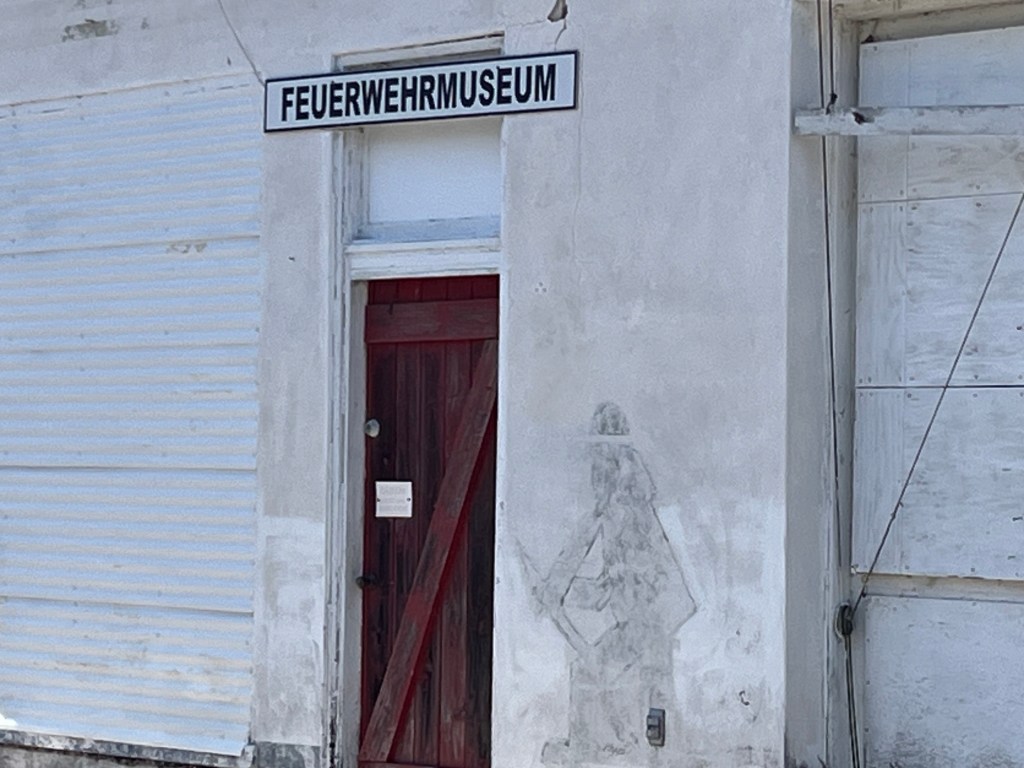
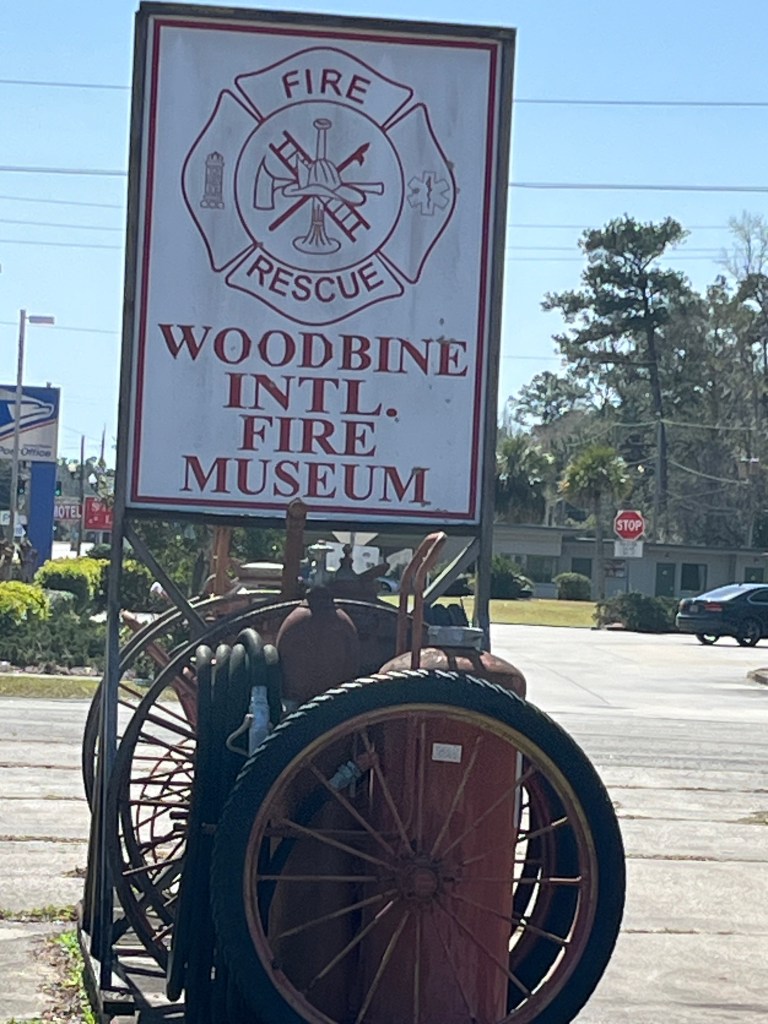
Yup. It was an antique store. Closed, but with amazing signs. A “Feuerwehrmuseum,” I have since learned, is a fire museum. I guess that makes sense.
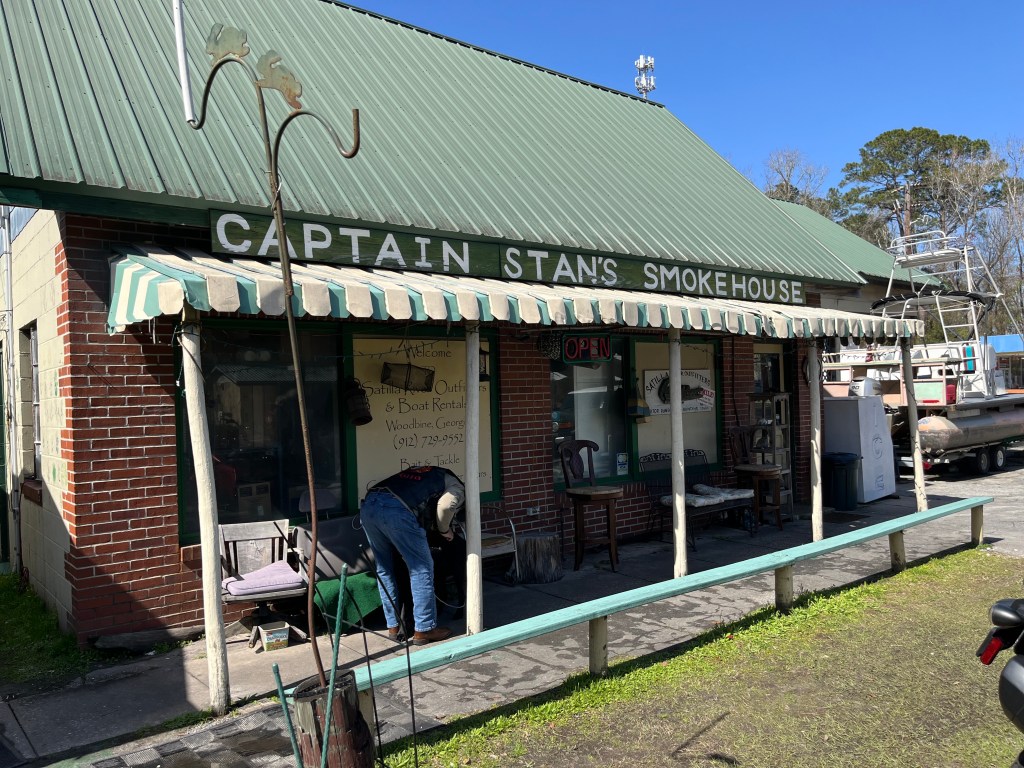
We laughed and kept driving. (At this point, there is no reason to include the diversion about how Rebecca needed to pee so we stopped at a sketchy-seeming gas station/country store that turned out to be clean and fun and fine, so I won’t.) Then we saw a very large group of Harley Riders … the Warthogs … and Stan’s Smokehouse … an utterly nondescript barbecue joint on the side of the road. (We would never have noticed it if Rebecca hadn’t needed to stop to pee.)
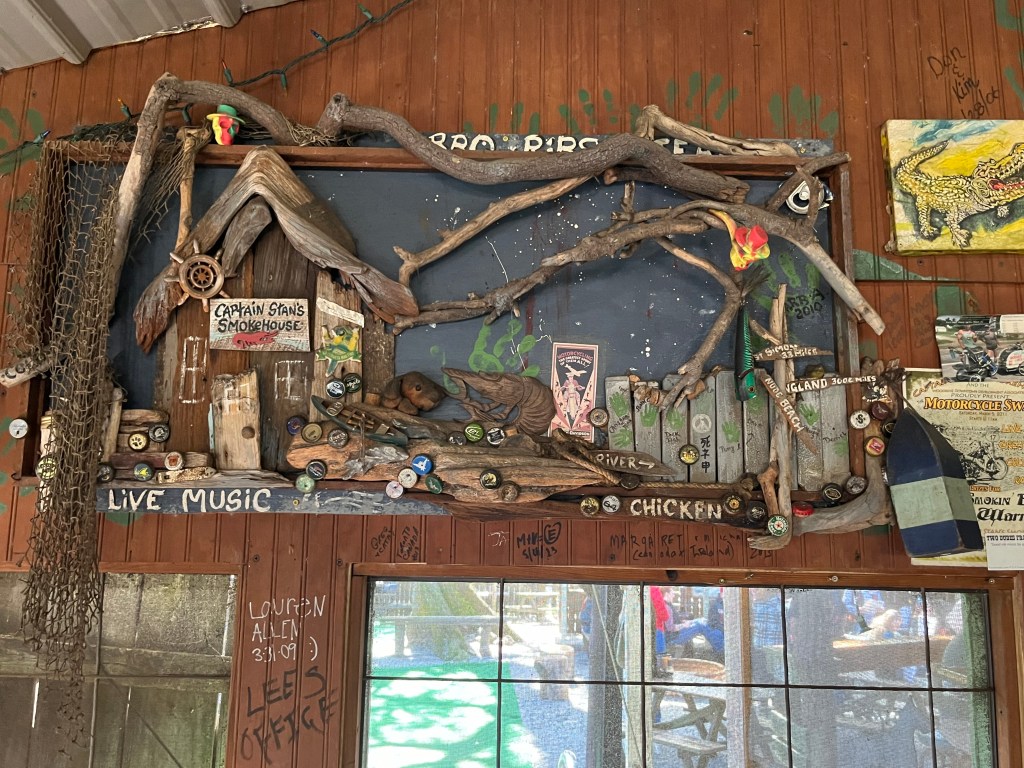
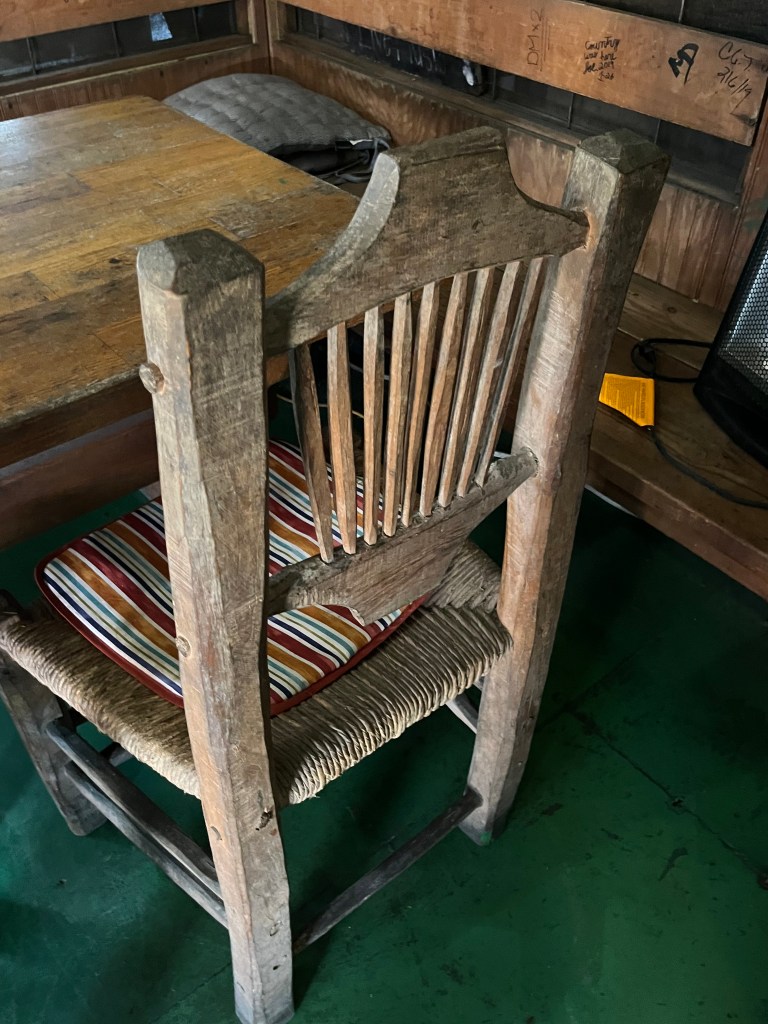
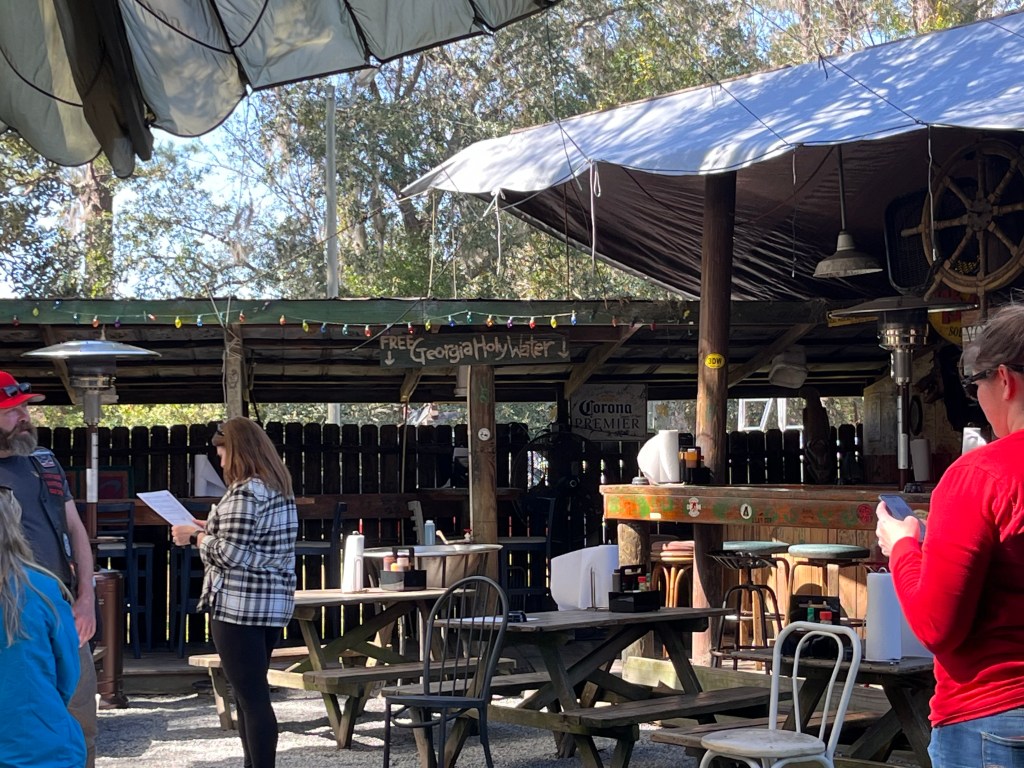
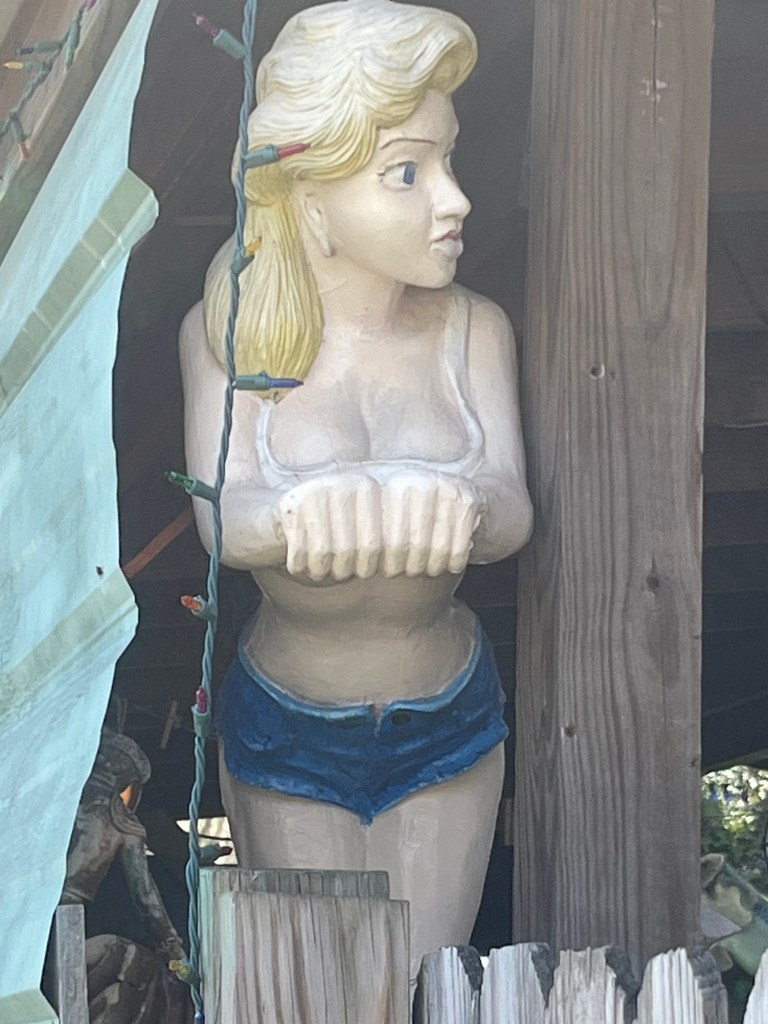
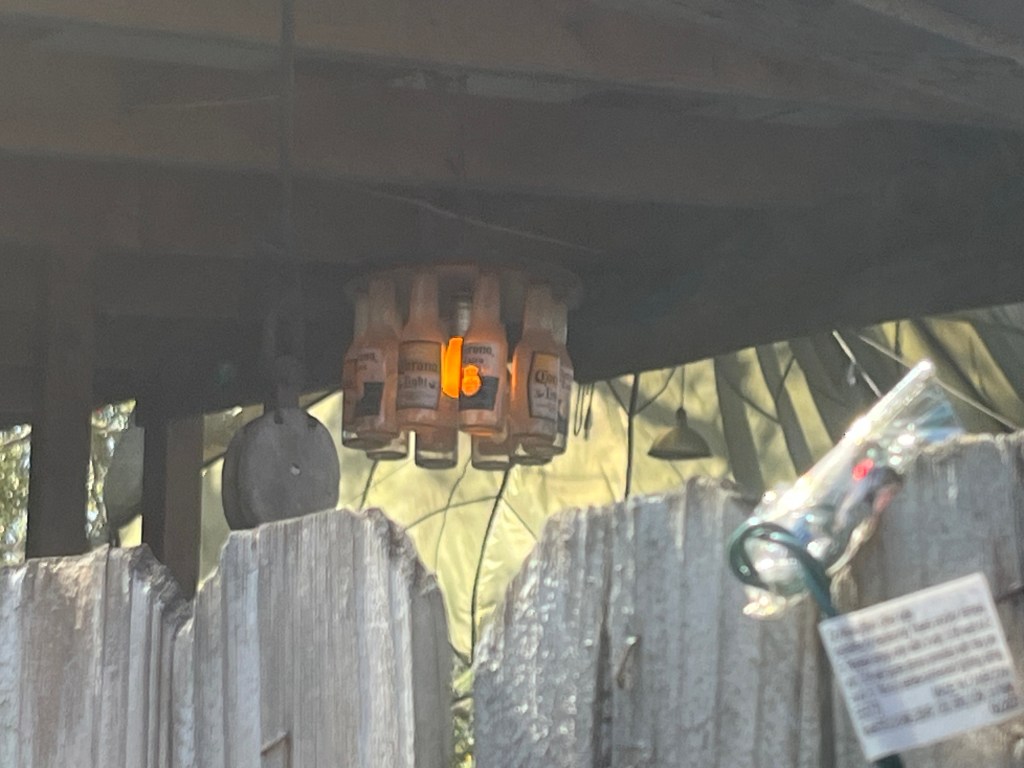
Neither of us was very hungry, but we ate nonetheless. The place was just too interesting and too cool. The leather-vested, heavily tattooed Warthogs were super nice and fun; the staff at Stan’s won our hearts: the utterly aloof waitperson had a world-class sleeve of tattoos and the counter lady had a heart-winning smile; the ribs were very decent; the lima beans were some of the best we have had anywhere; and the cole slaw was just fine. The decor was amazing! A fantastic roadside interlude!!!
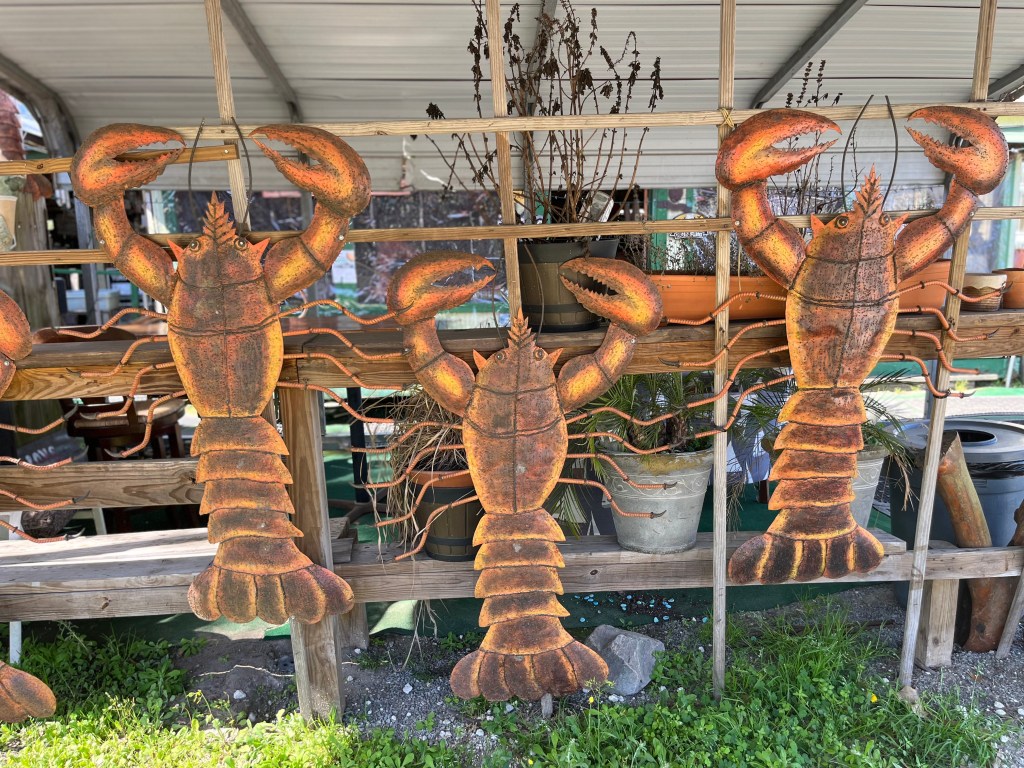
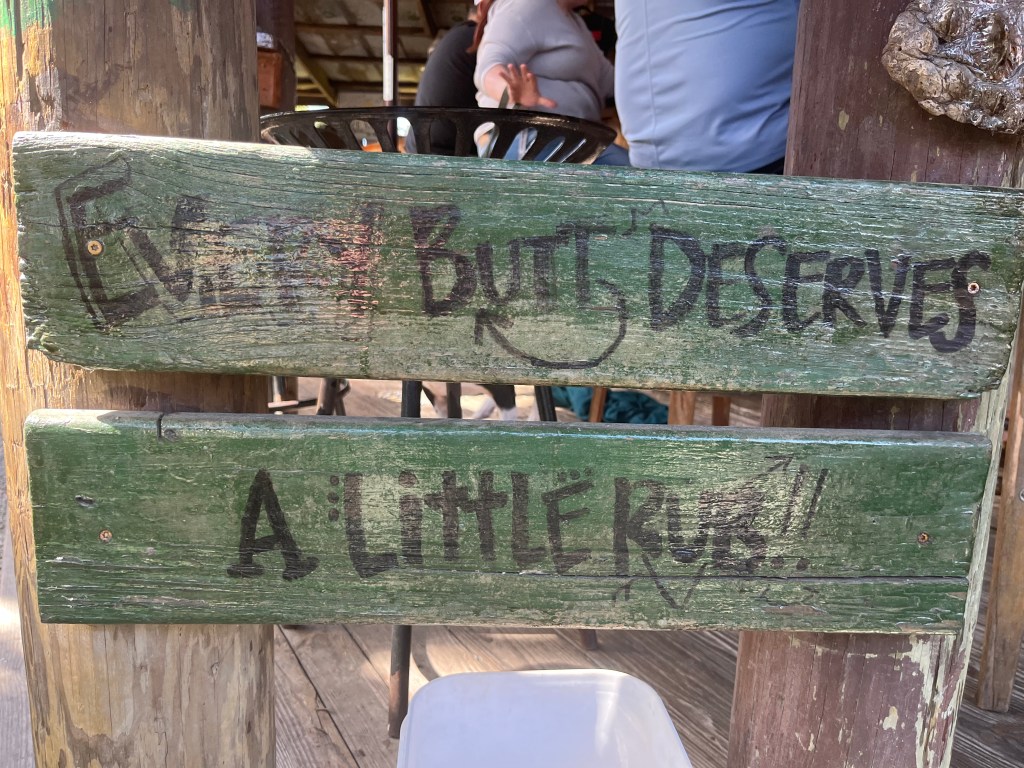
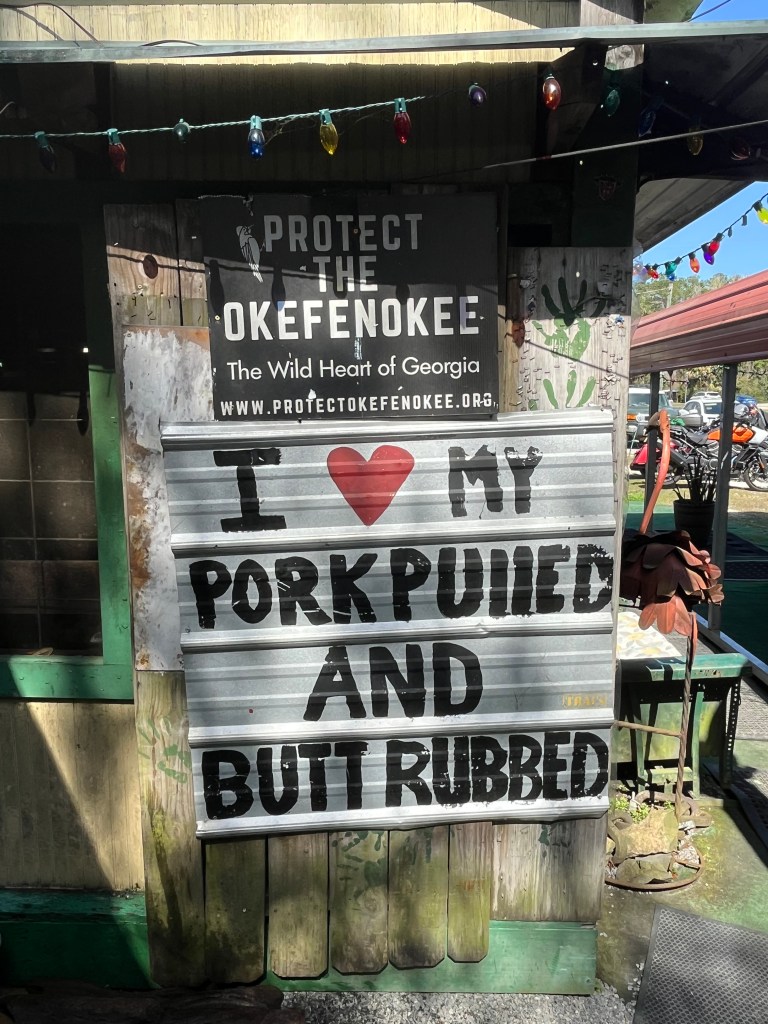
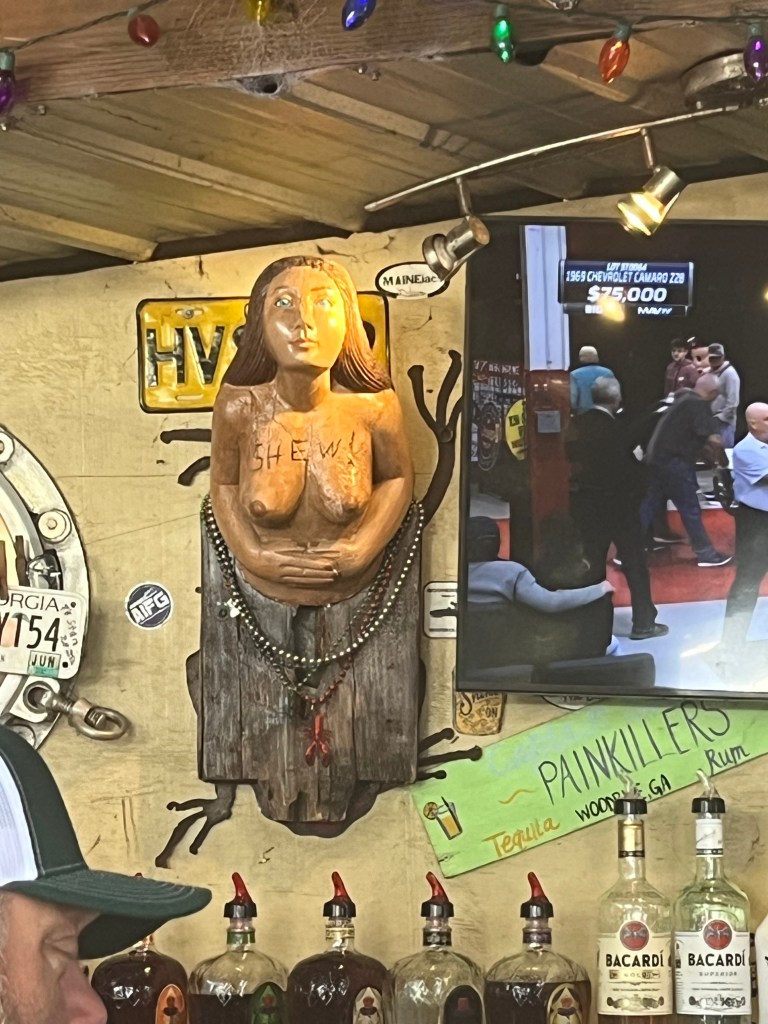
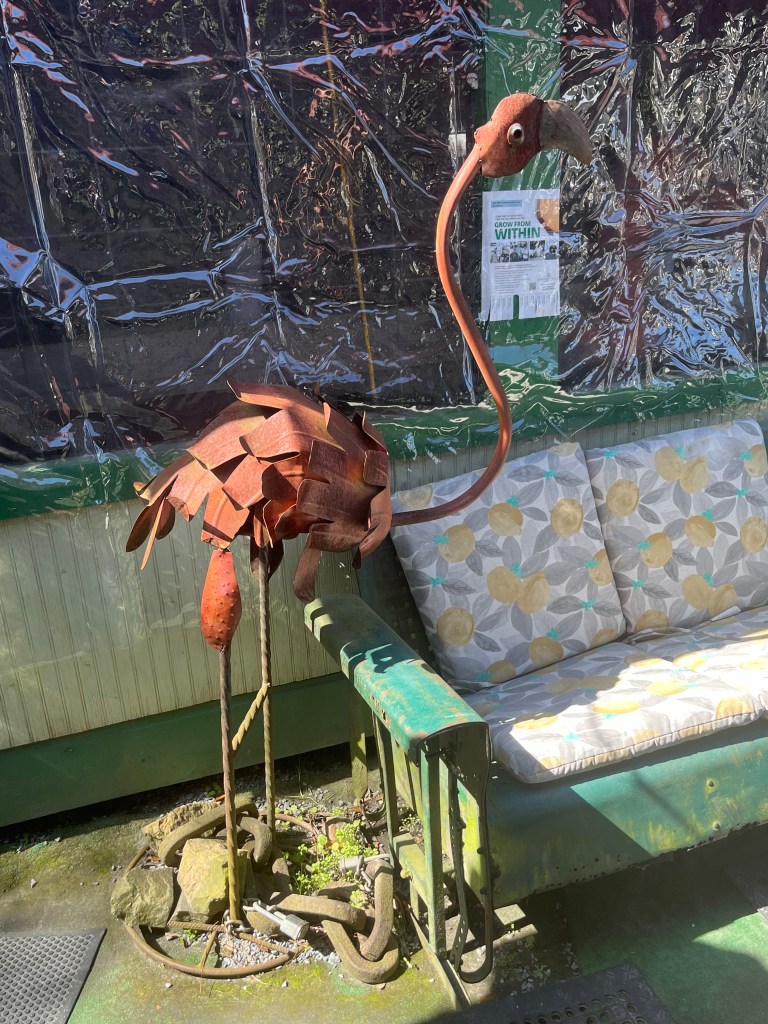
Monumentally wonderful and totally real folk art at Stan’s.
We split our BBQ’ed rib plate and left Stan’s bound for Fernandina Beach, the northernmost point of Highway A1A that would carry us south through Florida. But we barely drove a mile until we reach a fork in the road. Highway 17 went right. “DooDad’s” Seafood was on the left. I turned around. It just looked too wonderful! I was right!
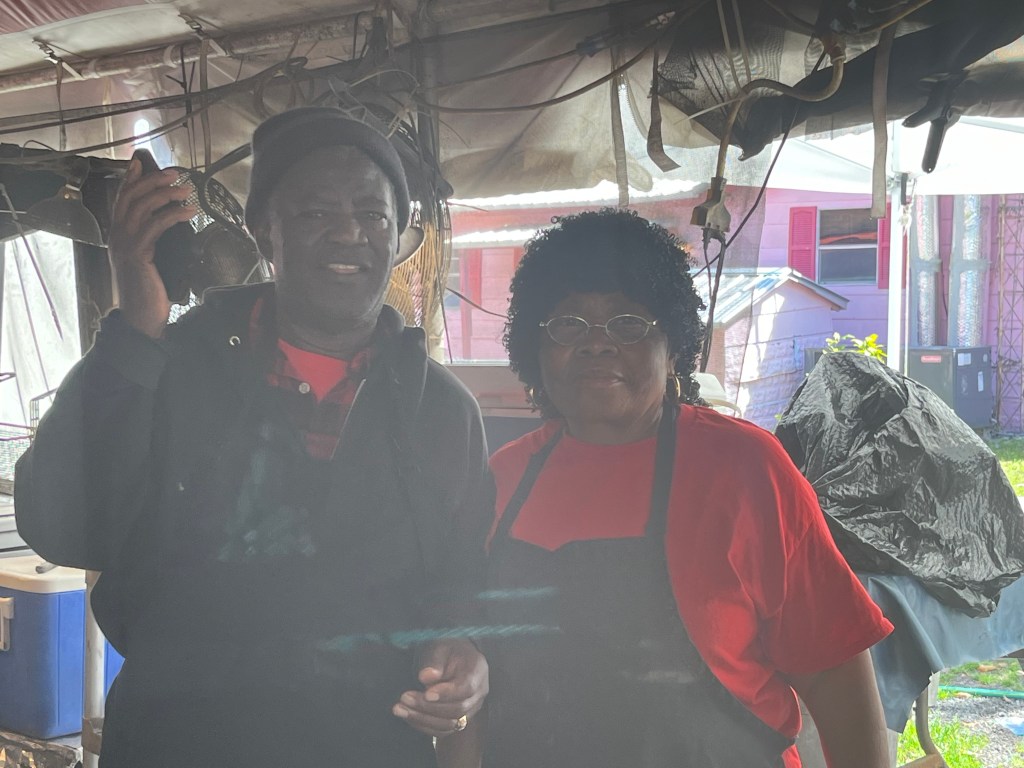
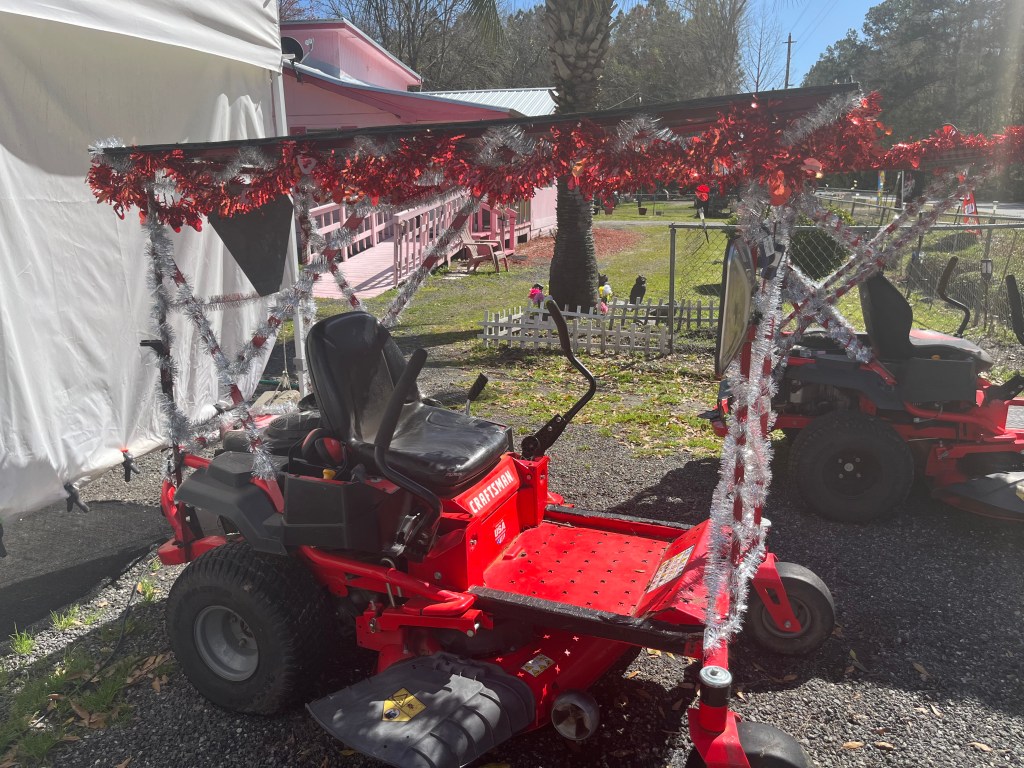
Larry Geter and his wife Lois have been married for 54 years. He takes the orders; she runs the fryer. He is in-your-face sociable; she is droll and hilarious. Larry’s claim to fame is that he looks exactly like James Brown the King of Soul. So much so that he was asked to serve as an usher at James Brown’s funeral. I asked Larry and Lois about their lawnmowers, both heavily decorated in red and silver. (They like them that way.)
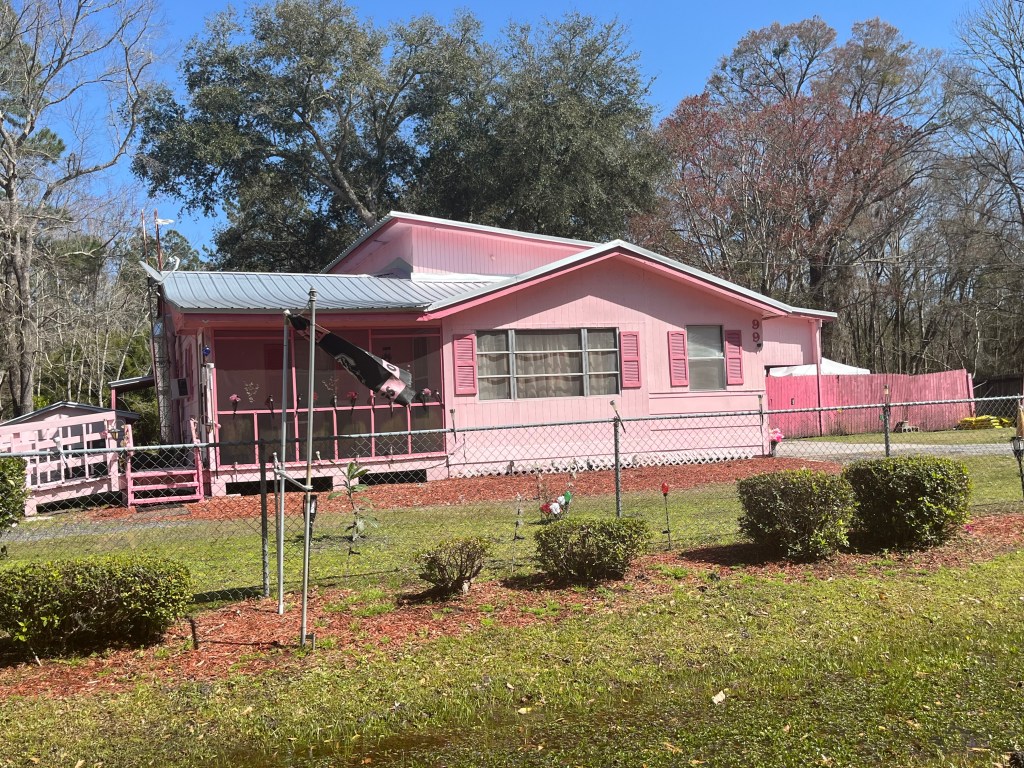
I ate the smallest bit of fried chicken I could order (because I was already stuffed from Stan’s) and we left. As we turned around, we noticed their house. In addition to being one of the best-kept places we saw, it was also bright pink.
We’ve been on the road for just over three weeks and traveled about 1,500 miles. We’ve seen old friends, started learning about the Gullah-Geechee culture of the southern coast, gathered sea shells and shark teeth, eaten a lot of fresh seafood, and laughed a lot! No real MyInnerSociologist moments have appeared lately, but that hasn’t mattered. These Odds and Ends will, I hope, help you experience some of the fun we are having, even if vicariously.
General Hilarity
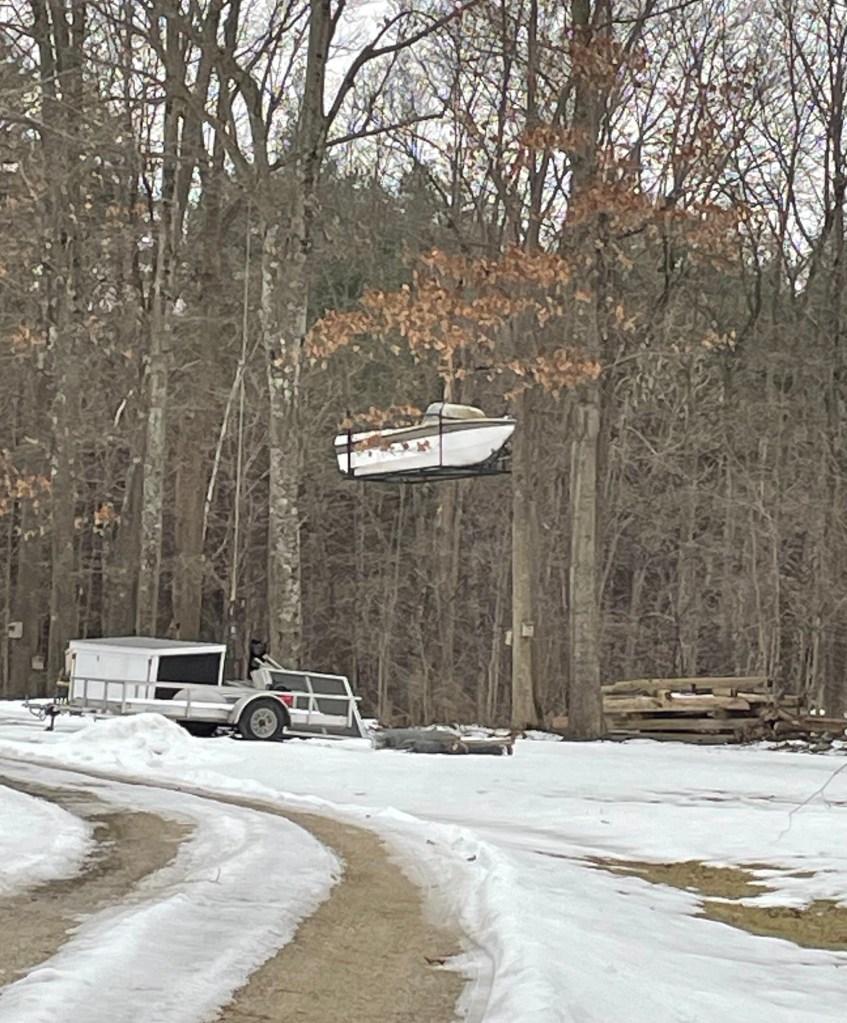
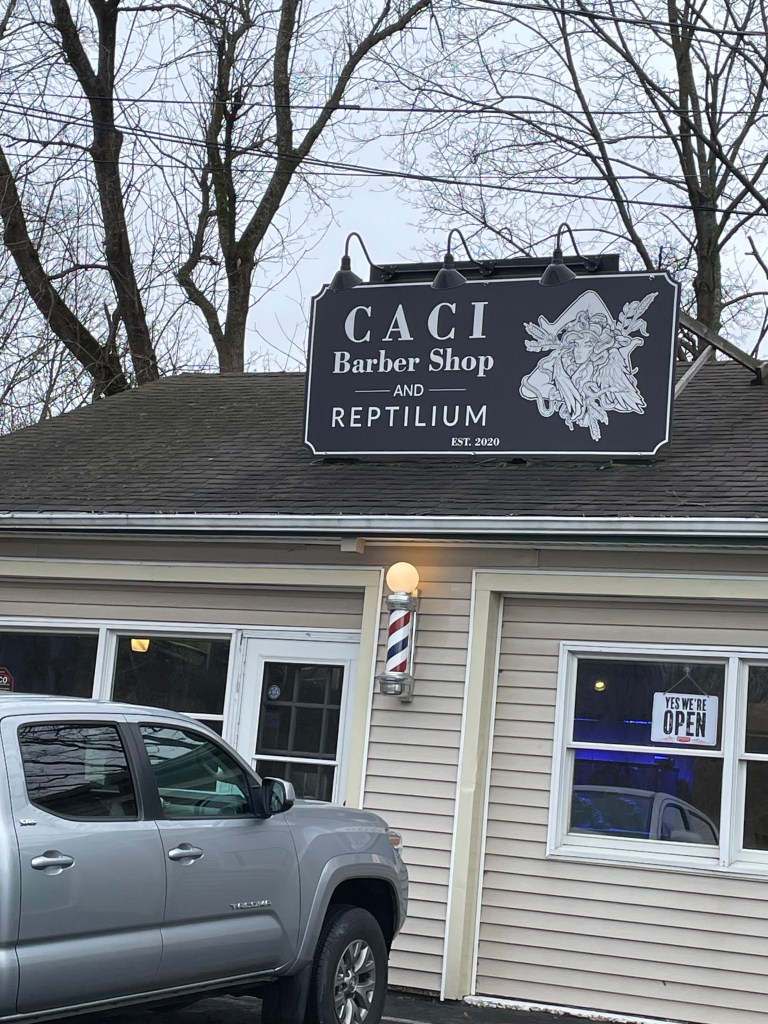
We were not on the road for 24 hours before we came across a boat in a tree and a combination barber shop and reptilium. So far, they are the only ones we’ve seen. We hope we find more.You just can’t come across enough barber shop/reptilium two-fers.
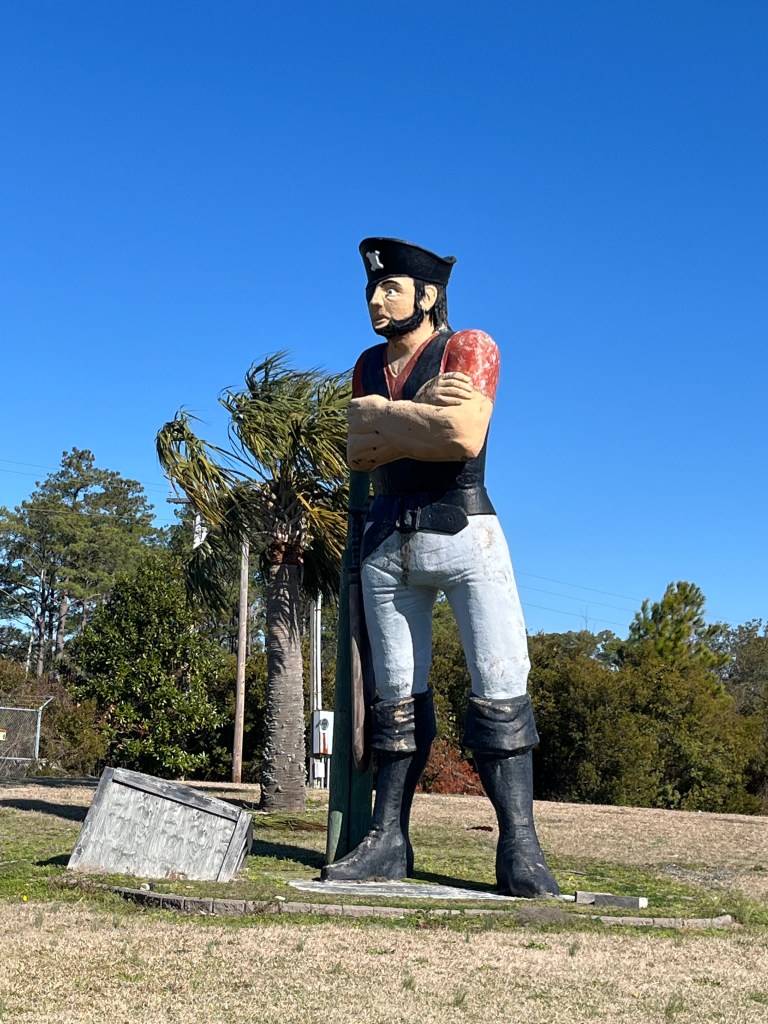
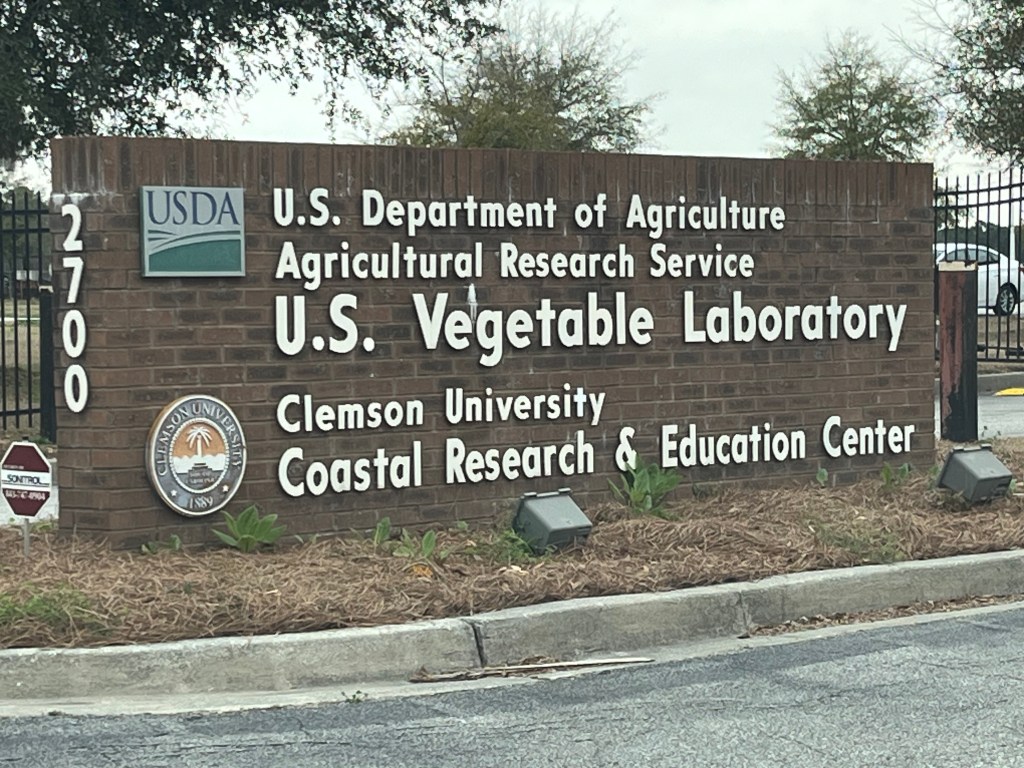
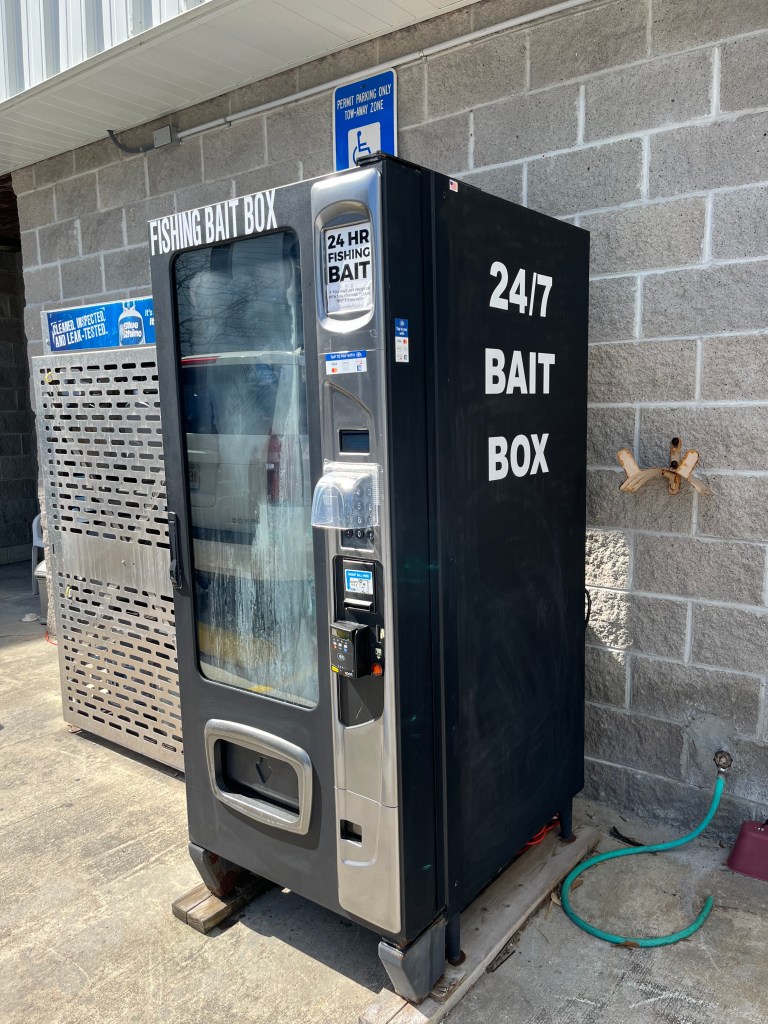
Dumb Roadside Attractions
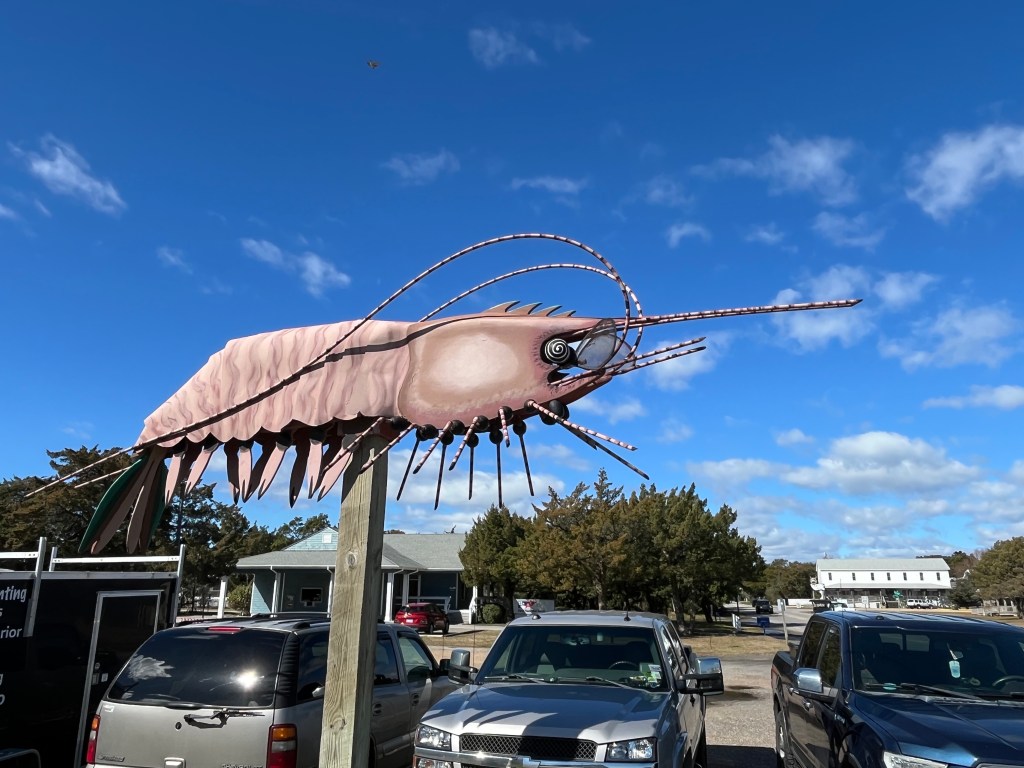
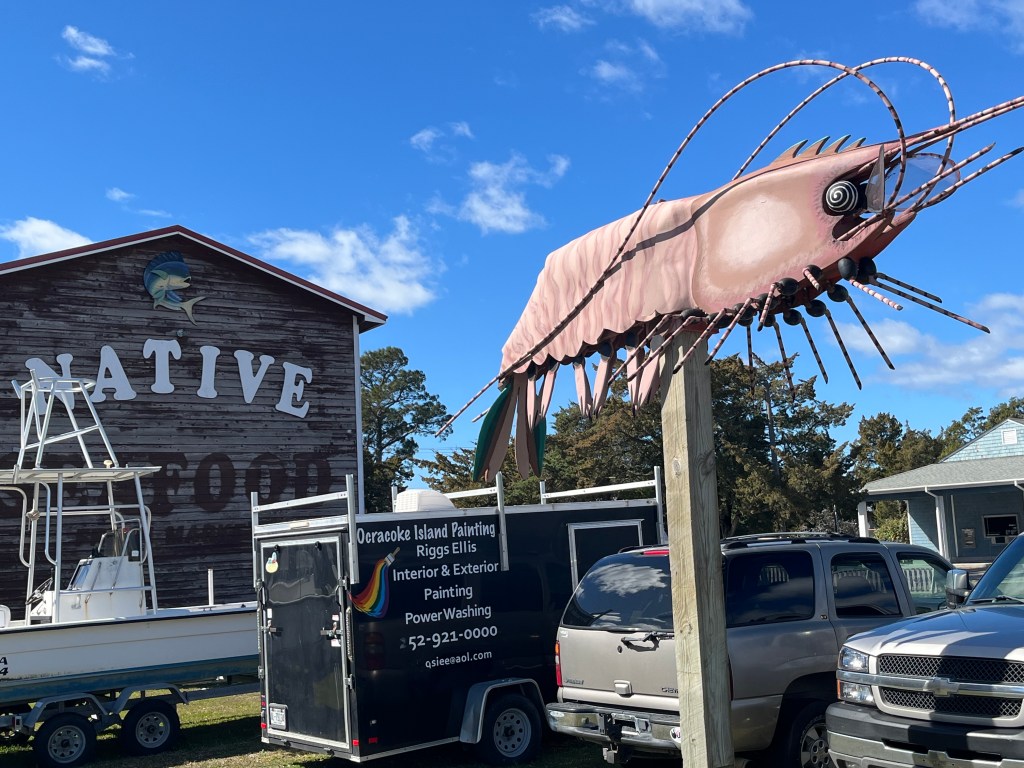
Giant shrimp in OcracokeGiant Blackbeard south of the Outer Banks. (Extremely well hung, I might add,)
Maybe there’s nothing really funny about the U.S. Vegetable Laboratory or a fish bait vending machine. I just hadn’t expected them.
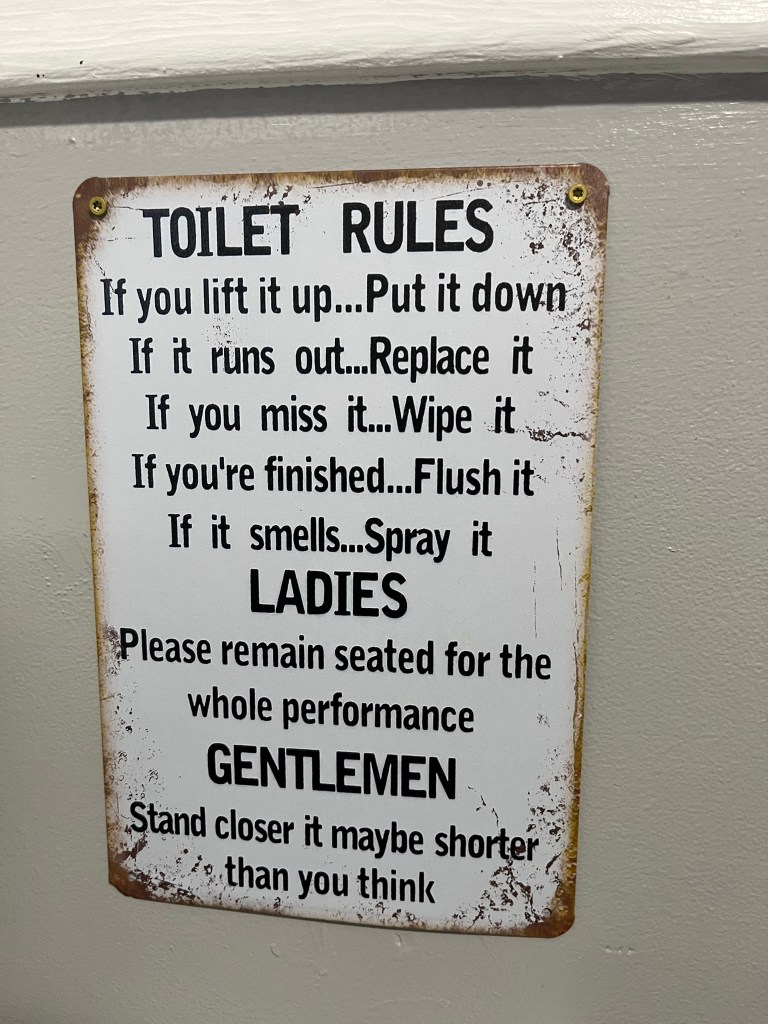
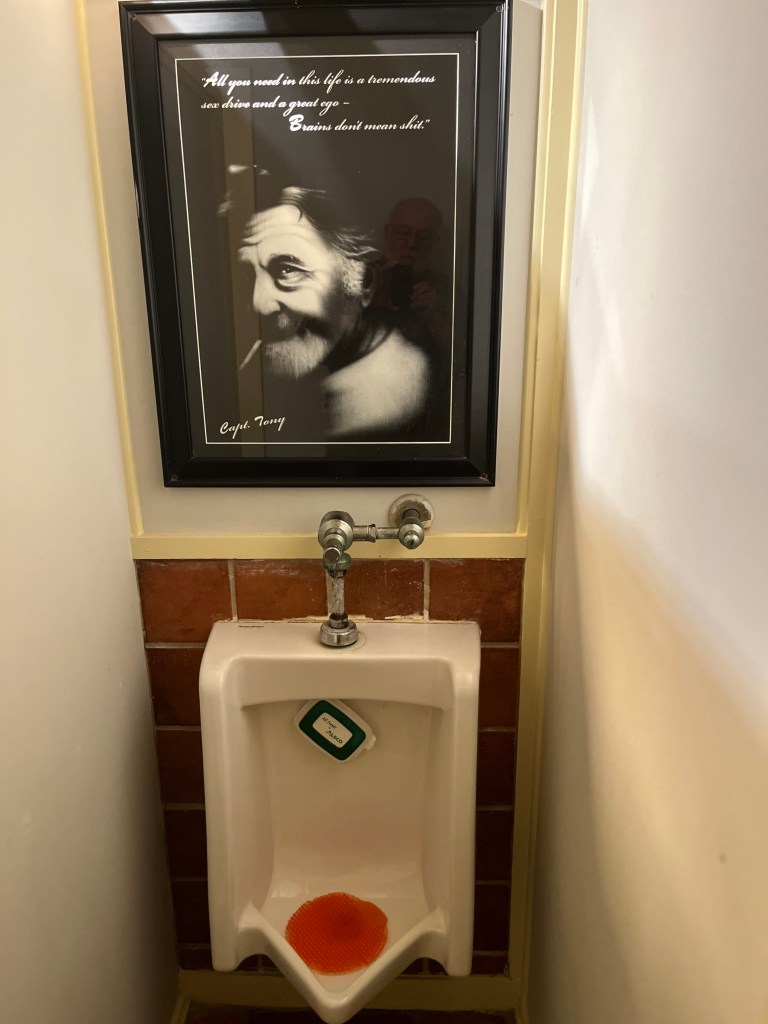
True Bathroom Humor
Maybe Men’s room/toilet stuff isn’t very funny to some people. It is to me. In case you can’t read it, the poster reads, “All you need in this life is a tremendous sex drive and a great ego. Brains don’t mean shit.” If we are really lucky, this will not be the last toilet humor I subject you to.
Trump Moments
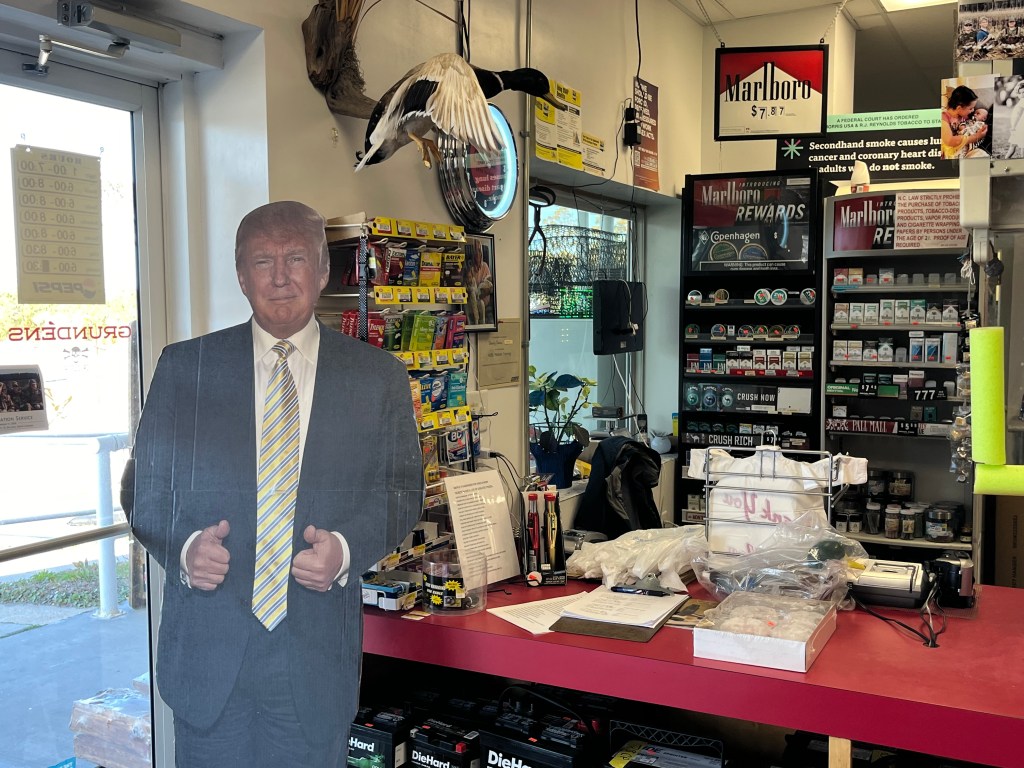
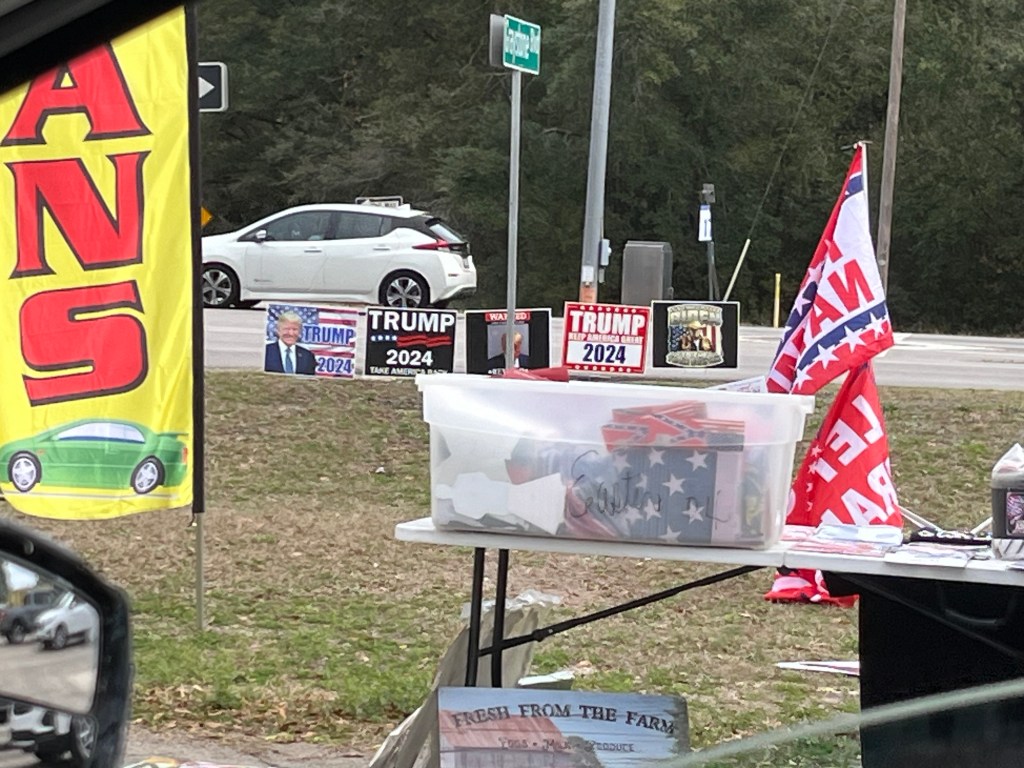
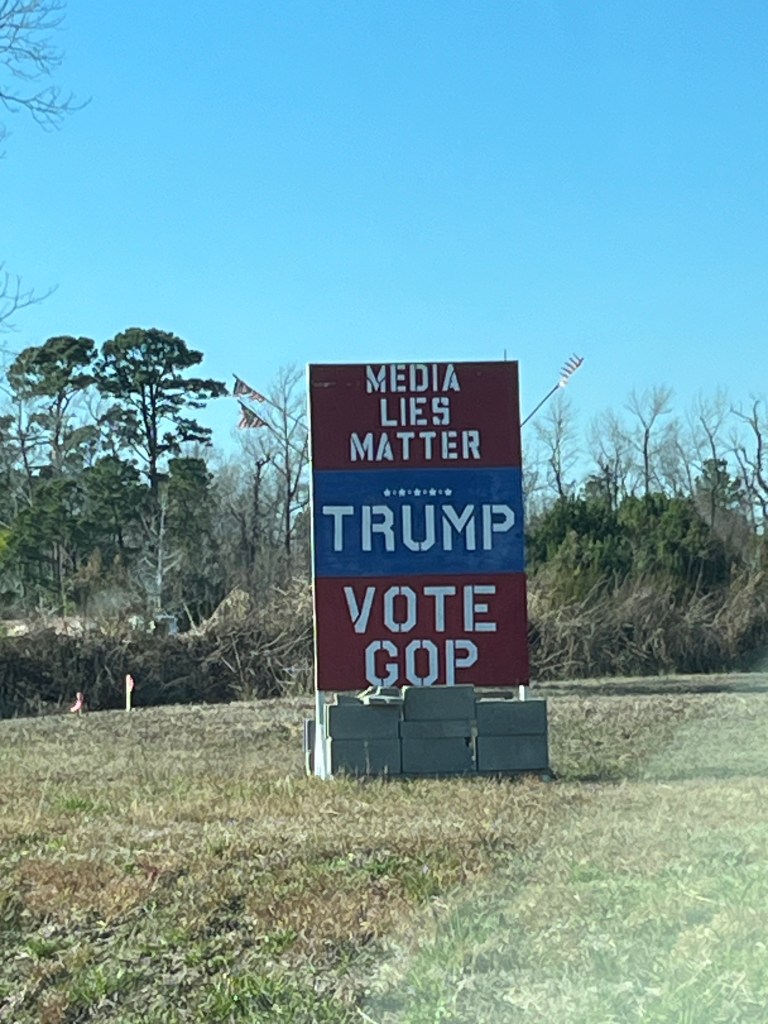
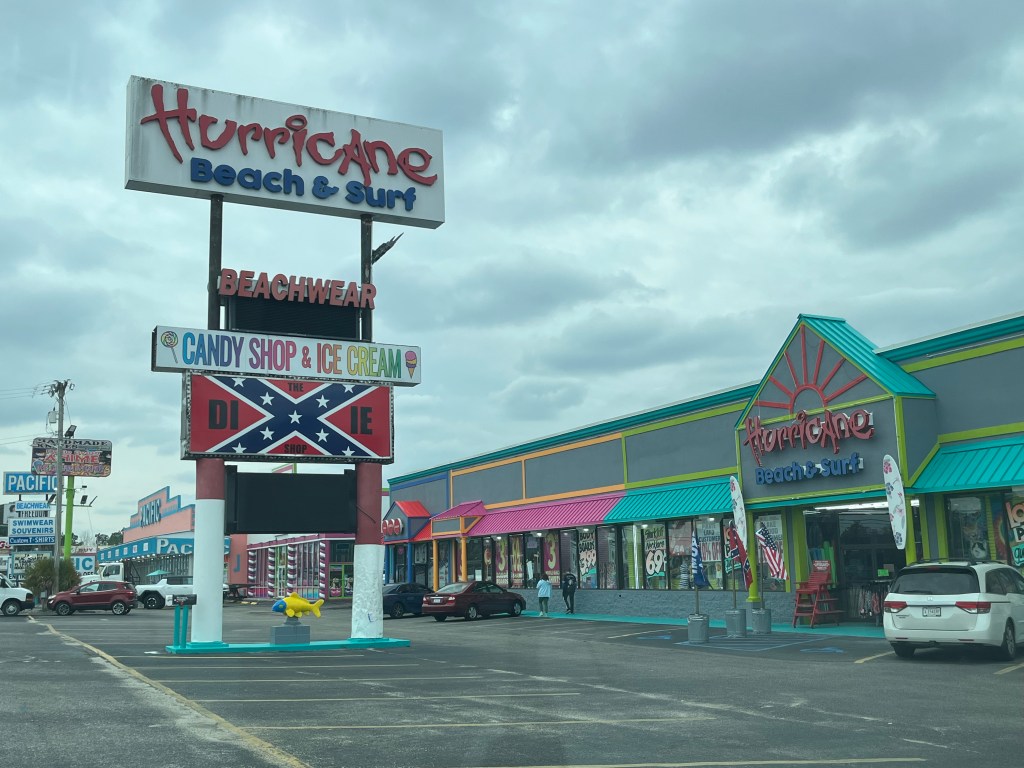
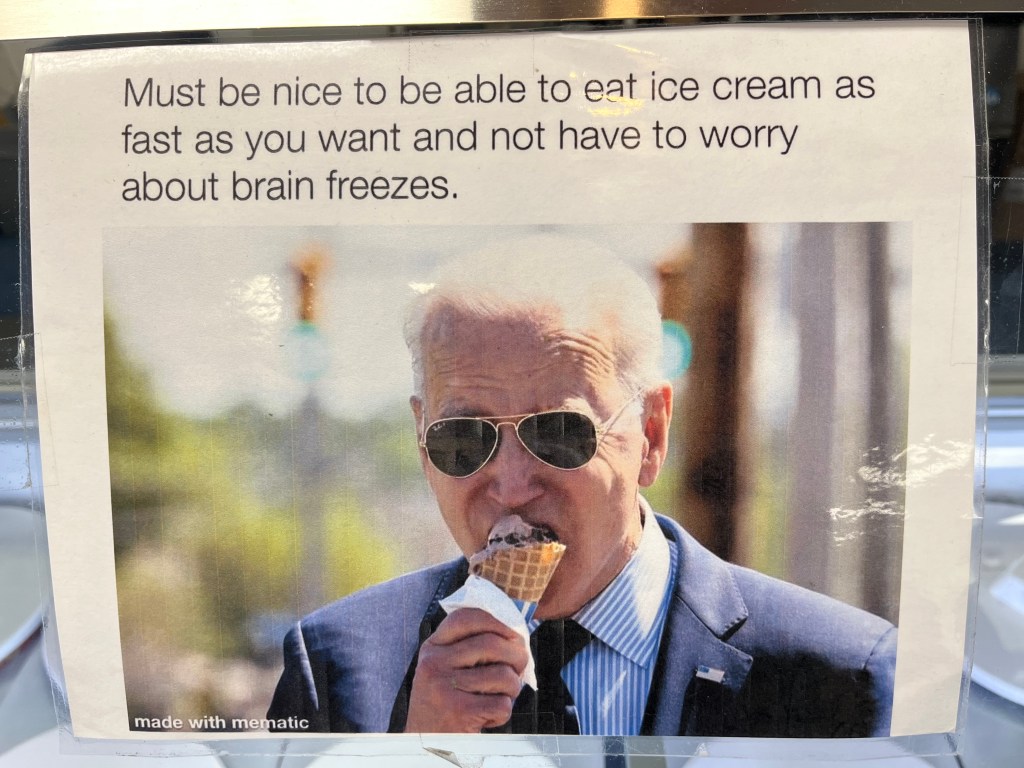
Unlike 4 years ago, we have (blessedly) not been inundated by visual pollution from endless Trumpsters. Even in South Carolina, where the primary ended on Saturday, 2/24, the roads were remarkably free of political drivel. But that is not to say that we didn’t experience some. The most memorable was the hand-painted sign in southeastern North Carolina that read, “Biden was not elected. He was installed. Like a toilet.” Damn, that’s clever! I didn’t get a picture of it. But I did snap a few others….
Cedar Island NC, (FYI, It is cardboard. Not really Trump.)At the SC State Line, a week before the primary.Because Fox & OAN & Newsmax are paragons of honest coverageNot really Trump, but…This one took me a while. Since Biden is already feeble-minded, brain freeze can’t make a difference. Get it?
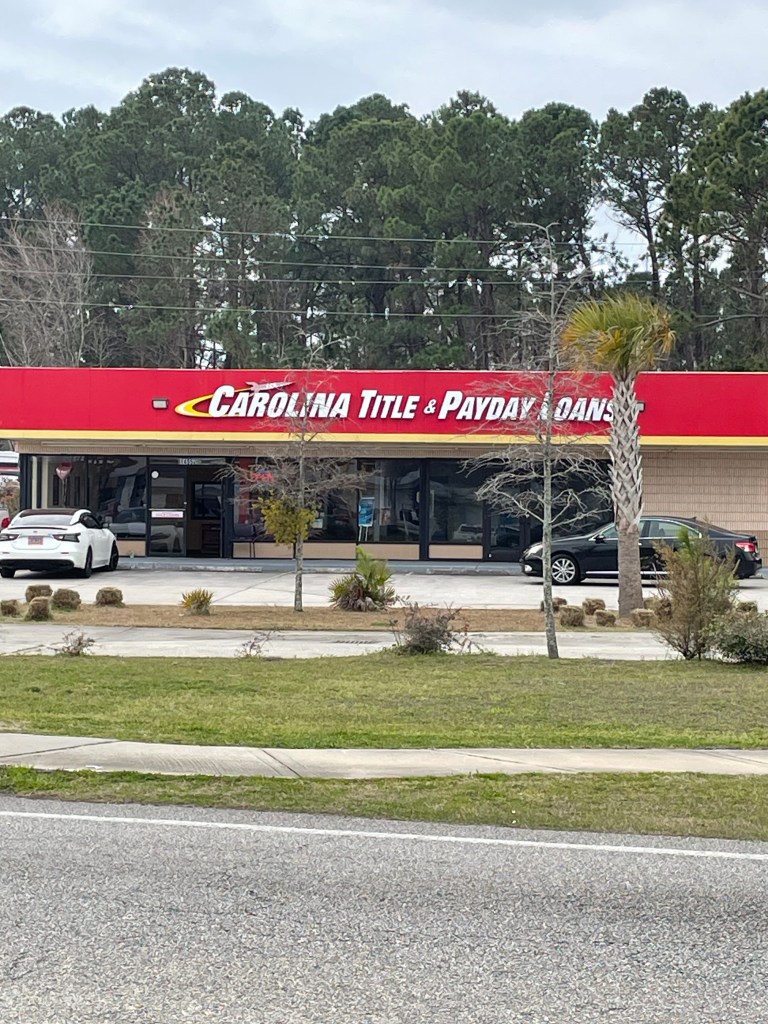
One of the most alarming and persistent sights throughout America is the ubiquitous presence of short-term loan purveyors. It hurts to think about the number of hard working, honest people who do not have the capacity to earn enough to go from paycheck to paycheck. I often wonder how the owners of these establishments can live with themselves while exploiting others so shamelessly, and I feel truly badly for the people who must work there, knowingly ripping off their neighbors so they can support their own families. Surely we must be able to do better.
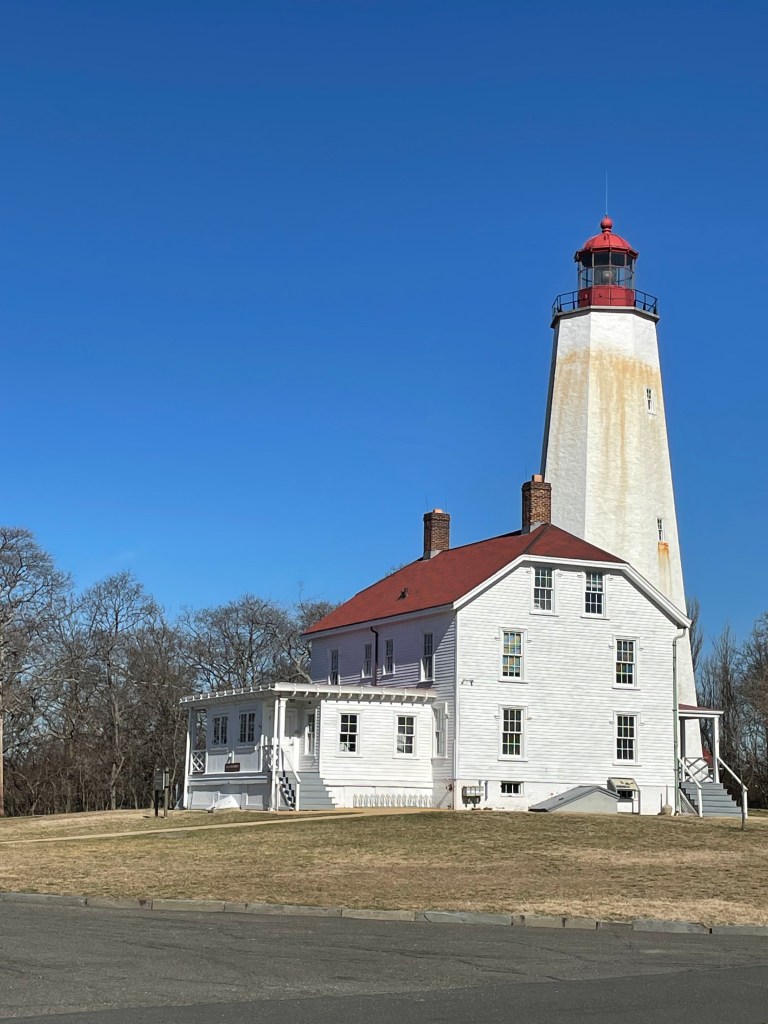
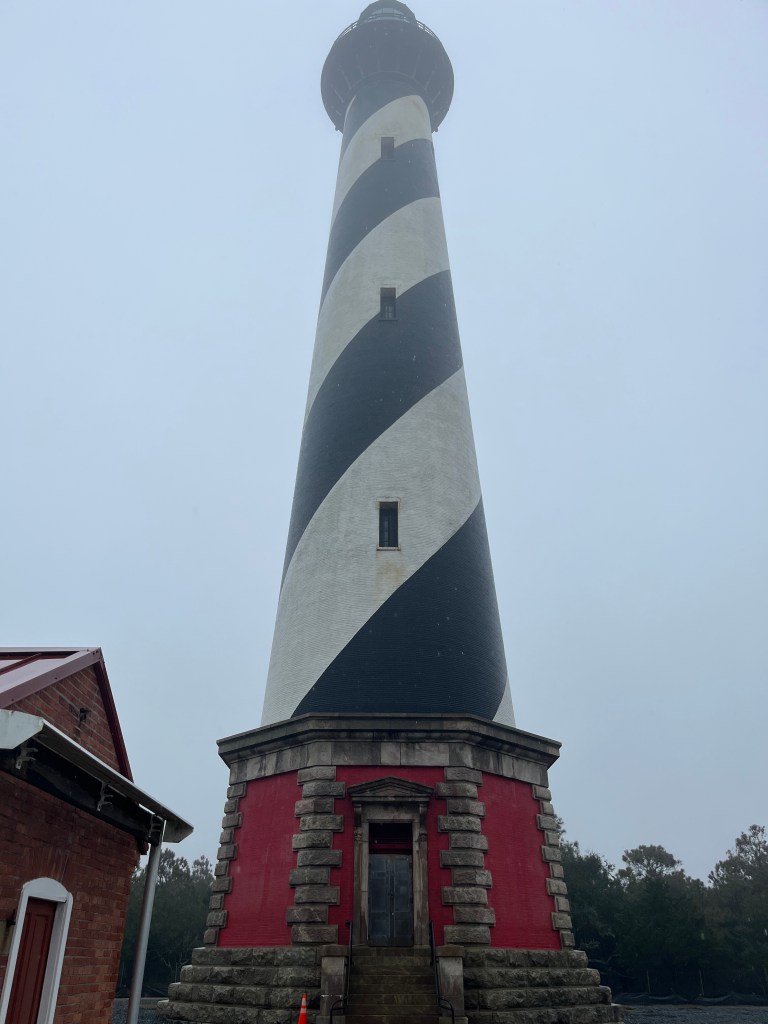
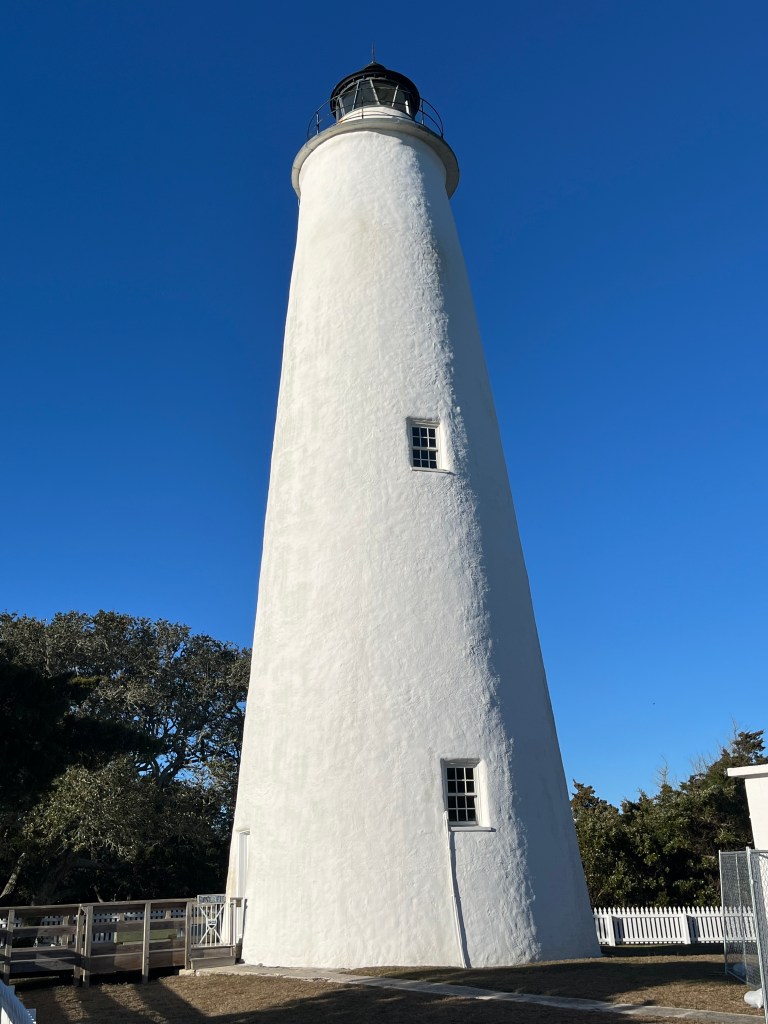
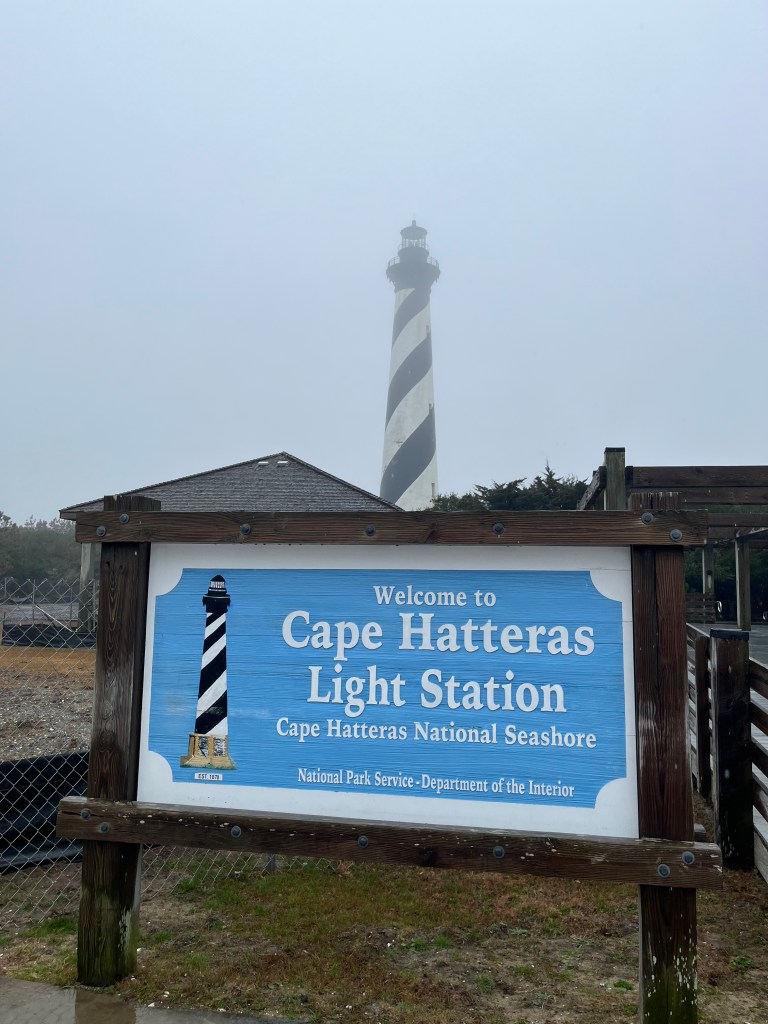
Lighthouses Every lighthouse has unique markings and shapes. They are a reminder of where we are and where we have been. Many of them continue to operate. None have operators. I assume none of them are necessary thanks to GPS technology. Nevertheless, they are really cool.
Sandy Hook NYNags Head NCOcracoke NCSt. Simons Island, GA
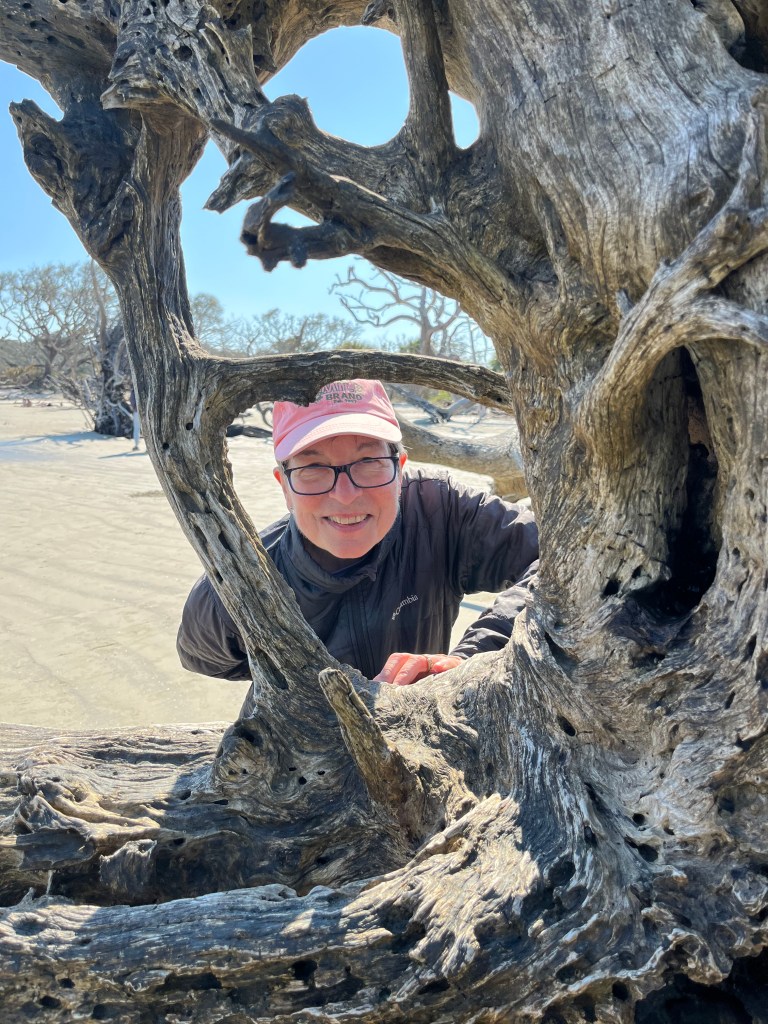
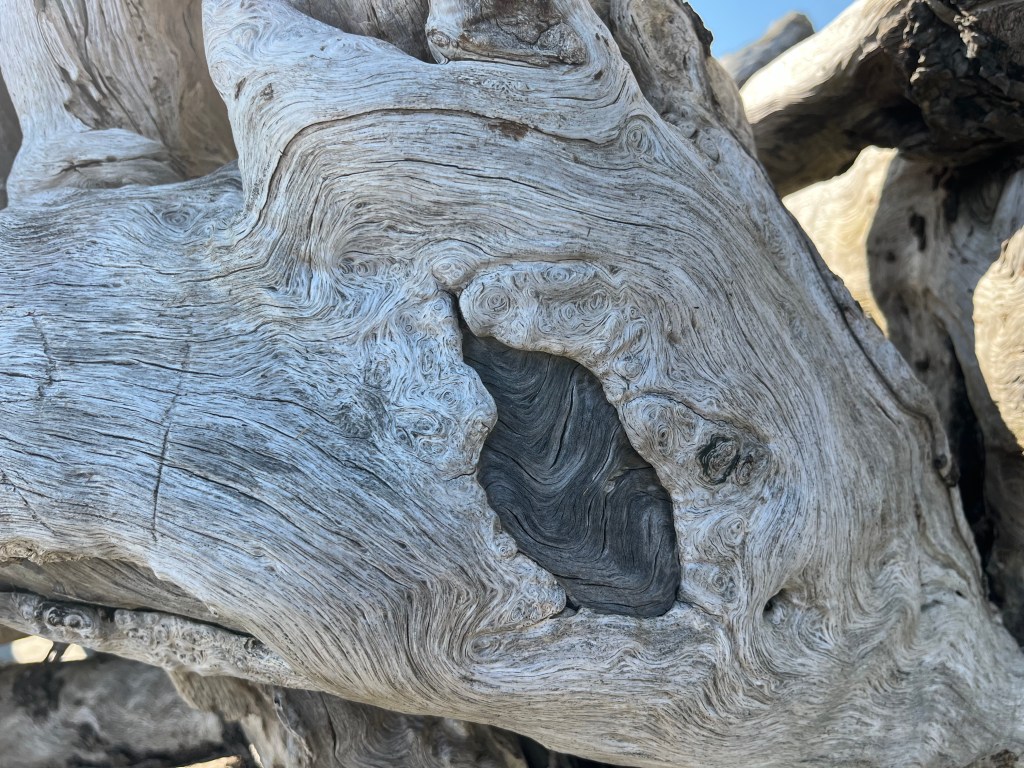
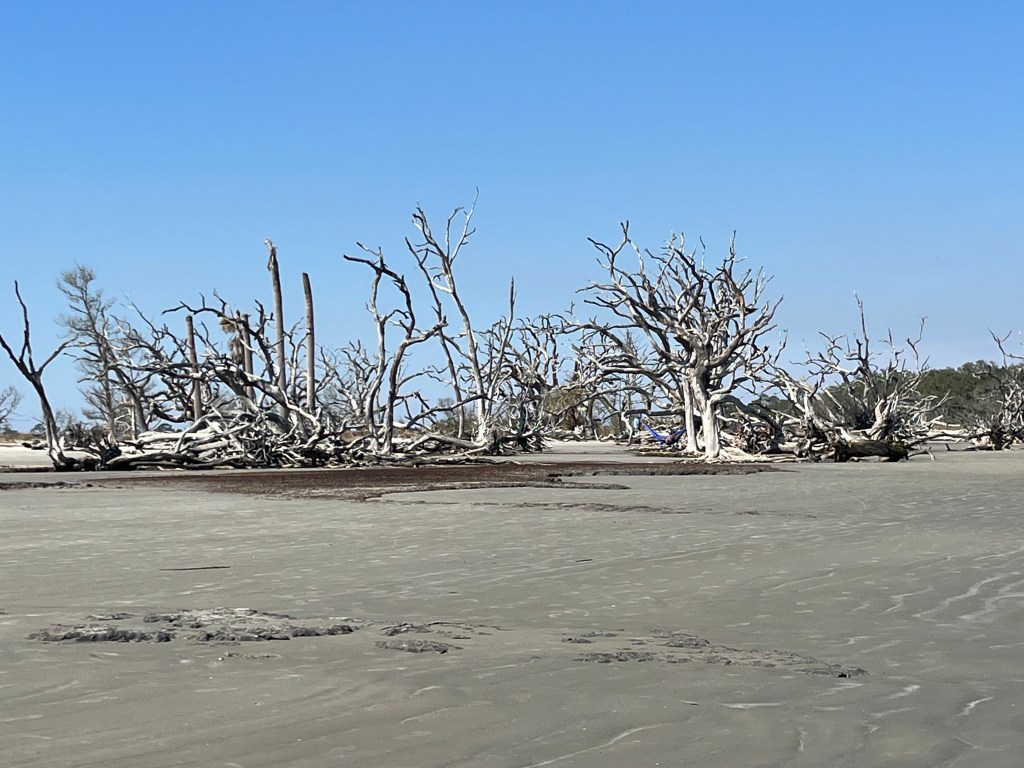
Driftwood Beach, Jekyll Island GA
When I was a kid, my family and another family of best friends vacationed on Jekyll Island. We have a wonderful story of filling the bathtub with fresh-caught crabs, only to have them escape the tub and freely populate our tiny cottage. Imagine freaked out parents trying to manage a bunch of pre-teen boys trying to catch rampaging crabs. We’ll be staying with Bill in Atlanta in a few weeks. I’ll bet our respective memories of the great crab escape aren’t terribly different.
I remember Jekyll as a comfy middle-class beach vacation spot surrounded by some very high-brow homes. It has changed to become far more commercial and less middle-class. Driftwood Beach says something meaningful about changes in a beach community. It had been a grove of live oak trees (the same live oaks in the hull of Old Ironsides, the USS Constitution, docked in Boston Harbor) when storms and erosion shifted the beach. Today, those long dead live oak trees stand as breathtaking remnants of the past.
Traveling the Deep South: Boiled Peanuts
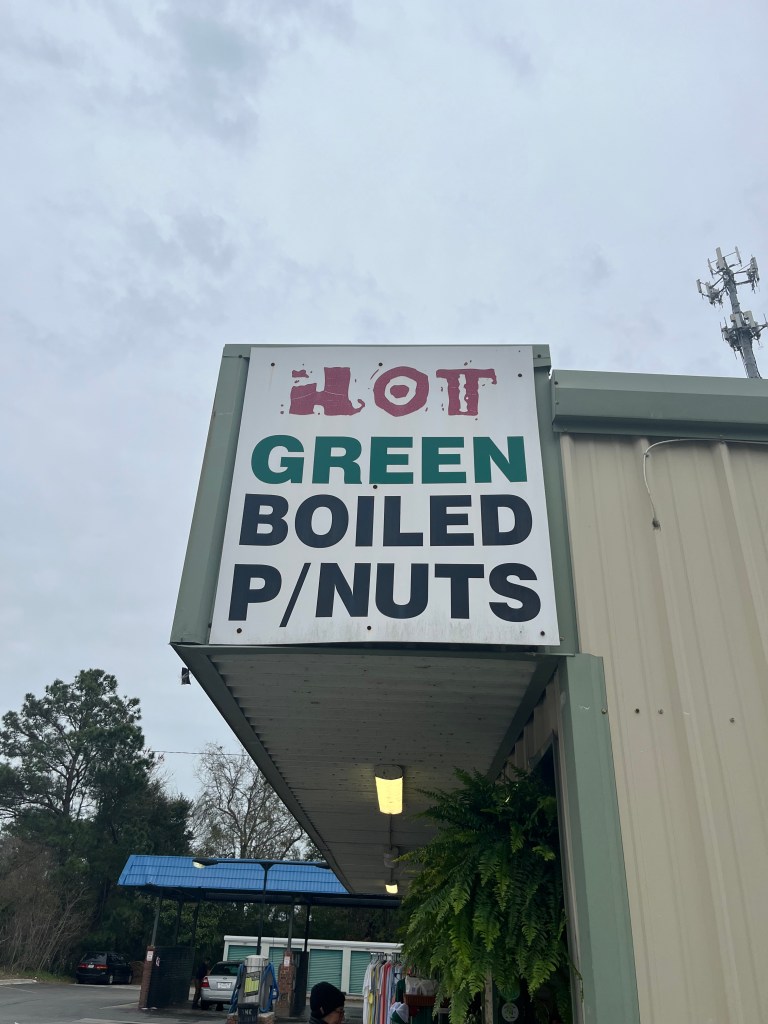
Few things represent the true deep south to me more than boiled peanut (pronounced “bawled peanuts” … unless you are from other southern locales, where they are pronounced “biled peanuts.” No place are they pronounced boiled peanuts until you get north of the Mason-Dixon line!
Bawled peanuts and cooker at Davis Produce near Tybee Island GA
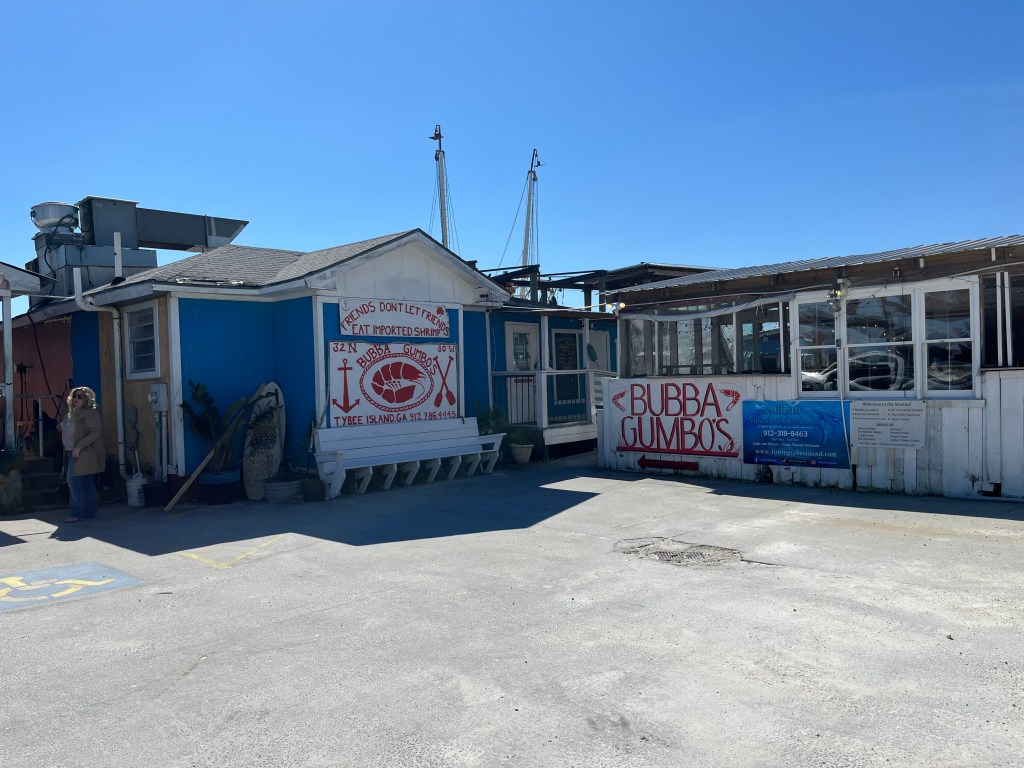
Finding a place to eat on Tybee Island
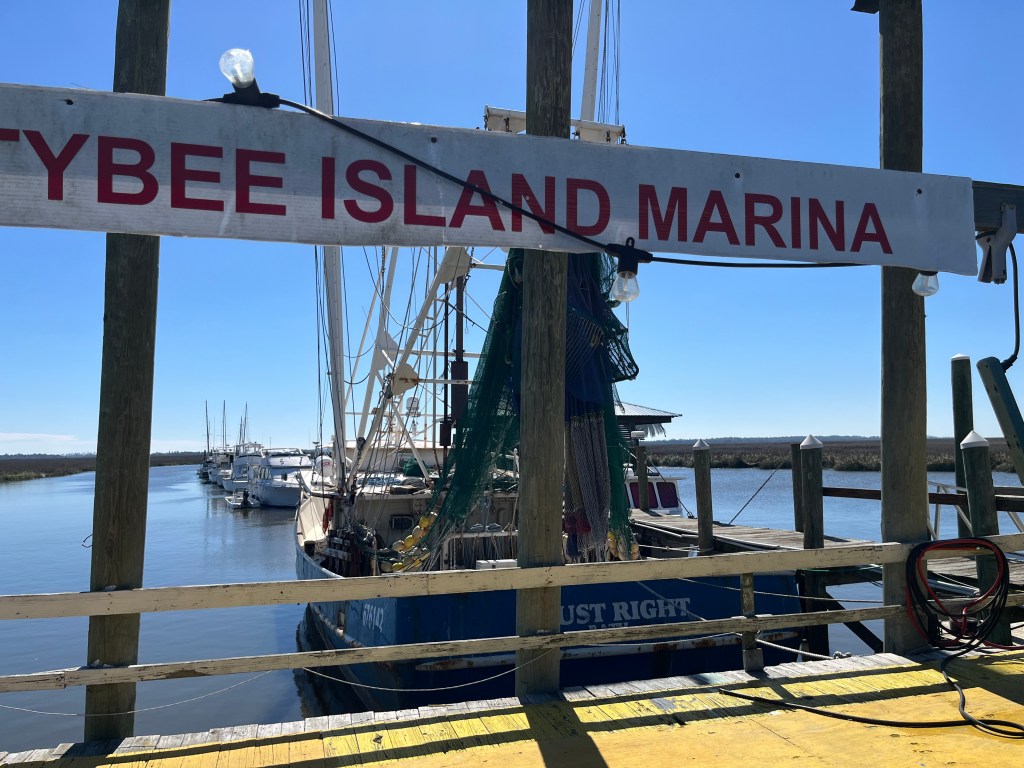
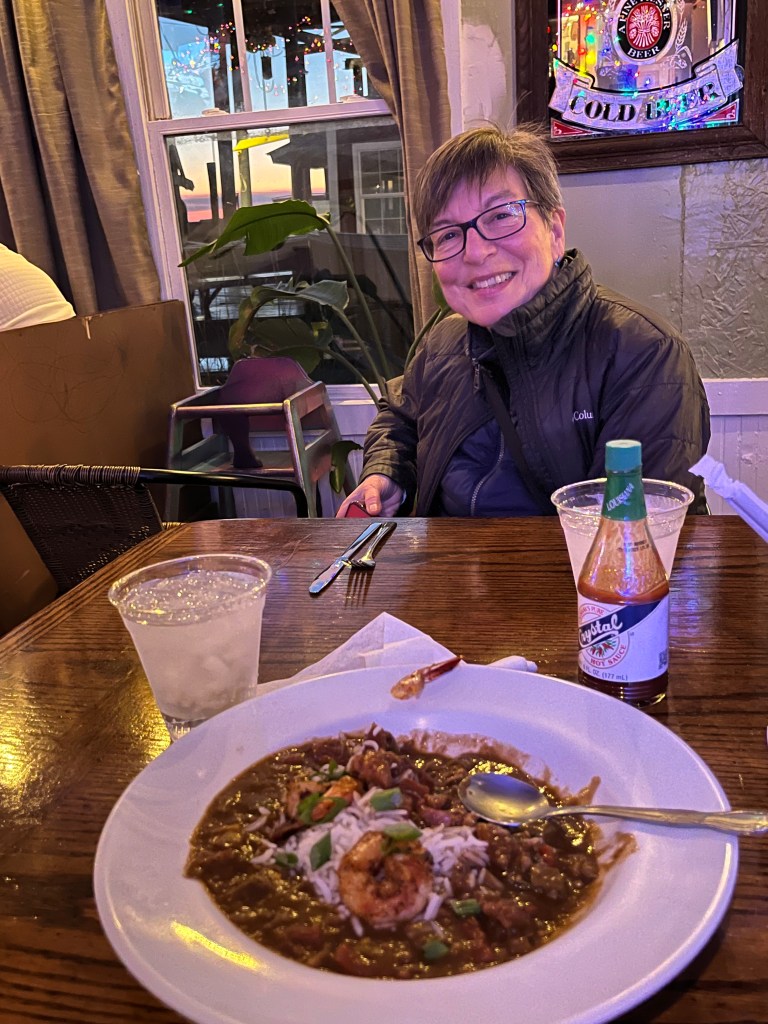
Tybee Island, off the coast of Savanna, is not very crowded in mid-February. In fact, it is pretty empty. Bubba Gumbos at the Tybee Island Marina provided all we needed, and we ate pretty well (though my jambalaya is better).
Charleston SC: In search of a hurricane
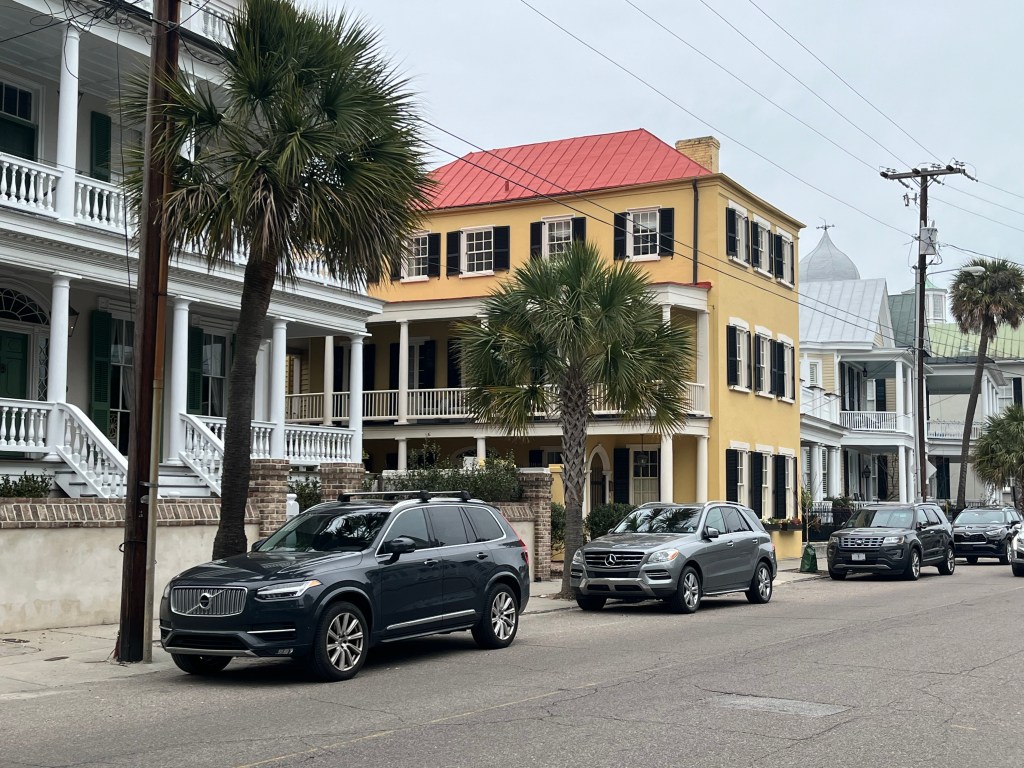
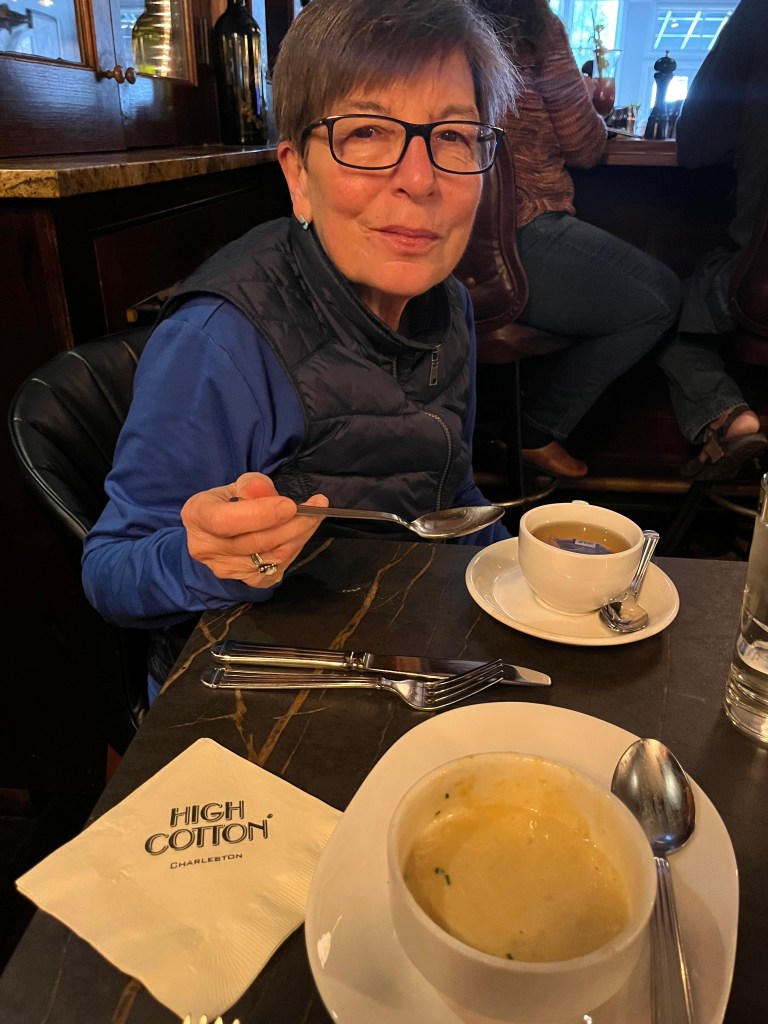
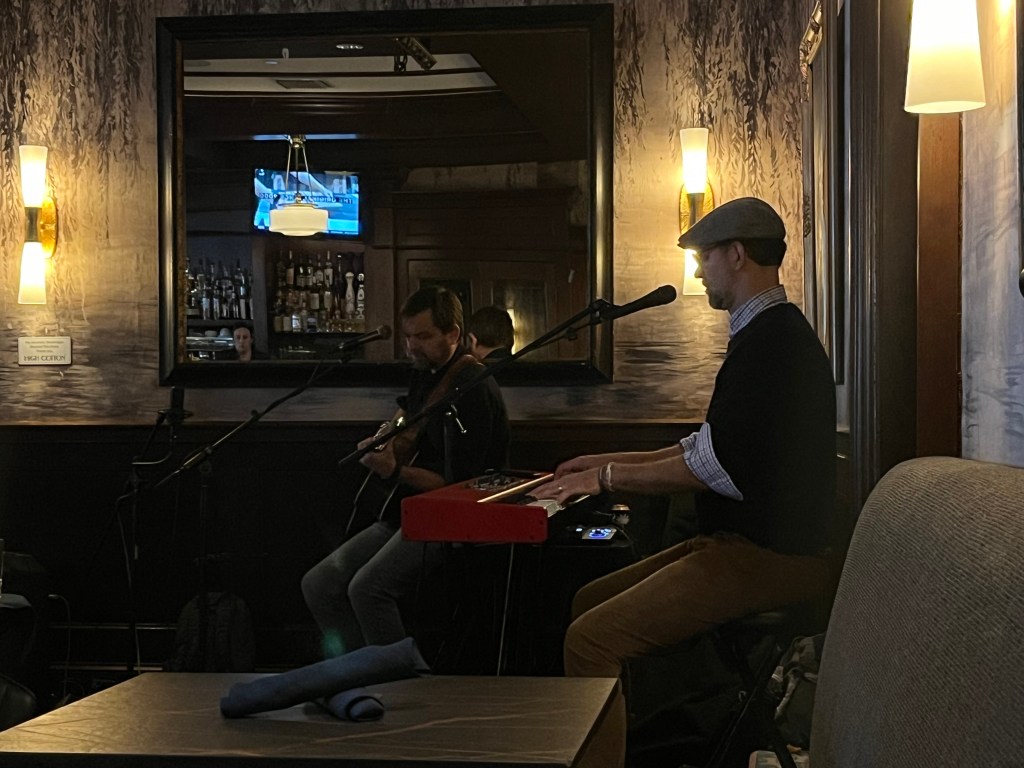
In the early 1970s, my brother Joe and I lived together in “Upper” South Carolina, the mountainous part of the state that abuts Georgia … where Deliverance was filmed. One weekend, we decided to visit his friend “Steinberg” in Charleston. Moments after we left the mountains, the radio started blaring alarming messages of Hurricane Gladys bearing down directly on Charleston. It was going to be a direct hit only a few hours after our arrival. Being a couple of dumb-ass boys having fun, we said WTF, let’s go anyway. We arrived at Steinberg’s, filled the bathtub with water to be safe, bought a mountain of fresh seafood and beer, and settled in to a balconied Charleston apartment waiting for the storm to hit. At the exact moment the winds were to arrive, the clouds opened and the sun broke through. We had plenty of seafood, beer, and water, but never a single sign of a hurricane. I have not been back to Charleston since. The photo is assuredly not the exact location, but a Charleston balcony is a Charleston balcony. It is damn close to where we had planned to weather the storm. Plus, the brunch we had at the High Cotton restaurant was darned good, and the jazz duo playing were fun to listen and to talk to.
We had a swell brunch at the High Cotton in Charleston of She Crab Soup, shrimp and grits, and some really sweet live music.
Diner Art
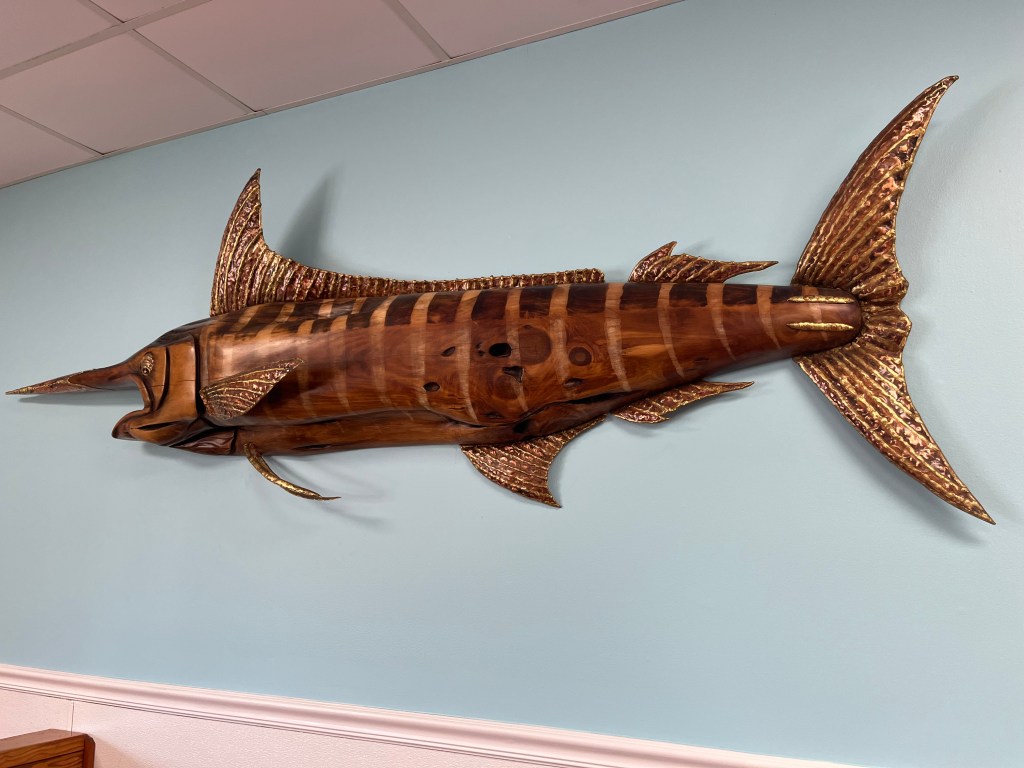
If you are really lucky, you might happen across a local diner that showcases some amazing local art. Kate’s Pancake House in Carolina Beach, NC filled the bill. A local artist gathers driftwood, sands and polishes it, then adorns it with fabricated brass pieces. The result is magnificent. We captured the sailfish (maybe 6′ long), the marlin (about the same size), and the turtle family (the large one must weight 150 pounds). Really beautiful, unusual, well-crafted work.
Eating in the Low Country
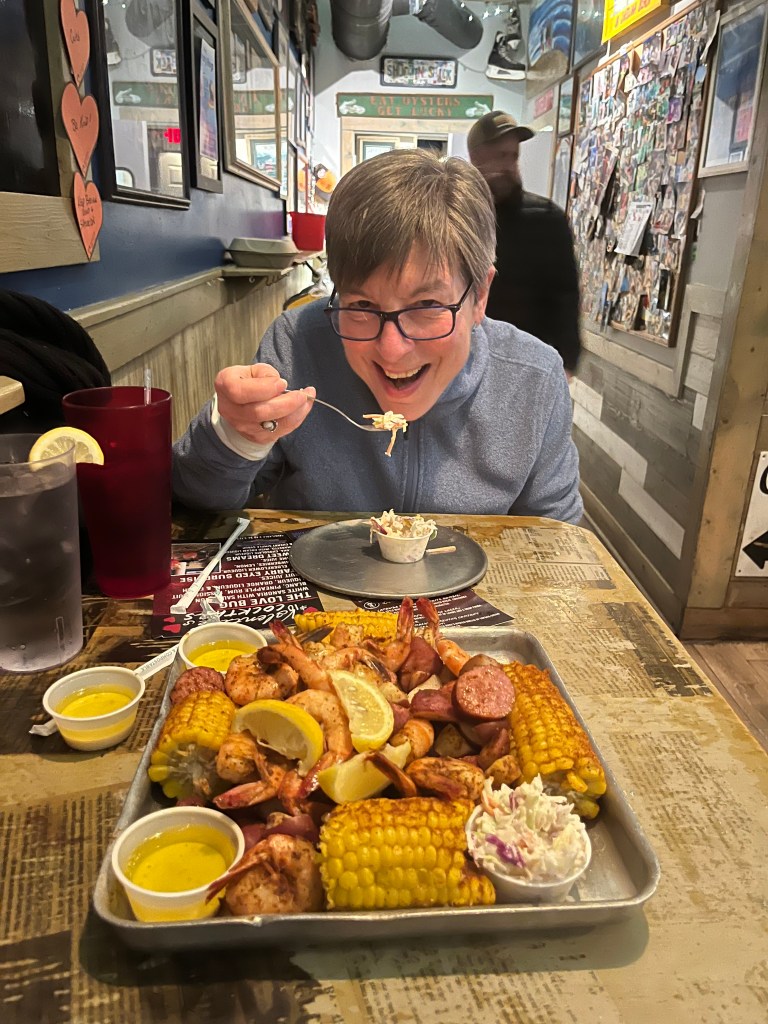
Ain’t nothing better than low country seafood!
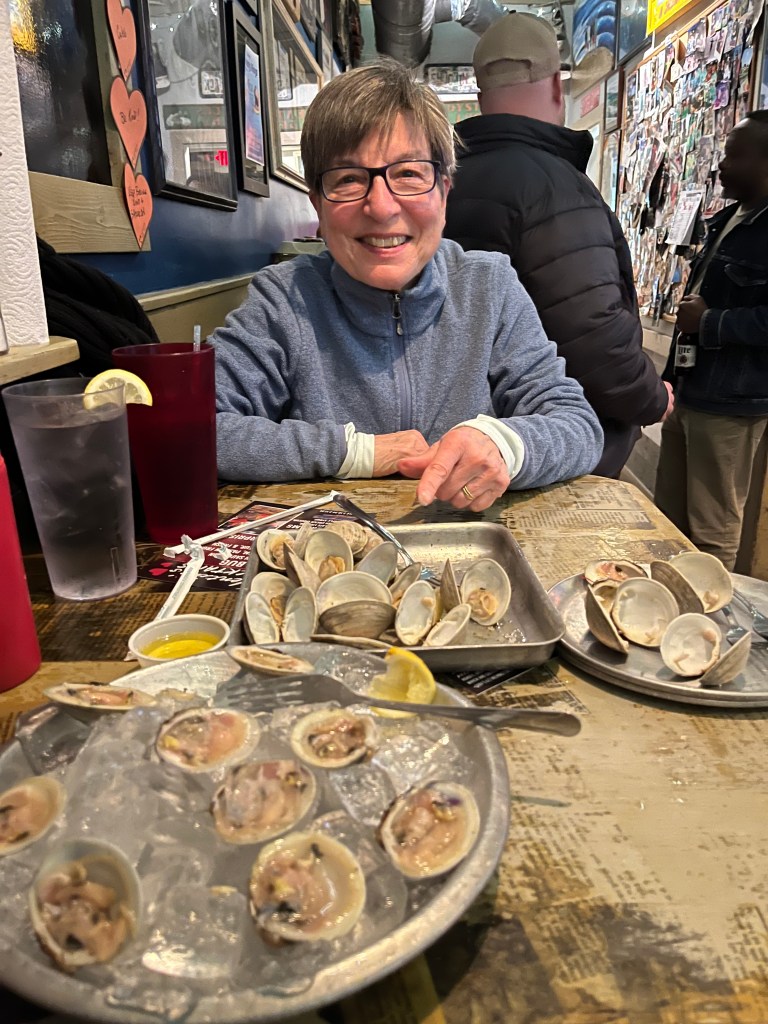
$0.50 clams and low country shrimp. But they always overcook the corn!
Fun Moments
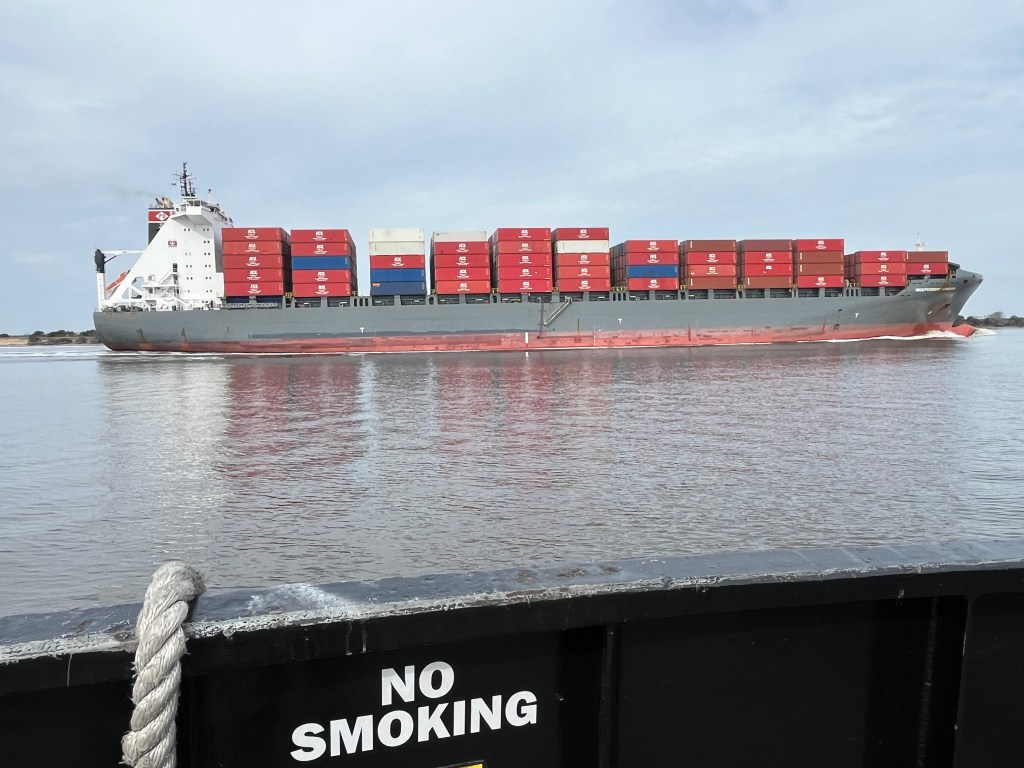
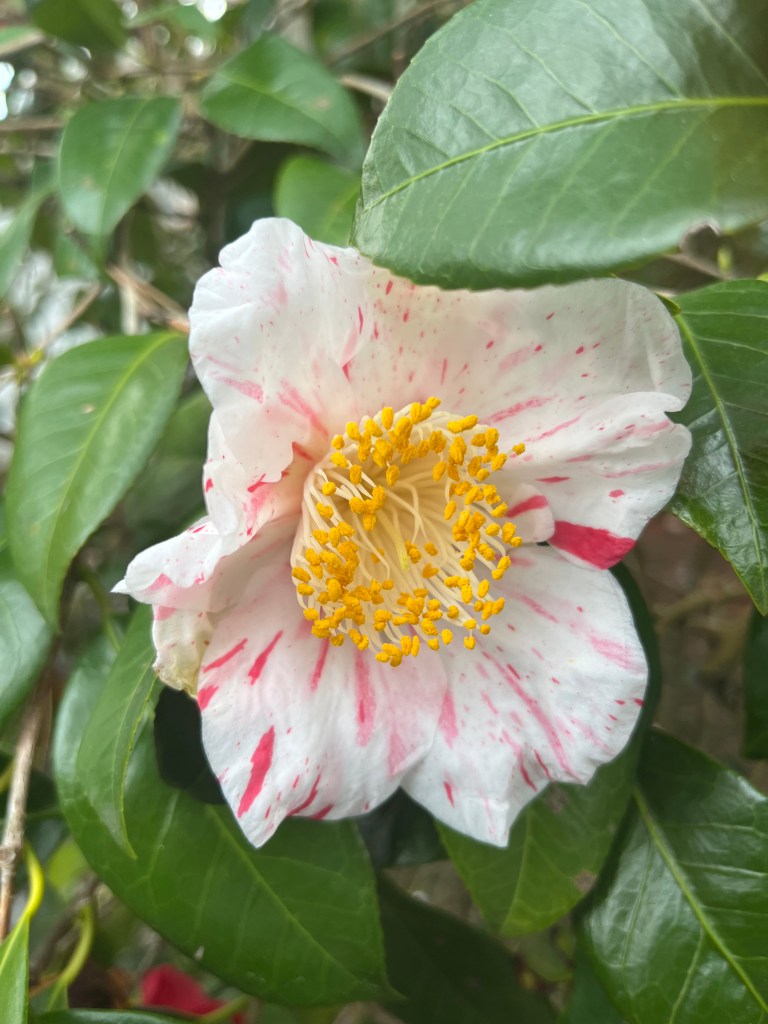
Dolphins frolicking outside the restaurant windows in Carolina Beach, NCA container ship passing the Fort Fisher – Southport ferry. All the old guys came out of their cars with their camerasCamelia’s blooming in early February in Pawleys Island
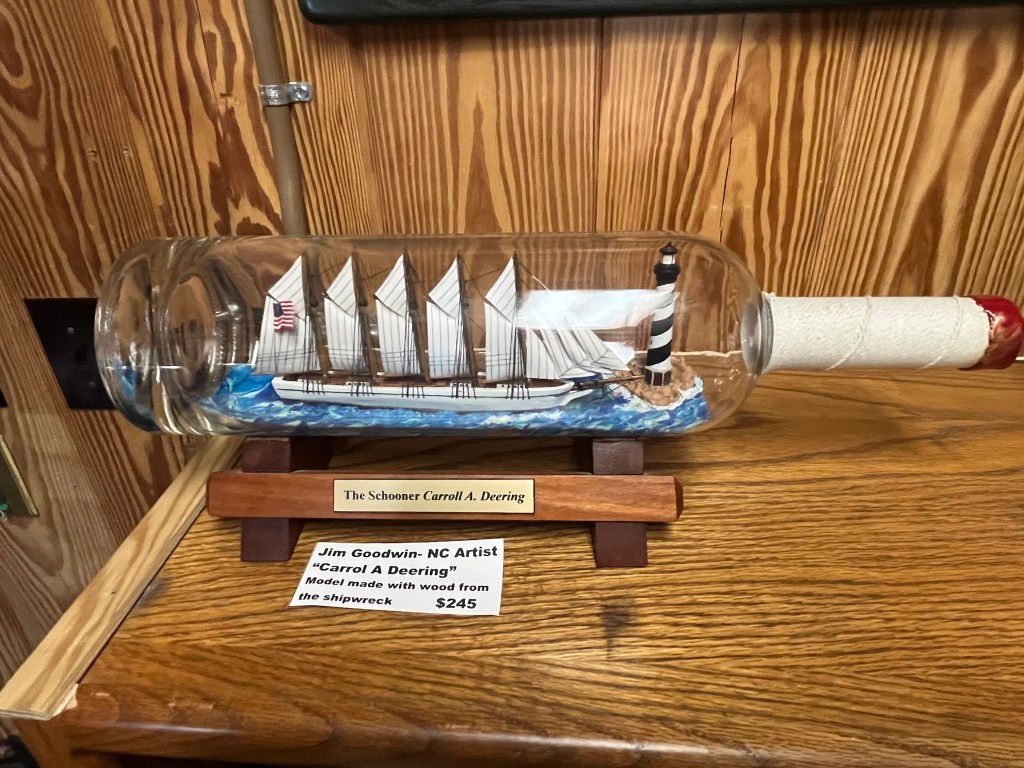
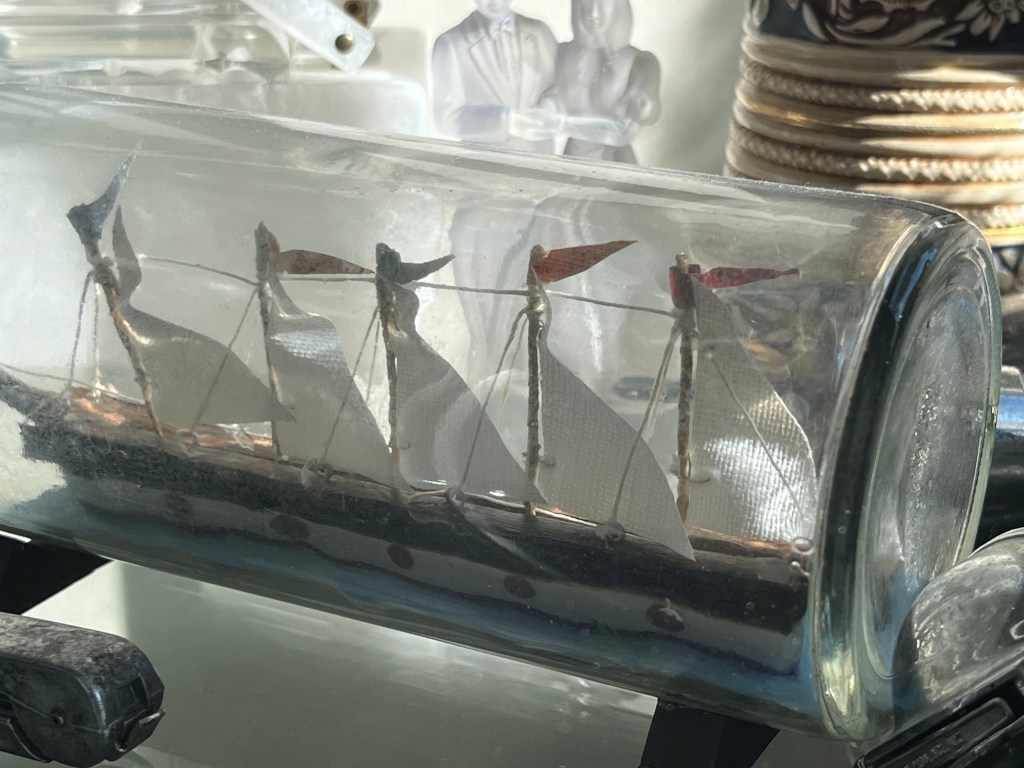
You just gotta love a good ship in a bottle. There is no shortage of them in the museums and visitor centers along the coast. I’m awed by the work that goes into them and love the stories … like learning that the wood in the carving came from the ship in the bottle.
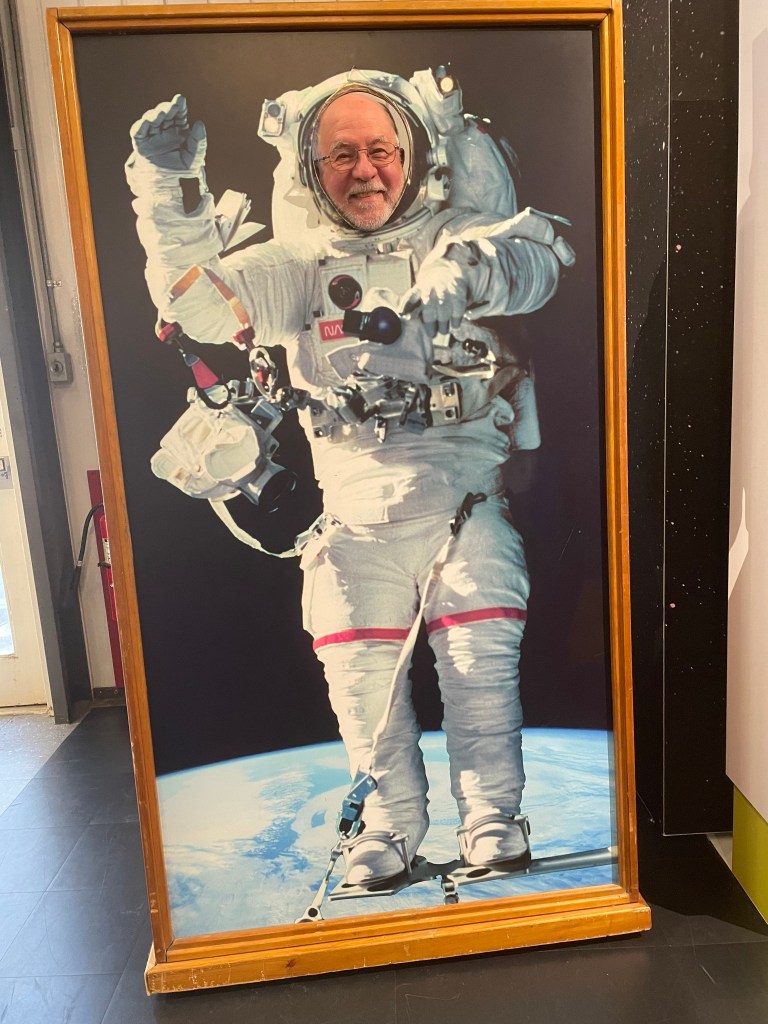
This is not actually me on the moon. It is me on Wallops Island, VA, on the road to Chincoteague. Stay tuned. We will be at Cape Canaveral in the few days with our grandsons. If we are really lucky, we might just find another photo op.
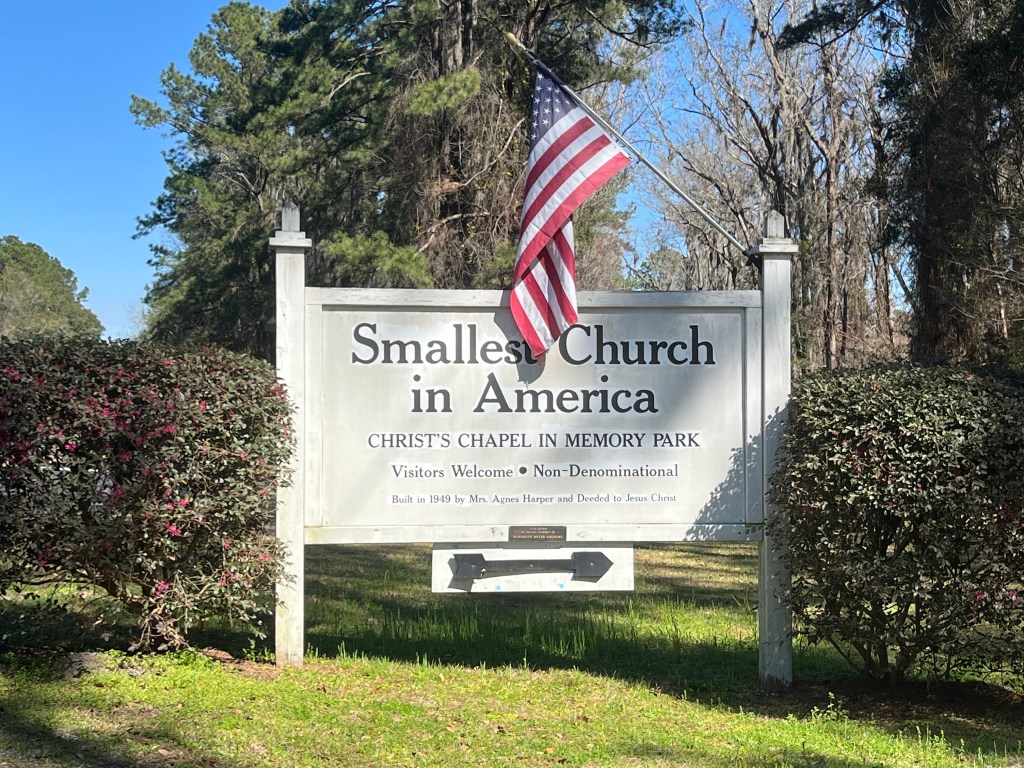
Superlatives matter. “A small church” in America may not have caught our eye. But the “smallest” church did. So we turned around for pictures. It’s about 6’X8′. No preacher. No bathrooms.
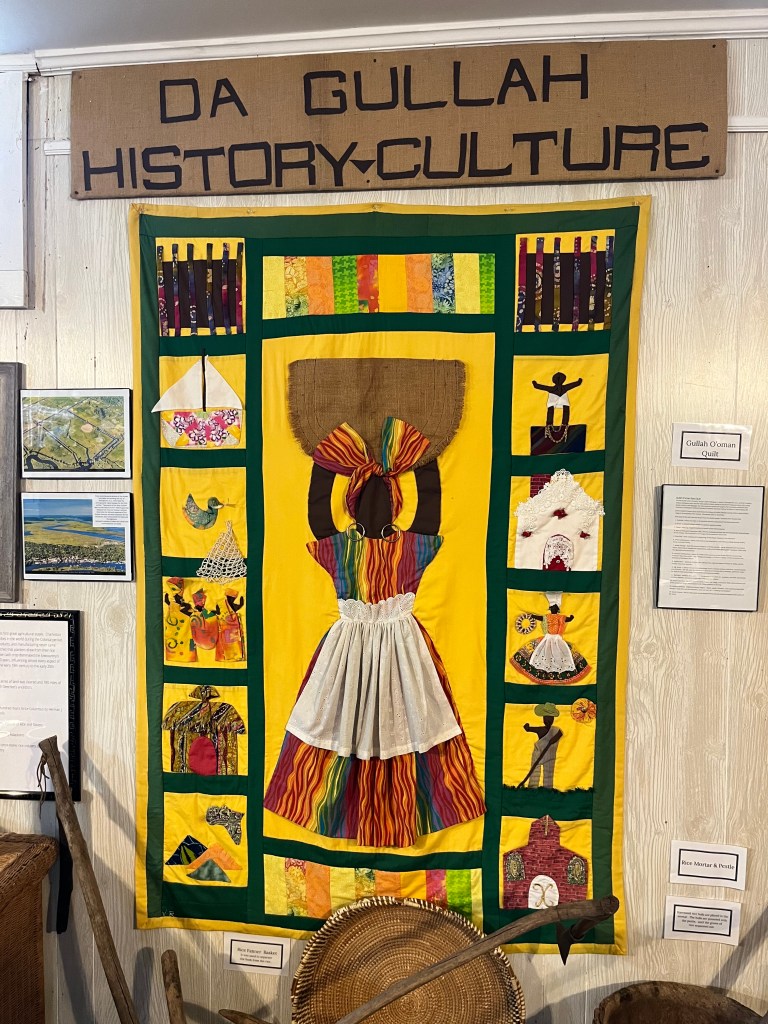
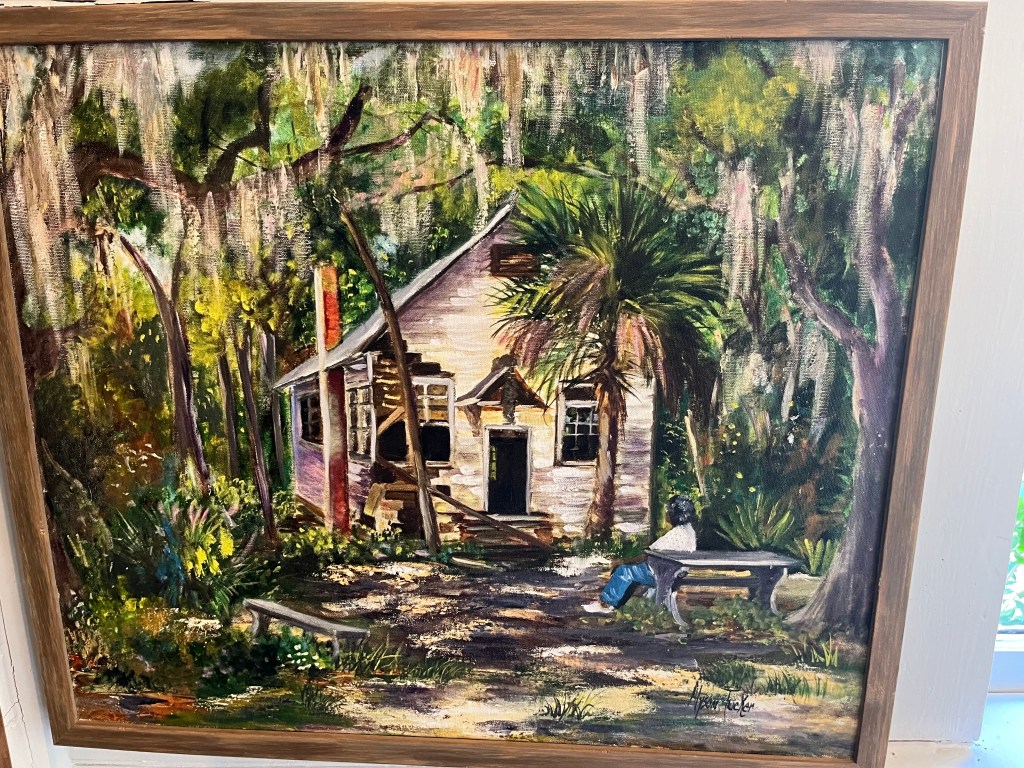
As I have come to understand this history, the Gullah-Geechee people came to the US as slaves from West Africa. They were enslaved specifically because of their rice-growing prowess, so they populated the plantations from Wilmington NC to St. Augustine FL. In some areas, the plantations grew cotton or harvested native lumber, such as live oak. On this trip, I wanted to learn more. Jim Brown, the NFL running back and Michelle Obama among many others, have Gullah-Geechee roots. We found a Gullah-Geechee museum in Georgetown SC and learned more on St. Simons Island GA at the Harrington School Museum. Learning of this culture and seeing it respected and sustained has been a high point of the trip. Any time you want to visit us and have some Hoppin’ John or enjoy a low-country shrimp boil, we’ll make a point of thanking the Gullah-Geechee.
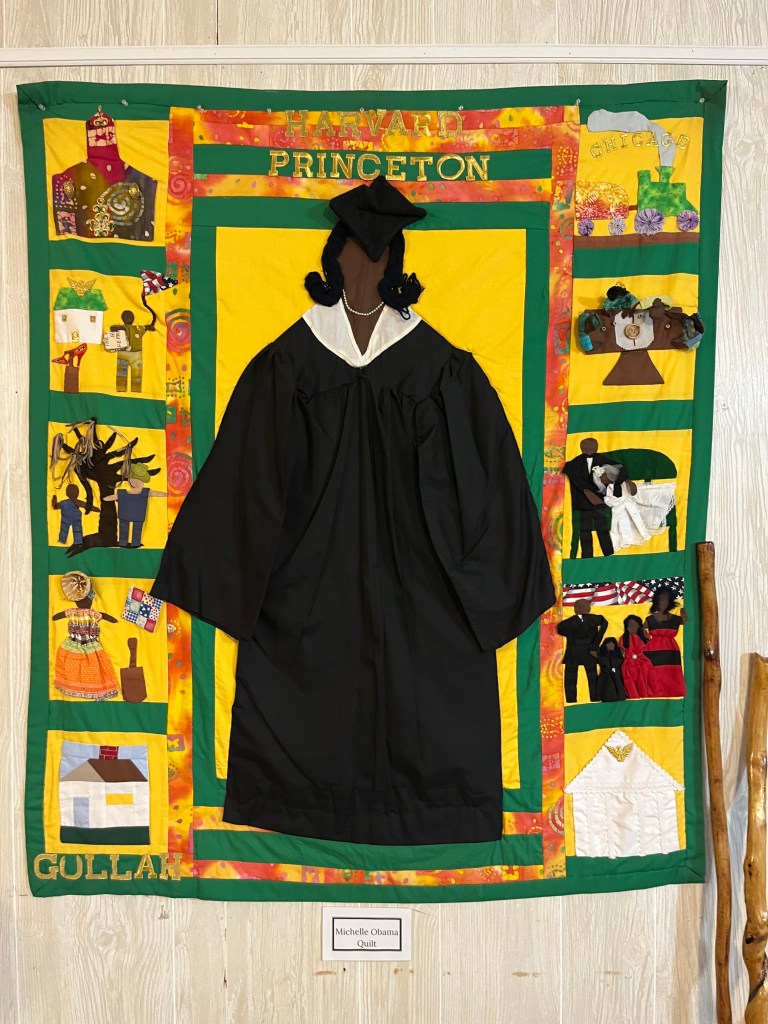
Quilts and tools and magnificent sweet grass baskets adorn the Gullah Museum in Georgetown SC. From bottom left to bottom right, each quilt tells a story. The one on the right is the Michelle Obama quilt, telling the story of her enslaved ancestors moving north in the great migration, her going to Princeton, marrying Barack, and, from a slave cabin, moving into the White House. If that doesn’t make you tear up, nothing will.
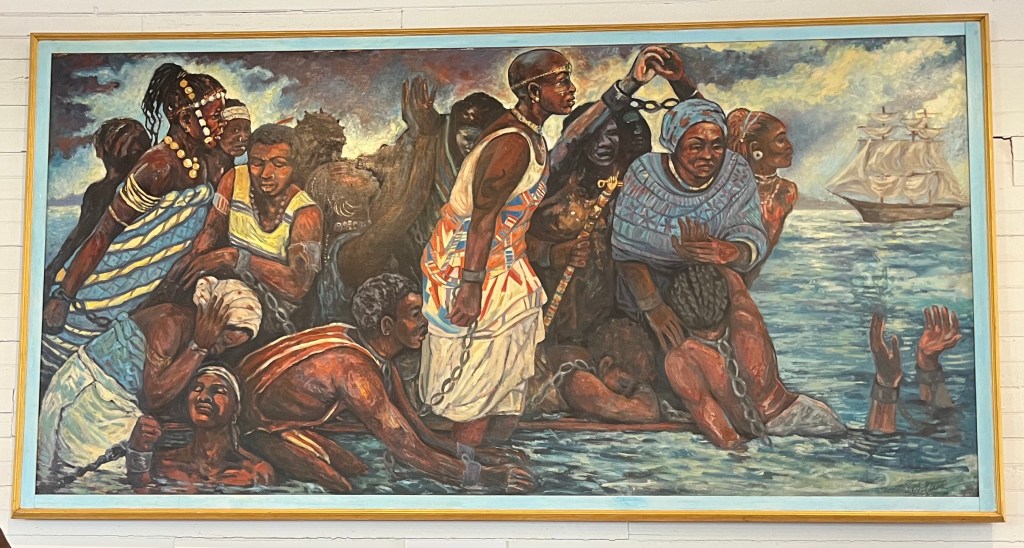
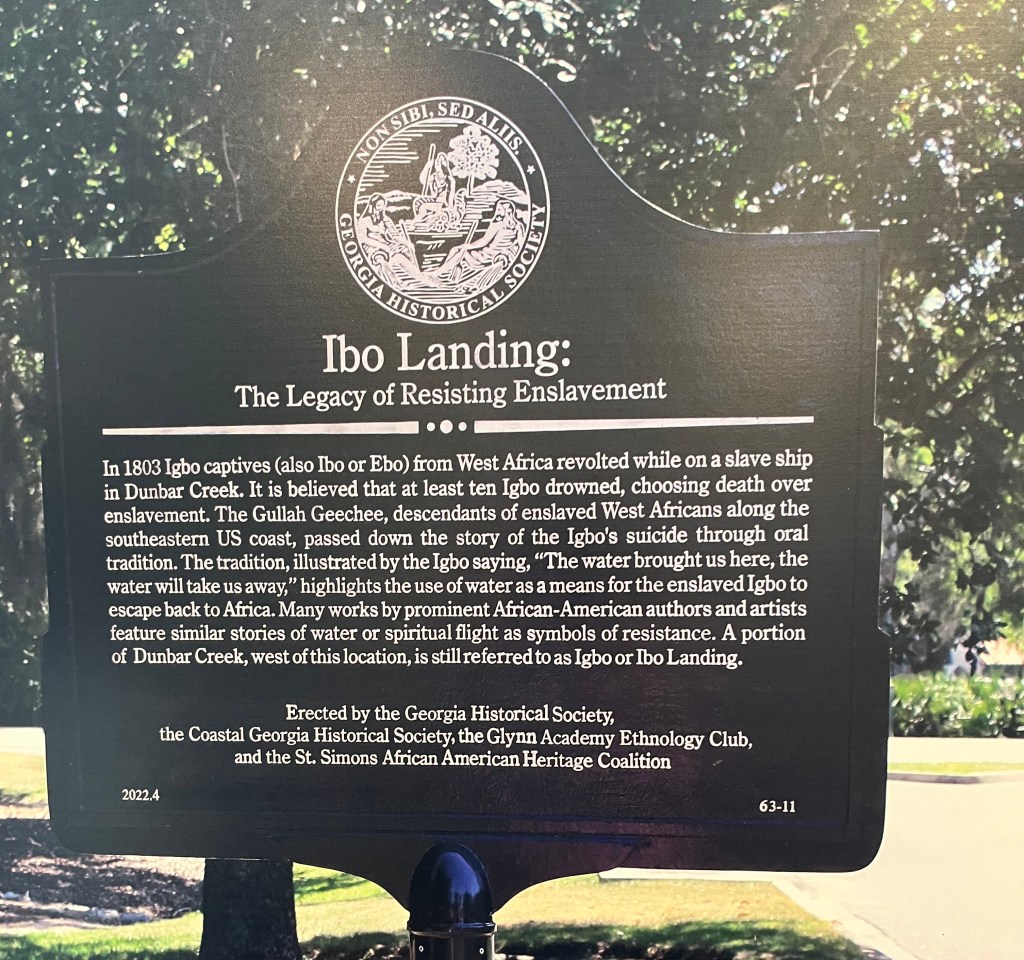
A painting and historical marker at the Harrington School in St. Simons tells the story of slaves drowning themselves in Dunbar Creek at Igbo Landing (or Ibo or Ebo, depending on the spelling) to escape the horror of slavery. The marker tells the story. The painting shows the story. The link following the next two photos shows a “Ring Shout” by the “Gullah-Geechee Ring Shouters” remembering the story.
Twenty-five or so years ago, Rebecca and I celebrated our anniversary by going to Tanglewood and spending a weekend in Stockbridge, Massachusetts. In Stockbridge, we saw a photo of a very pensive John Lee Hooker in a display case that we fell in love with. We asked about it and learned that the photographer, Clemens Kalischer, then in his 90s, still operated a small studio there. We hunted him down and spent a few hours jawboning. He told us about taking the photograph at a symposium at the Music Inn in Stockbridge in 1954 tracing the roots of American blues music. He had a single print of the photograph in his studio and an old matte. He erased the writing on the old matte, re-signed it, and put it into a used frame. It hangs in our living room as one of our most prized possessions.
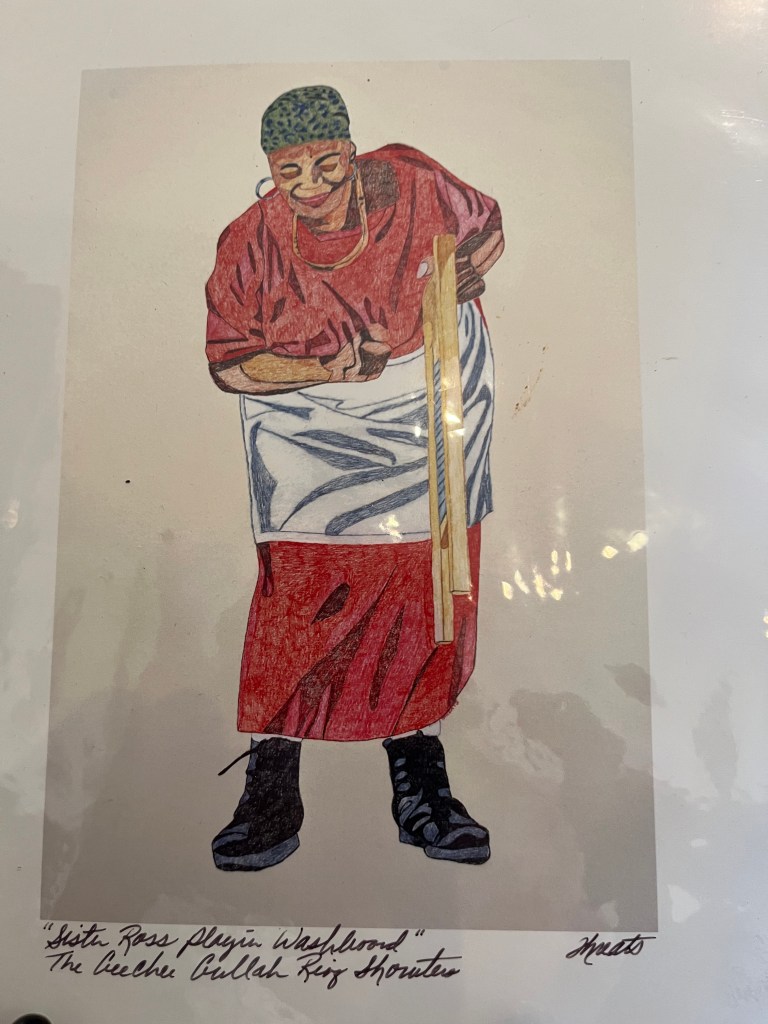
The picture shows Hooker, hand on forehead, beneath a blackboard containing a map of the evolution of the blues. I knew most of the early influences on the blues – marches, hymns, reels, jigs – but I had never heard of a “Ring Shout.” Now I know. It is from the Gullah-Geechee tradition that has influenced not only blues, but also spirituals and zydeco music, with the percussion coming largely from a washboard. Just as I had done with the picture of John Lee Hooker, I fell in love the with the picture of “Sister Ross Playing Washboard” as part of “The Geechee Gullah Ring Shouters.” This link will take you to a video of the Gullah Geechee Ring Shouters singing about the drownings at Ibo (Igbo) Landing.
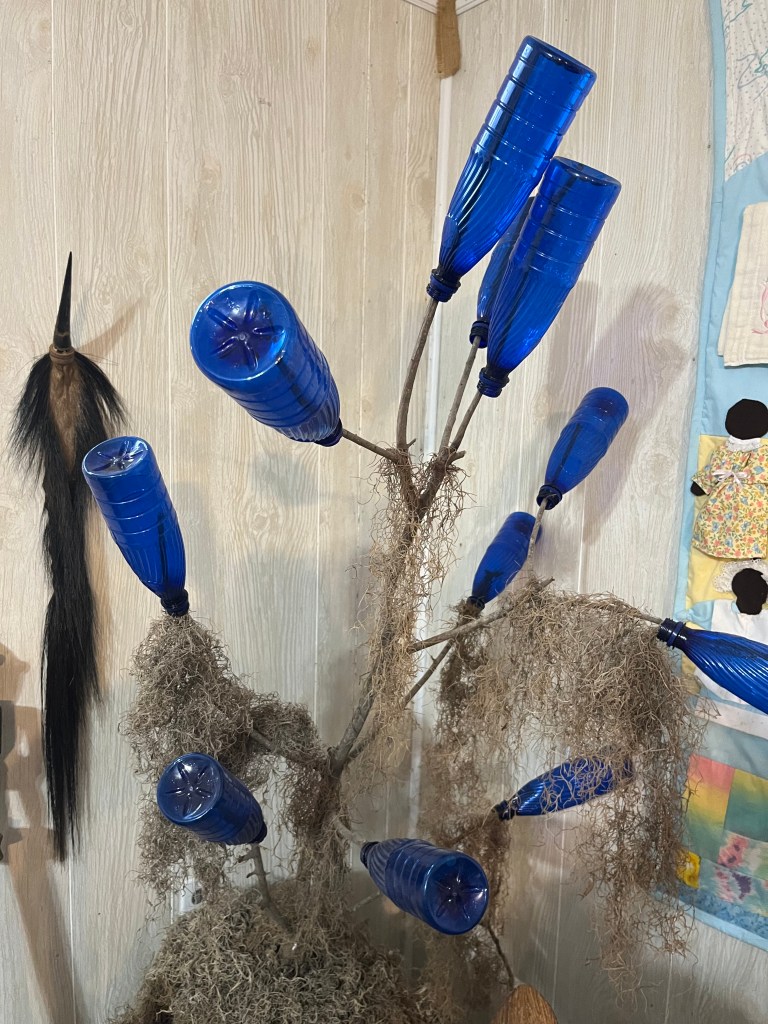
In my decades of traveling around the south, I have happened across any number of “blue bottle trees.” I have never known what they are … until now. The tradition has its roots in West African “Hoodoo” and dates back more than 1,000 years: Blue bottles are talismans that ward off evil spirits! As the interpretive explanation in the Georgetown museum explained, “Evil spirits are afraid of water so blue bottles ward them off. If the evil spirits enter the bottle, their fear traps them inside, and in the morning when the sun comes up, they will be destroyed by the sunlight. If you’re not sure the light of day has really done its job, you can cork the bottle, take it to the river and throw it in the water. An evil spirit has no chance against the river because they fear it.”
Tabby Construction
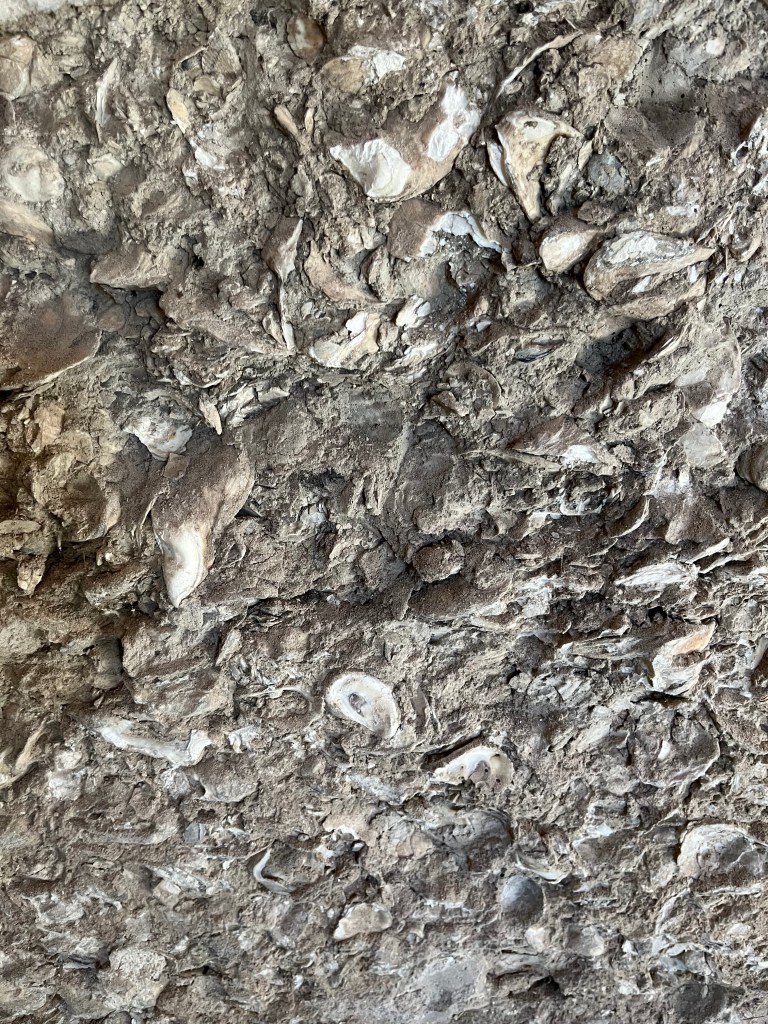
In addition to living in typical wooden shacks, the Gullah-Geechee lived in homes built of “Tabby,” a unique form of South Georgia concrete. They cooked seashells until they crumbled, which provided lime. They mixed the lime with sand, water, and intact shells to make a form of concrete. The unground shells stay visible in the long-dried slurry. The tabby photo is of the walls of a slave family’s home at Ibo Landing on Dunbar Creek in St. Simons. In 19th-Century construction, the “Tabby” was the concrete itself. In modern architecture, “Tabby” is a faux aesthetic technique that involves embedding shells into mortar on the exterior of buildings.
In August 1980, I finished my doctoral dissertation. Because of the timing, I wouldn’t actually graduate until January. For the first time in years, I had a bit of time to breathe and revitalize.
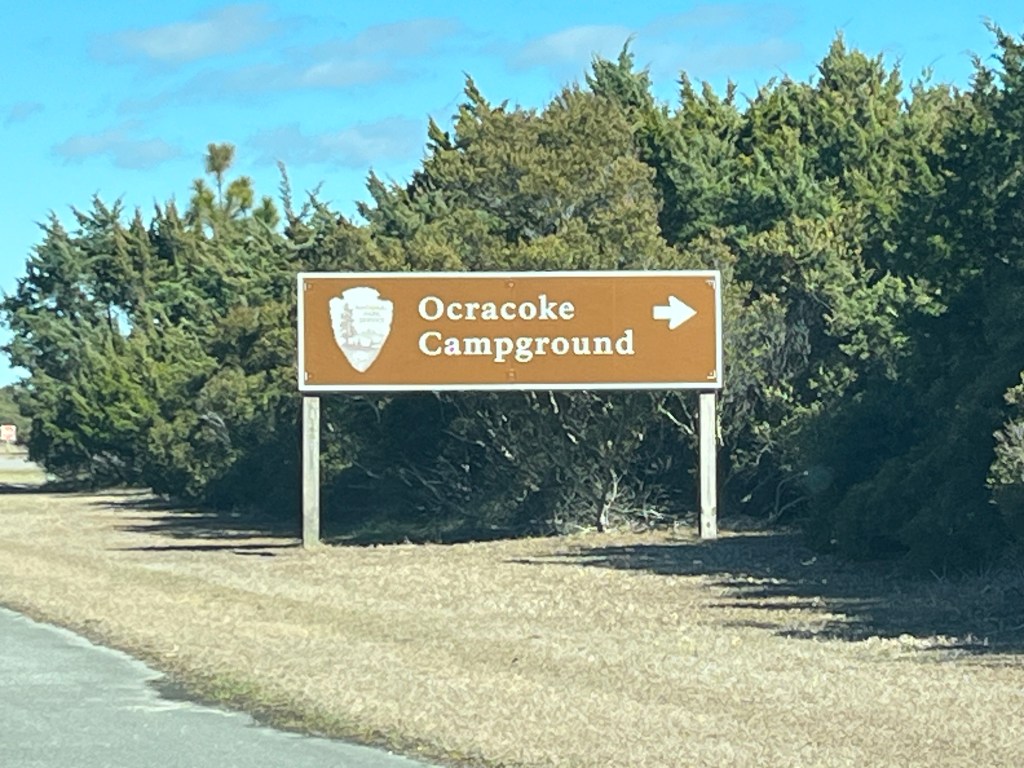
At that point in my life, I drove and often lived in a Volkswagen camper, “Victor Von Volkswagen.” (Thanks for the name, Wolbe!) Some people thought of Victor as a vehicle. I didn’t; he was my best friend. Victor and I planned a post-dissertation adventure: a week on Okracoke Island at the southern tip of North Carolina’s Outer Banks. We made reservations at the National Seashore Campground.
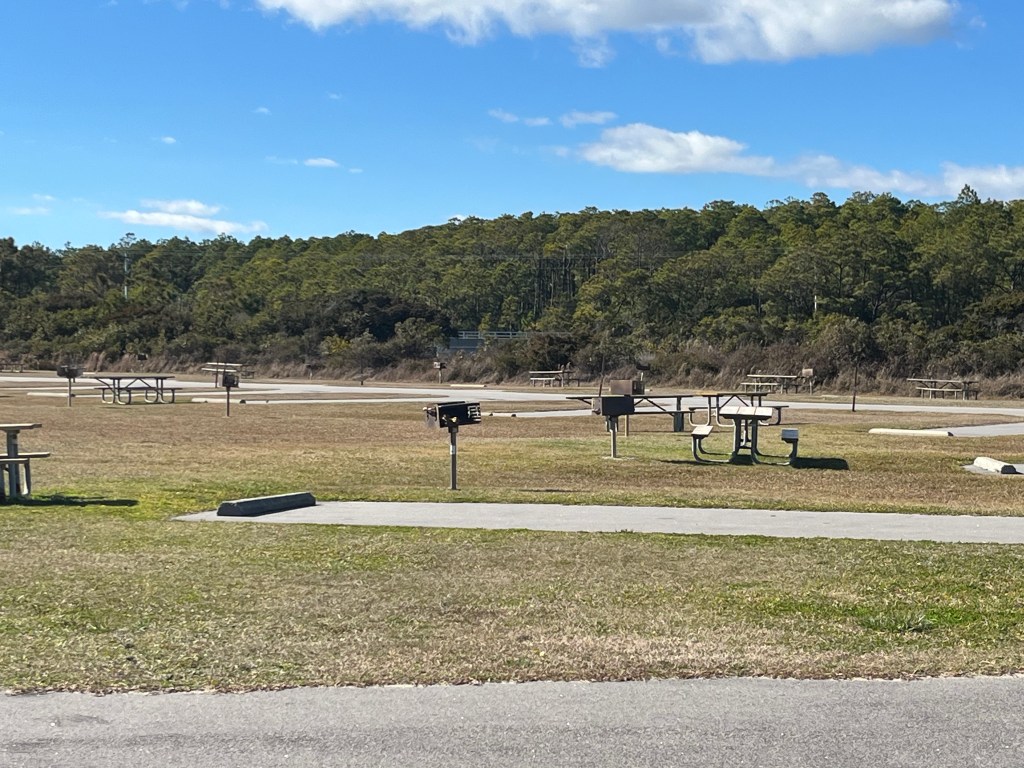
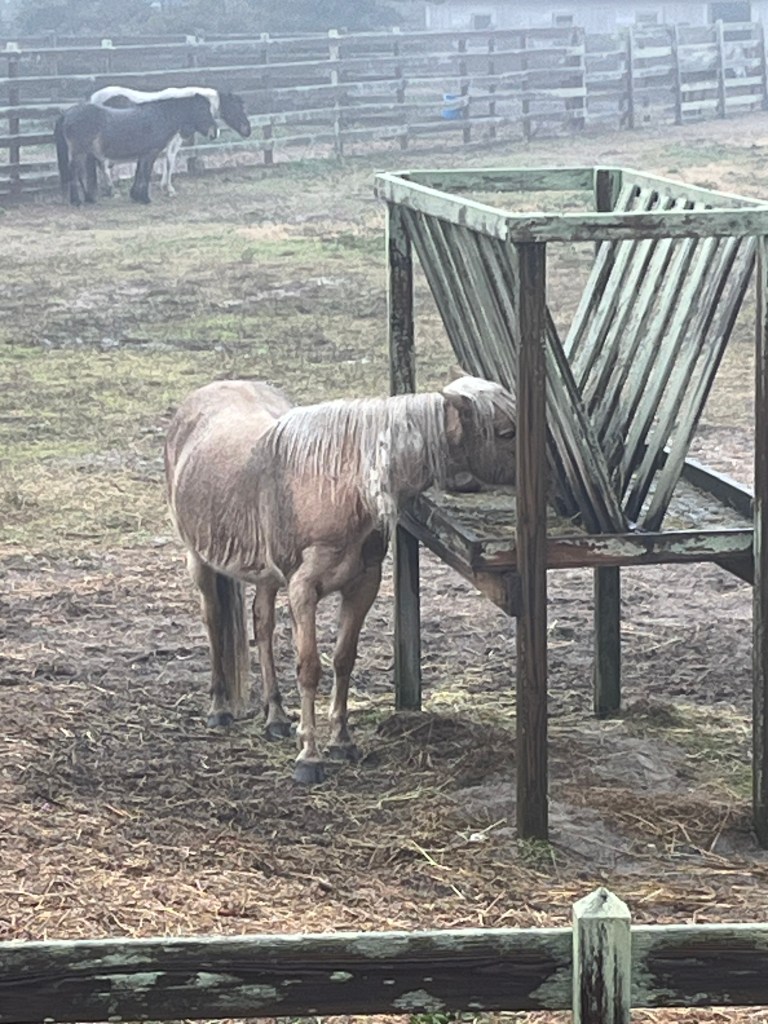
The beaches and sights of the northern Outer Banks – Kill Devil Hill, Kitty Hawk, Nag’s Head – were gorgeous but way-too populated. Okracoke was perfect. My campsite was a parking space on the beach with a picnic table and fire pit. The shower was open-air: a stand pipe with a shower head, pull cord, and wooden platform. Nudity at the shower prevailed; there was no privacy and no apparent self-consciousness. Wild ponies roamed the island and the campground freely; pods of porpoises frolicked in the surf. The heat and sun were oppressive and splendid.
My campsite was a parking space on the beach with a picnic table and fire pit
My daily schedule never wavered. I woke up early and ate breakfast. Then I hit the beach. First , I needed bait: sand crabs. Like a human sanderling, I following the surf and dug furiously. With a full cup of sand crabs, I waded waist deep into the ocean and cast as far as I could. Except for a couple of dogfish – small sharks that fight like crazy – I don’t remember what I caught. I just remember that I caught a lot of fish! Sometime around mid-day, I’d pack up my gear, go back to my campsite, clean the morning’s catch, and get the fillets on ice. Then I’d head into the village to re-provision at the Okracoke Variety Store (unchanged in 43 years): a sack of ice, some beer, a few groceries, then back to the campground for a nap. Sleeping allowed the hottest part of the afternoon to pass unnoticed. Then, around 2:30 or 3:00, the morning routine repeated: a cup of sand crabs, a few hours of fishing, fish cleaning, and a sack of fillets.
For a whole bunch of us crazy hippies, the campground came to life as the afternoon waned. Throngs of us became friends and prepared to party. Every evening turned into a community potluck. I provided lots of fresh fried fish. By the time we finished eating, someone had built a campfire on the beach. We told stories, communed with the waves, and played music until Mr. Sandman called us to bed. For seven days, the schedule never varied. I departed Okracoke sorry to see the island fade away, but happy that I had discovered and experienced a true paradise
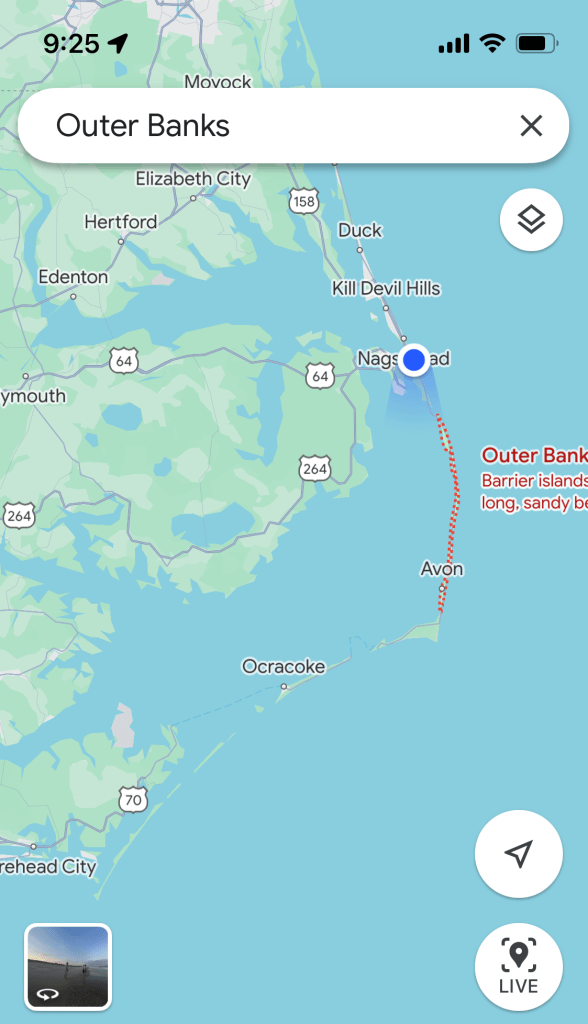
As Rebecca and I planned this trip, a big part of the lure was knowing that we would spend several days on the Outer Banks, including a night or two on Okracoke. We had a perfect room in Nag’s Head: a funky Comfort Inn right on the ocean with our own private balcony for all of $82. On our first day, February 10, the thermometer hit 72.
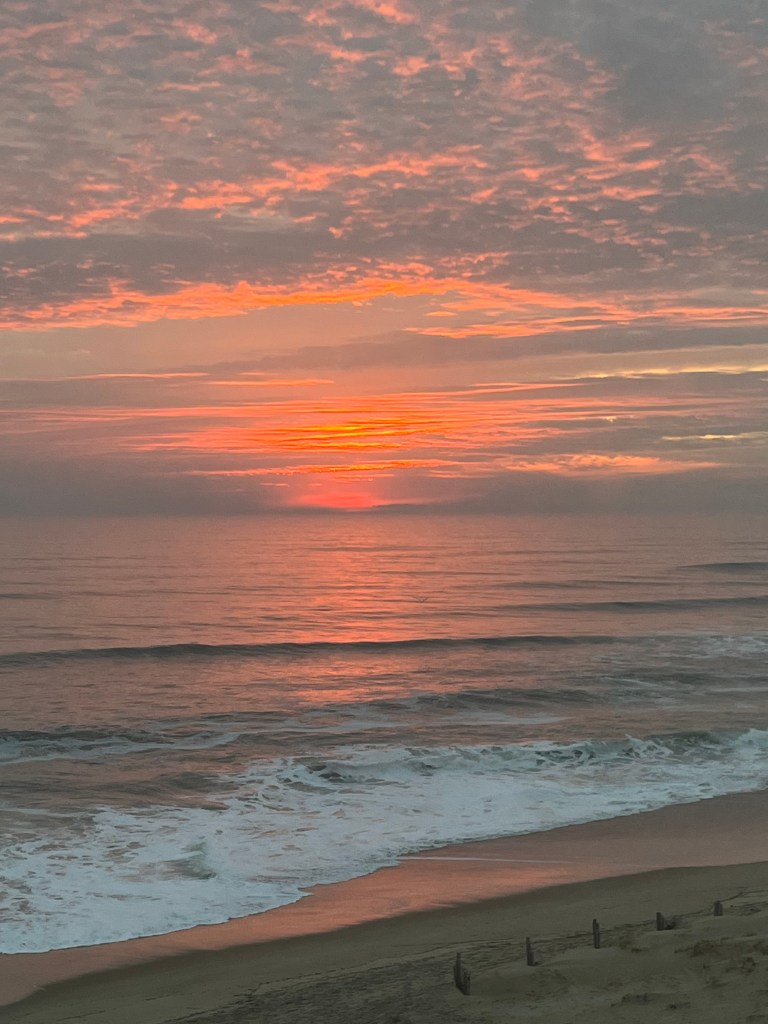
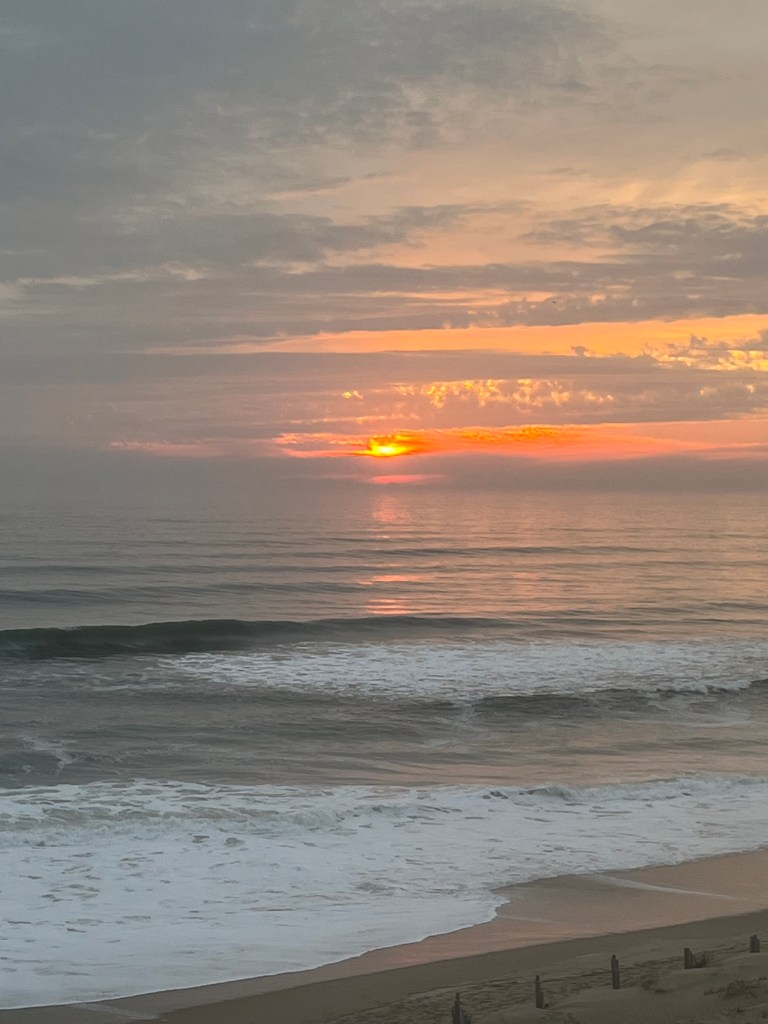
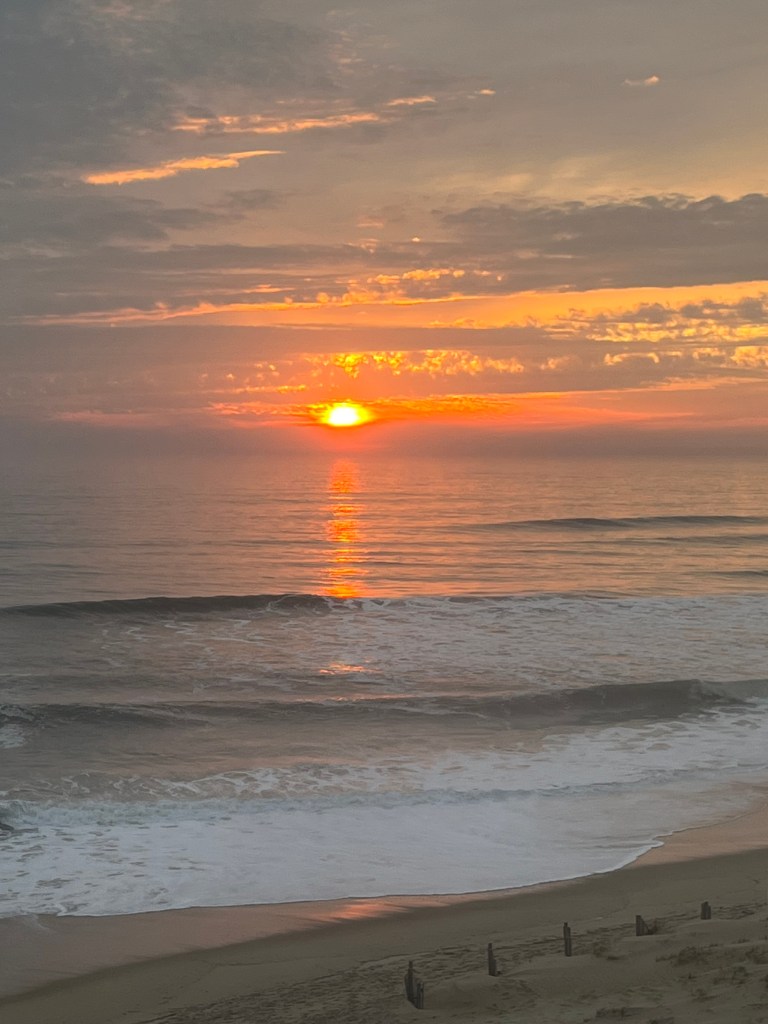
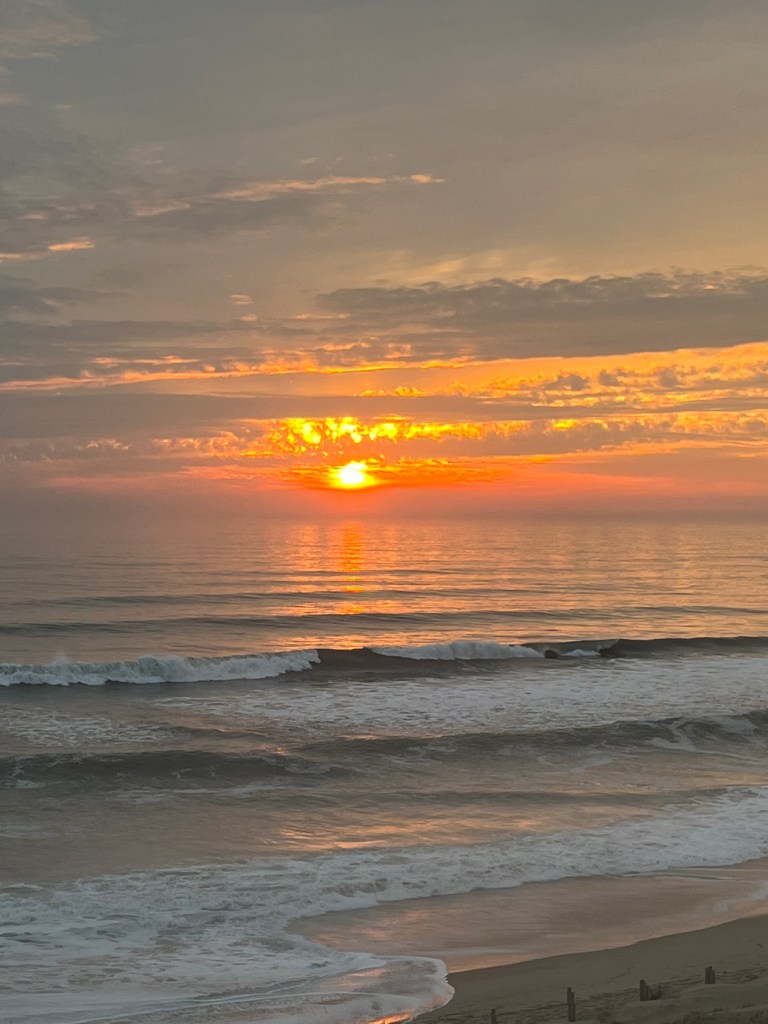
Sunrise from Nags Head
February 11 was Super Sunday. Neither of us are real football fans, but every wannabe sociologist has to love the Super Bowl, one of the great annual societal moments of collective insanity. During the pandemic when traveling didn’t exist, Rebecca and I hosted our own Super Bowl parties for two, complete with chili, wings, guacamole, veggie platters, etc., etc., etc. This year, we couldn’t host because we’d be on the road. So we counted on the Outer Banks for a venue.
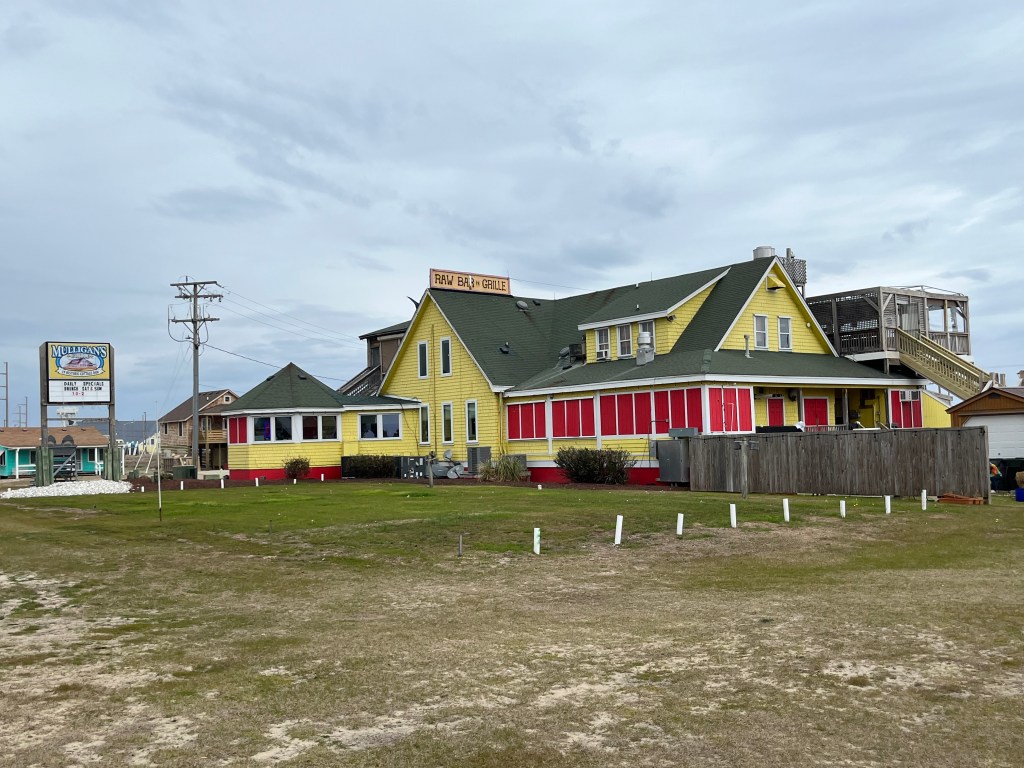
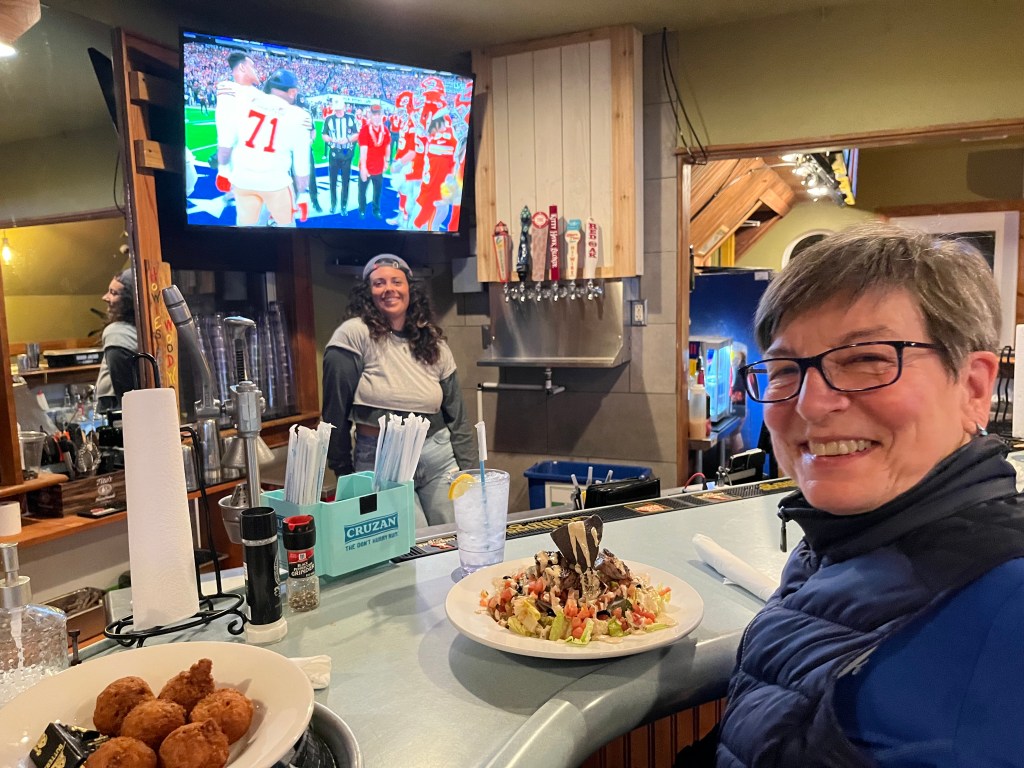
Alas, the Outer Banks let us down. Most places were closed, so we chose the upstairs bar at Mulligan’s in Nag’s Head. The bartender couldn’t wait to get out of there, and the other people at the bar had a “What game?” attitude. The hushpuppies were doughy and lousy. (Steamed shrimp and salad came through again. We have our go-to staples, you know.) We bolted in the middle of the second quarter, returning to the practice of hosting our own damn SB party. Fortunately, this year’s game actually had the very rare quality of being good, and seeing Taylor getting excited about Travis made everything else irrelevant. Don’t you agree?
Mulligans looked like it would be fun for the Super Bowl. Alas.
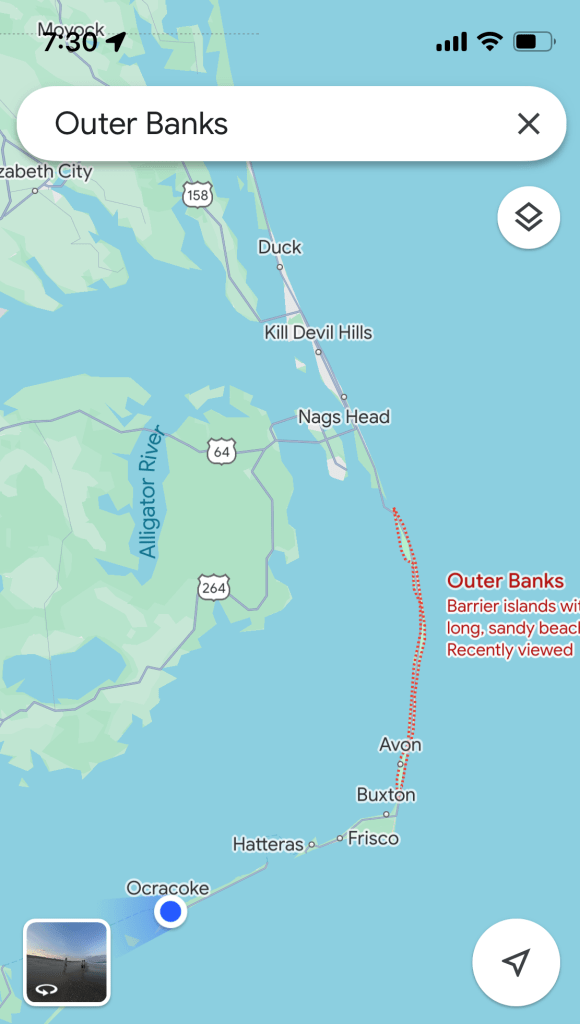
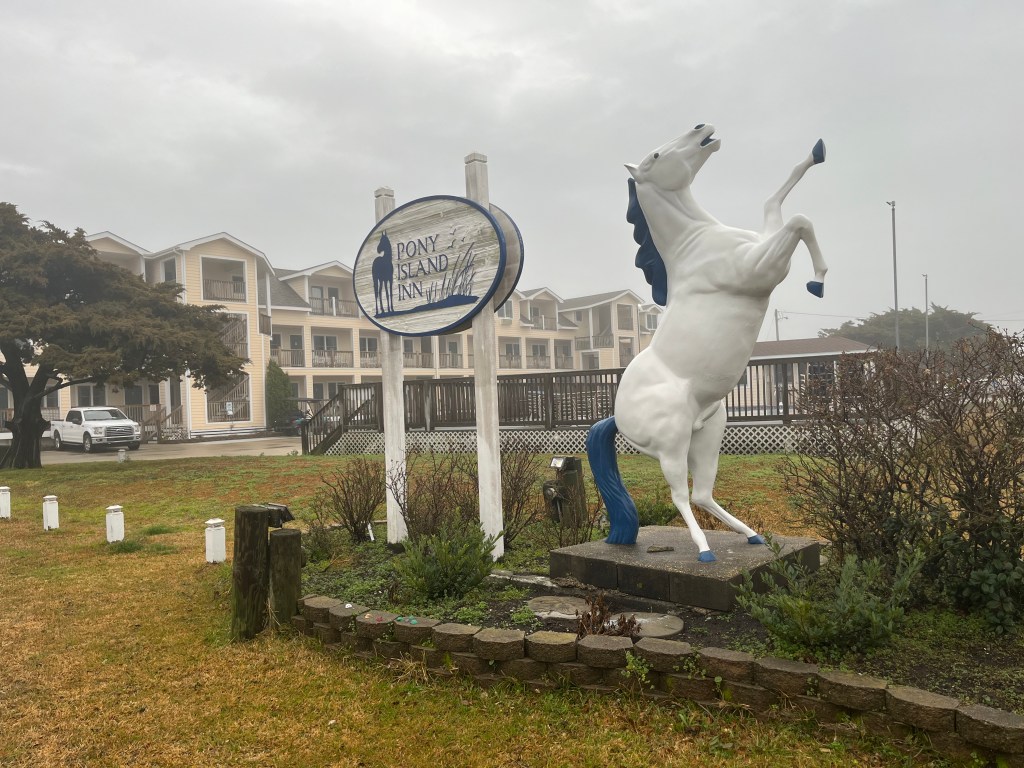
Monday was a driving day. We covered 85 miles in 7 hours, from Nag’s Head to Okracoke. Not bad, even by our standards. As I write, we are comfortably settled into a room at the Pony Island Inn and fully sated thanks to Jason’s, the only open restaurant on the island. Maybe we will leave tomorrow. Maybe not. Once the winds reach 30 mph, the ferries don’t run. We’d be stuck on Okracoke for another day. OH NO!
The Outer Banks are magical!
Nags HeadOcracoke
Ours were the only footprints in the sand for miles at low tide. Off-season travel is the best!
Front of the Pony Island InnBack of the Pony Island InnFor real Ocracoke Pony
When the phone rang on Tuesday with a North Carolina number, I hoped. ”Mr. Mirvis,” the man said, “I have some bad news. This afternoon’s ferry has been cancelled.” ”WooHoo!!!!” I blurted, thrilled to be stranded in Ocracoke.
We spent the afternoon making friends … with John “The Pirate” MacKenzie, the guy who sold us our ferry ticket and jawboned us about the island and retirement and being 75 and his comfy home in a small RV and the chili he makes; Kim, one of the desk clerk’s at the Pony Island and the partner of Grayson the General Manager who wasn’t sure she wanted to live on Ocracoke but loves it now; Jordan, the other desk clerk who wanted to learn more about WordPress, loves to fish, and has an epic number of food allergies; Grayson, who manages the Pony Island Inn and cannot understand why the Rescue Squad and Fire Department on Ocracoke don’t have a better relationship; Valentine aka “Rambo,” the maintenance guy at the Pony Island who washed and folded our laundry for us since Ocracoke does not have a laundromat; Danny and Jimmy, our waiters at Jason’s who waited on us three times since it is the only open place on the island; and Melissa, the Postmaster, who is simply delightful. Ocracoke is a true gem. You will never find yourself there by accident; it is 1.5-hour ferry ride north to Hatteras and a 2.5-hour ride south to Cedar Island or Swan Quarter. Man, is it worth it!!
Most really bad restaurants are in-your-face, impossible-to-miss bad: bad food, bad service, creepy and uncomfortable, grossly over-priced, etc. But some are much less obvious. Case in point: the Ropewalk Restaurant in Chincoteague, Virginia.
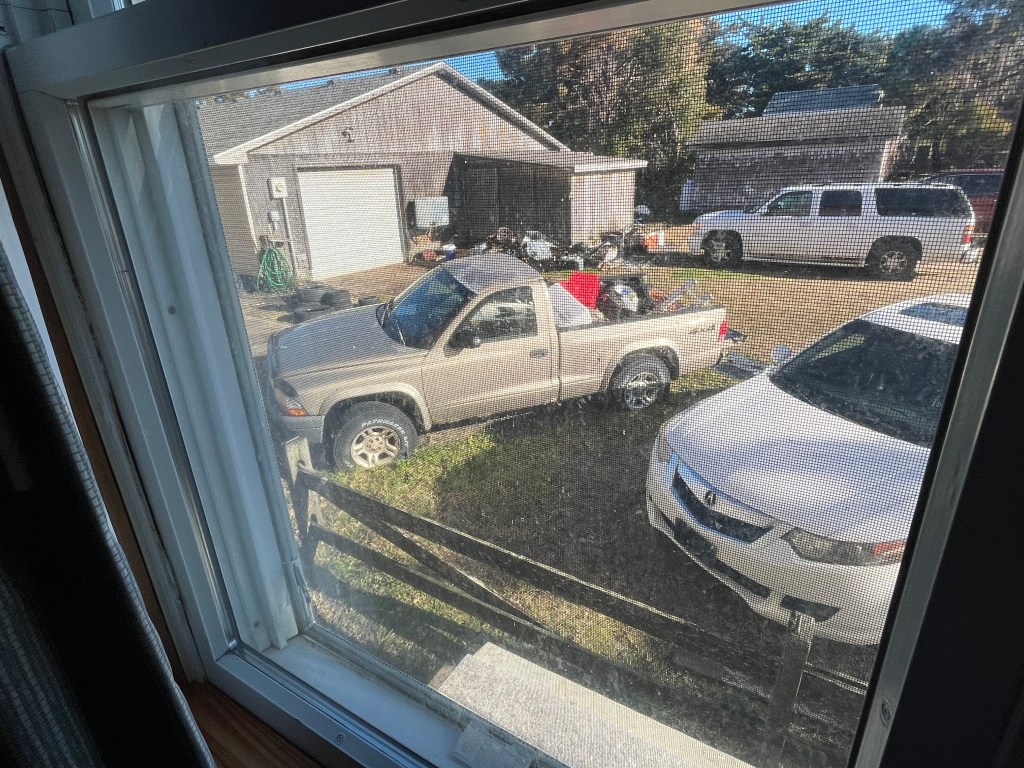
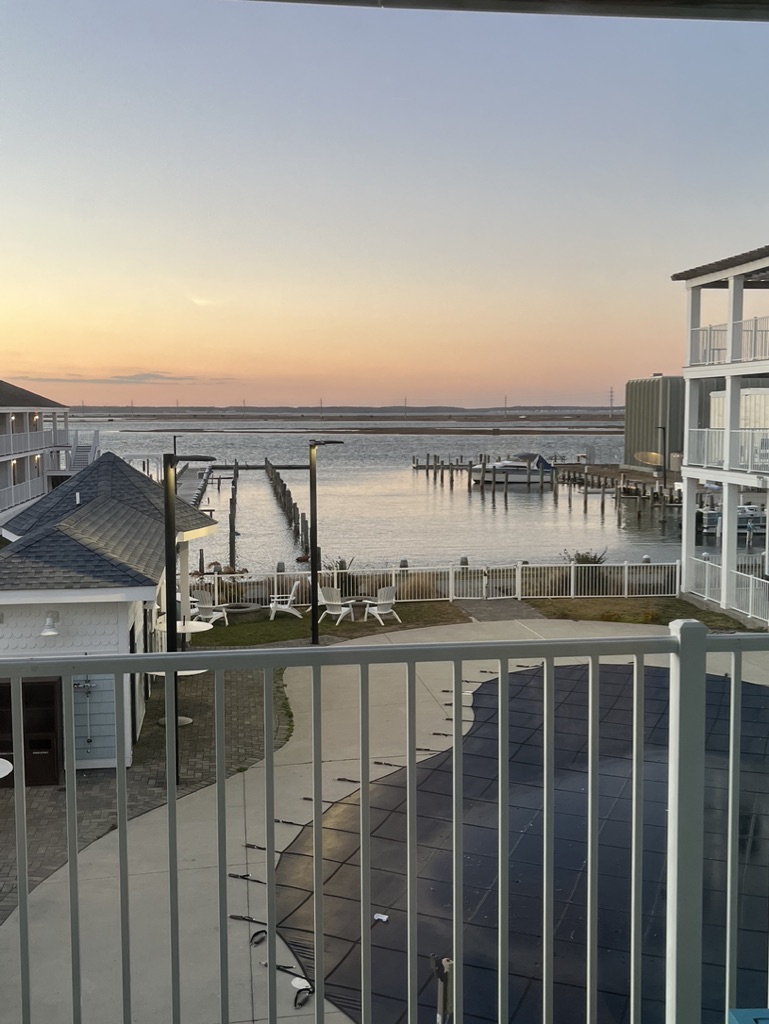
Our room view
In its defense, Chincoteague is an off-the-beaten path island in the middle of the eastern shore of the DelMarVa peninsula. It is not a place you might just find yourself. But it is not quite as deserted as the map might make you think. The Navy, NOAA, and NASA have facilities there. Plus, winter is a time for construction and infrastructure improvements. While not full, the motels that stay open do a brisk business, even if at a dramatically reduced rate. (We paid $84 for a water view room that might go for $300+ in summertime.)
The Ropewalk was one of the few open restaurants. It had a surprisingly large clientele to attract … and attract they did. On a random, cold Tuesday night in February, it was packed, mostly with contractors and workers, and only a few crazy wanderers, like Rebecca and me.
Fortunately, we arrived early, so getting a table was easy. Sandy, our waitress, was sweet and helpful. The view of the bay was superb. The murals lining the walls were gorgeous. Everyone seemed to be having fun. The menu has lots of variety, a fair amount of local and boiled (non-fried and gluten-free) options, and the prices were not at all outrageous. The place looked great. What could go wrong?
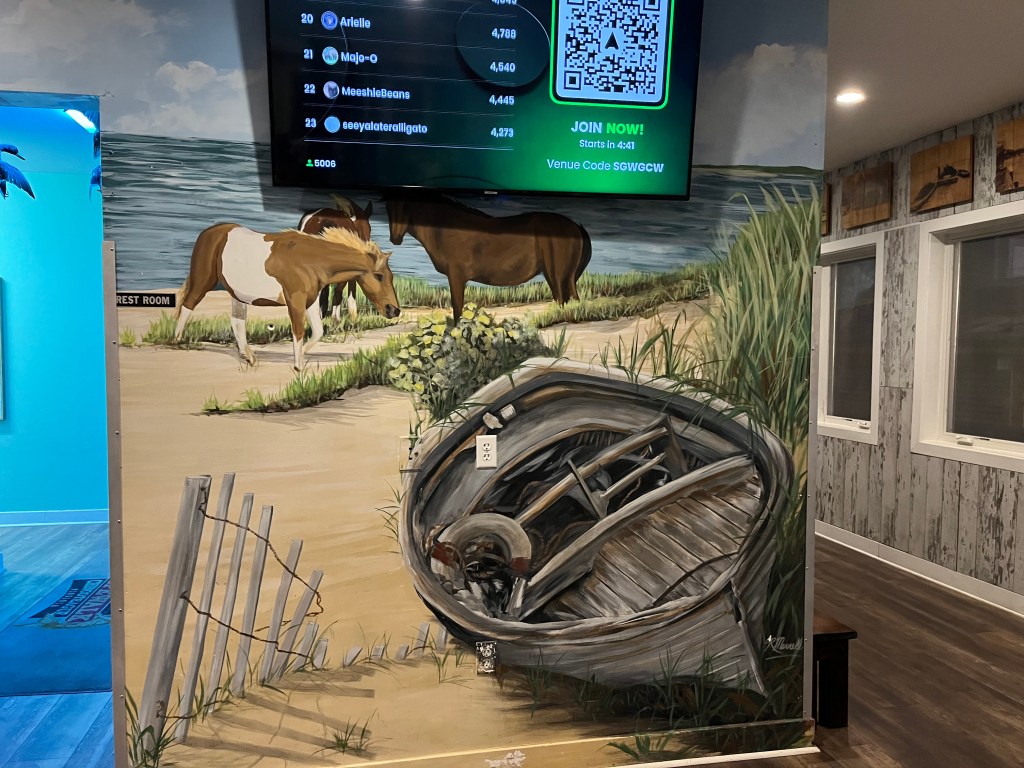
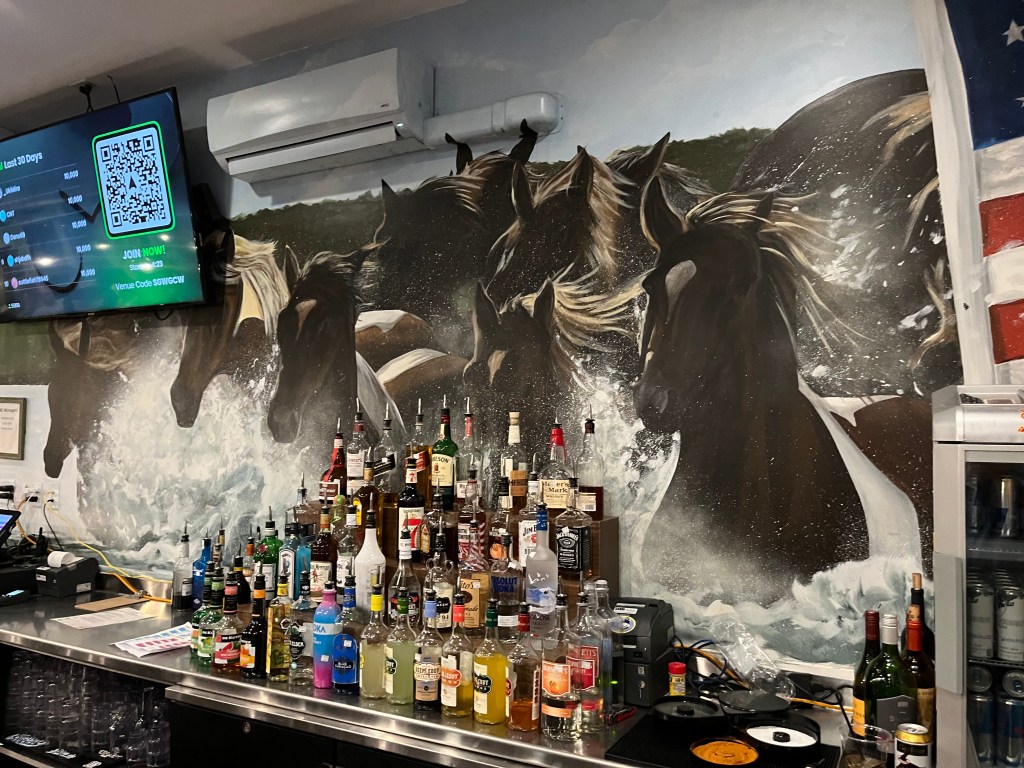
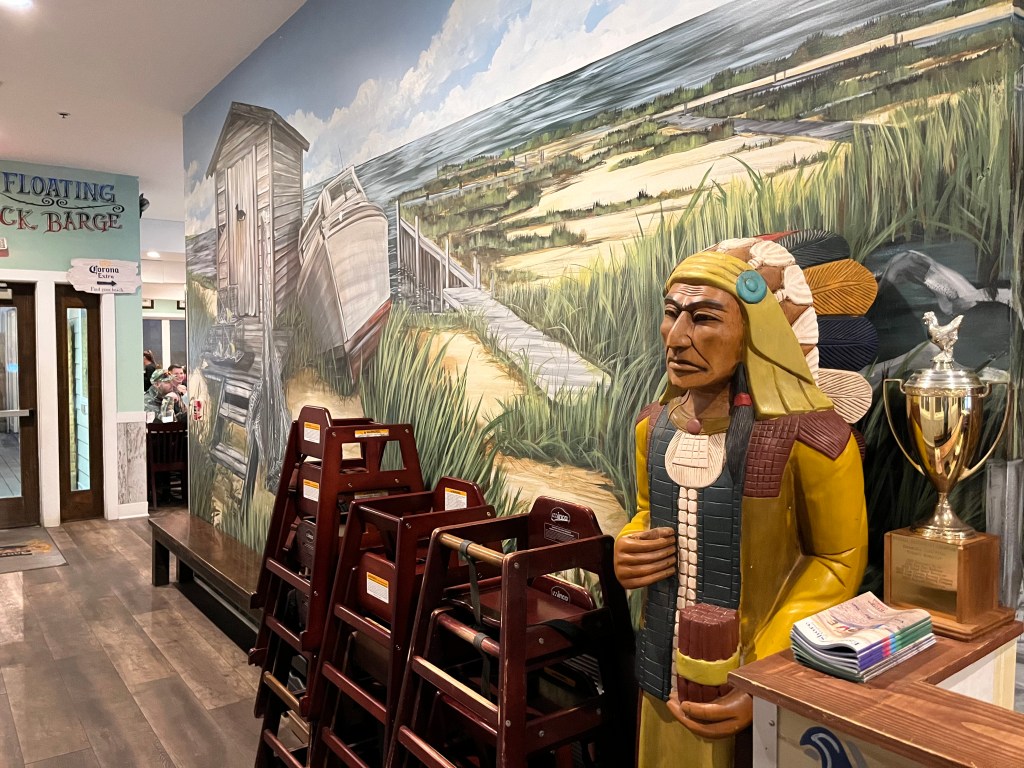
The murals were gorgeous
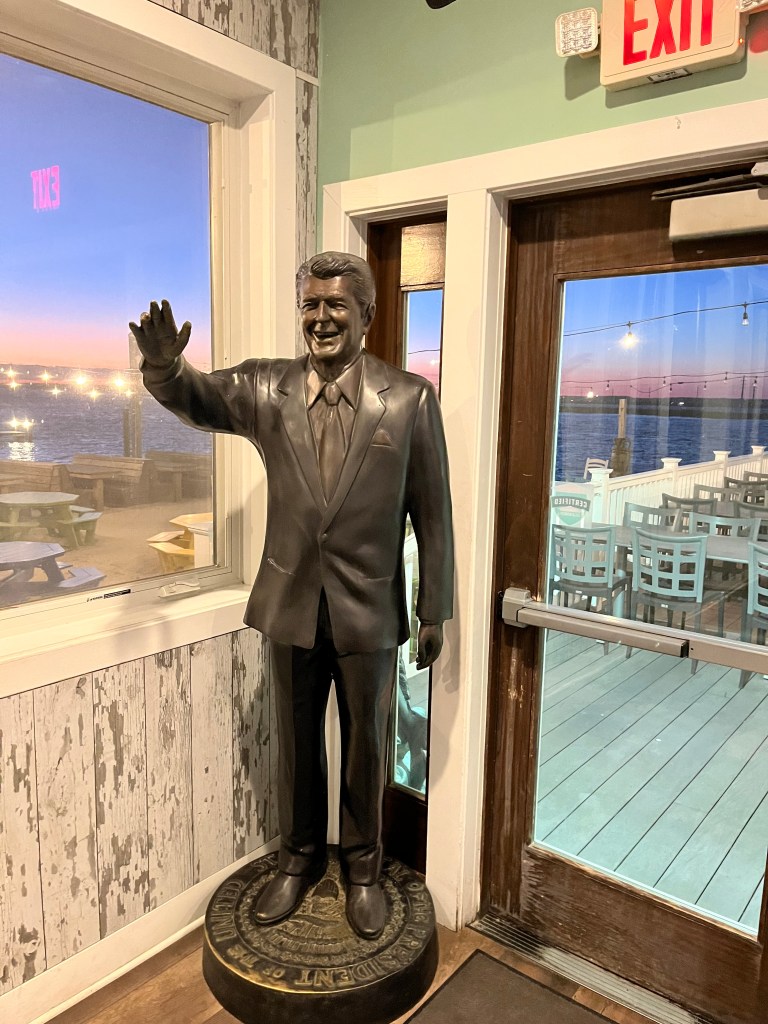
As we walked from the entrance to the dining room door, a life-size bronze statue filled the corner of the hallway. It stopped me in my tracks. What the hell was a life-size bronze sculpture of Ronald Reagan doing in a restaurant in Chincoteague? WTF!!!!!
WTF!!!
I asked Sandy to explain his presence. She said that the restaurant’s owner (who was noticeably absent) thought Reagan was the best president ever, so he had the bronze statue made at his own expense. It adorns the entryway to his restaurant.
For the most part, I try not to get too political in this blog. Unfortunately, I am not very good in the self-control department. While Reagan had qualities that I deeply appreciate – like his affability and his desire to work across the aisle with the likes of Tip O’Neill – his politics were horrible. Let’s start with his first official act as president: ripping Jimmy Carter’s solar panels off the roof of the White House declaring (as I recollect) that energy conservation meant sitting in the cold in a sweater. (Jimmy Carter famously encouraged energy conservation by turning down the thermostat and wearing a sweater, which he did throughout his presidency.) As a long-time advocate for renewable energy and conservation, shall we say that Reagan’s policies sort-of rubbed me the wrong way. His “trickle-down” economic policies, his labor policies still make me crazy (think Air Traffic Controllers), his military policies (like the invasion of Granada!), and most-of-all, his environmental policies were direct precursors to today’s rants of “I’m going to drill, drill, drill.” His Interior Secretary, James Watt, was a bastard!!! Known as an anti-environmentalist, he purportedly said that “after the last tree is felled, Christ will come back.” In characterizing the panel reviewing his coal leasing policies, he offered reassurance to others by saying he had “every kind of mixture … a Black … a woman, two Jews and a cripple.” He never did spend time in jail … just 5 years of probation … for withholding documents in an influence peddling investigation.)
Being greeted by Reagan upon entering the dining room made a most unpleasant first impression.
But let’s get back to Sandy the Waitress. She was in our age range, 70-ish +, and super nice and friendly. She also was alarmingly overworked, waiting on way-too-many tables across way-too-much geography. She could not possibly keep up.
We ordered a salad that came with blue cheese and asked Sandy to put the cheese on the side. (Rebecca doesn’t eat dairy.) Sandy replied, “Always.” When the salad arrived, it was filled with crumbled blue cheese, but we did indeed have two blue cheese dressings on the side. OOPS. As Sandy later said, and we totally agreed, it was an honest mistake. We did not see Sandy for 10 or 15 minutes while another worker took our salad back to the kitchen and replaced it with one with crumbled blue cheese on the side. Sandy was way too busy taking orders from other tables. The restaurant was insanely understaffed. Sandy’s comment about it being an honest mistake caused Rebecca and I to look at each other in guilt-ridden disbelief: we both feared that Sandy herself might be charged for the salad because of the mistake. I do not know if we were right, but I would not be surprised.
That the restaurant was so understaffed also seemed Reagan-esque: if the owner can keep the restaurant filled, the happy customers will tip the wait staff generously, thus enabling his profits to “trickle down” to the lowly line workers and wait staff. We did indeed tip Sandy well, but we have no idea if she or the cooks or the helpers received any of it.
Following the salad, we got our first course: a bowl of Maryland crab soup. It was really tasty … in a canned tomato sort-of way. Then I tasted the potatoes and the other veggies in the soup. Every bit of it, including the almost-imperceptible crabmeat, tasted like it came from cans. Crap! I could have made that soup in minutes for pennies per bowl. It was tasty, but a million miles from anything special or worthy of restaurant fare.
Our main course was actually delicious and deserves almost no criticism: boiled shrimp. It was as billed: boiled shrimp. I did, however, have to ask for lemon and horseradish to accompany the plain ketchup they served along with it. To the chef’s credit, the shrimp were not overcooked.
Once we ate, my Inner Sociologist started watching the restaurant, which was filled with contract workers who were there doing any number of different jobs on the island.
I noted the platters of food that the (all-too-sparse) waitstaff took to the tables. The fried stuff was the perfect color of fried food, but each piece had an identical swerve-y pattern and a perfect this-didn’t-happen-here crust. I’ll be damned, I thought; they are not preparing the fried fare here; they are buying it frozen, warming it in the fryer, and serving it.
Then I noticed the people, mostly young and densely packed. “Good lord,” I realized, “We are in a germ incubator! We’ve got to get the F out of here, and quick!” (Fortunately, we are recently vaccinated and very healthy.)
I stood up to try to get Sandy’s attention so we could get a check and bolt. Getting the check took a good while, and during that time a DJ started broadcasting something over a speaker system. His voice was so garbled that nothing audible resulted … but it was very loud.
Great timing. We got our check, left our tip, and escaped as quickly as we could.
Mine and Rebecca’s time in Chincoteague was good. My Inner Sociologist’s time in Chincoteague was FANTASTIC!!!!!!
And sorry for the political digression. I hope I did not offend anyone too badly.
Oh, and by the way, that in-town airport in DC will always be Washington National to me. No other names really work.
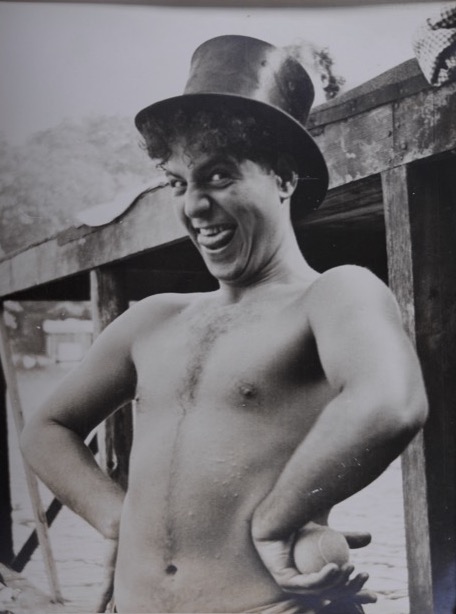
My father, Stan Mirvis, aka Pop, circa 1940-ish at Lake Hopatcong, New Jersey
When I was a kid, we had an old family photo that we cherished: My father by a lake with a top-hat and no shirt, a shit-eating grin, gripping a tennis ball, with a poison ivy rash on his side, looking exactly like Harpo Marx. A decade or two ago, Rebecca took the print to be reproduced. Now we all have copies of it, and it holds a place of honor in our homes. It is a wonderful way to honor and remember a truly kind, funny, smart, good man … and great father. He died of cancer in 1979 just after his 63rd birthday. That was 44 years ago. 25 or 30 of you reading this blog remember him. I feel happy every time I see this picture.
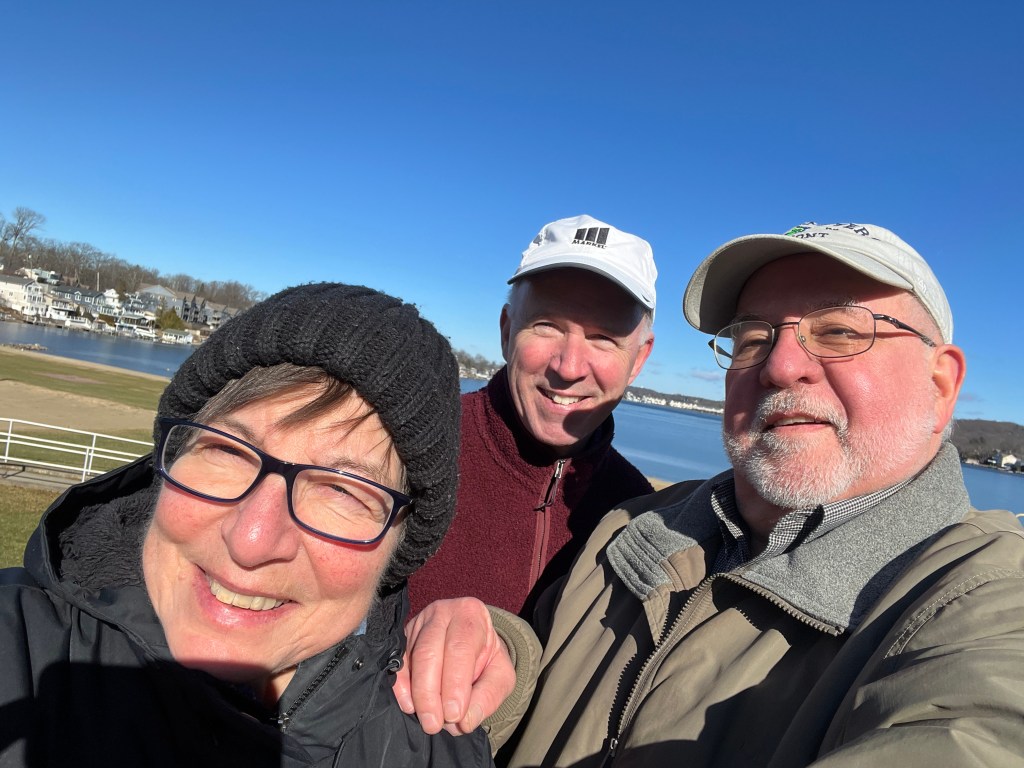
On Thursday, we left Vermont, headed for our wintertime adventure. On Friday, we arrived in Chester, NJ, where we spent the weekend with Jim and Julie Duffy, some of our very best friends. Chester, NJ is about 20 minutes south of Lake Hopatcong, the site of the photograph. For a few weeks, Duffy and I had been talking about what to do during our visit. Could we find the exact spot of the photo?
We’d be near the lake for a whole weekend. How many structures like the one in the picture could there be? We prepared to spend the weekend location hunting, searching for the exact site of the best father photo of all time!
Here is the story of the photo. After high school and before WWII, Pop had three best friends, Wally, Seymour, and Artie. The four of them worked in Manhattan. In the summer, they rented a cottage at Lake Hopatcong. They hopped on the train as soon as work ended on Friday and returned late Sunday or early Monday. The four of them stayed best friends their entire lives. Their wives became best friends. I loved them all immensely. Wally became an organizational consultant; Seymour a studio photographer; Artie a high school principal; and my dad, a textile wholesaler.
I carry a memory of the four of them in my pocket, where it has been since Pop died. He always carried two silver dollars in his pants pocket. They were so old that they were worn clean of any signs of having been silver dollars. They were just silver discs.
The four best friends all went off to WWII at about the same time. One of their fathers (I don’t know which one) gave them each a silver dollar when they left for Europe with the request that they all return them when they came home. Miraculously, they all came home. When they went to return the silver dollars, instead of accepting them, the father gave them each a second one. As far as I know, the four friends carried those coins the rest of their lives.
When Pop died in 1979, those two coins became mine. I cherished them. But one night, my car was broken into, and the coins vanished. Oh, how I cried at their loss. I put a Liberty half dollar in my pocket that day, and I still carry it. Like Pop’s, the signs of it having been currency are long gone, but it is one of my most loved possessions.
This weekend, I hope to bask in the love and camaraderie of those four amazing men as I search for the site of the photo. Stick with me. I’ll let you know what I find.
Chapter 2
It’s early Saturday morning. My heart is pounding with excitement. There is a good reason why Jim Duffy is such a best friend. He’s done his homework. He printed lit from the website of the Lake Hopatcong Historical Museum. He found a ton of leads. I’ve left messages with the museum. Sadly, they are closed for renovations until March. The search has begun. After breakfast, we hit the road.
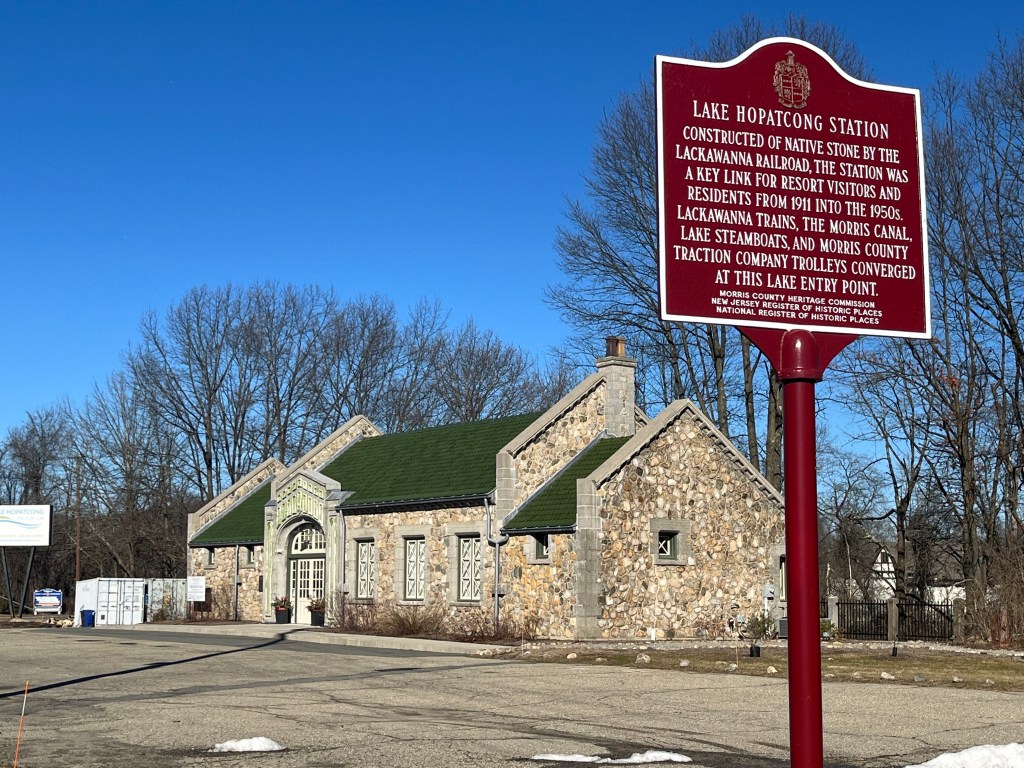
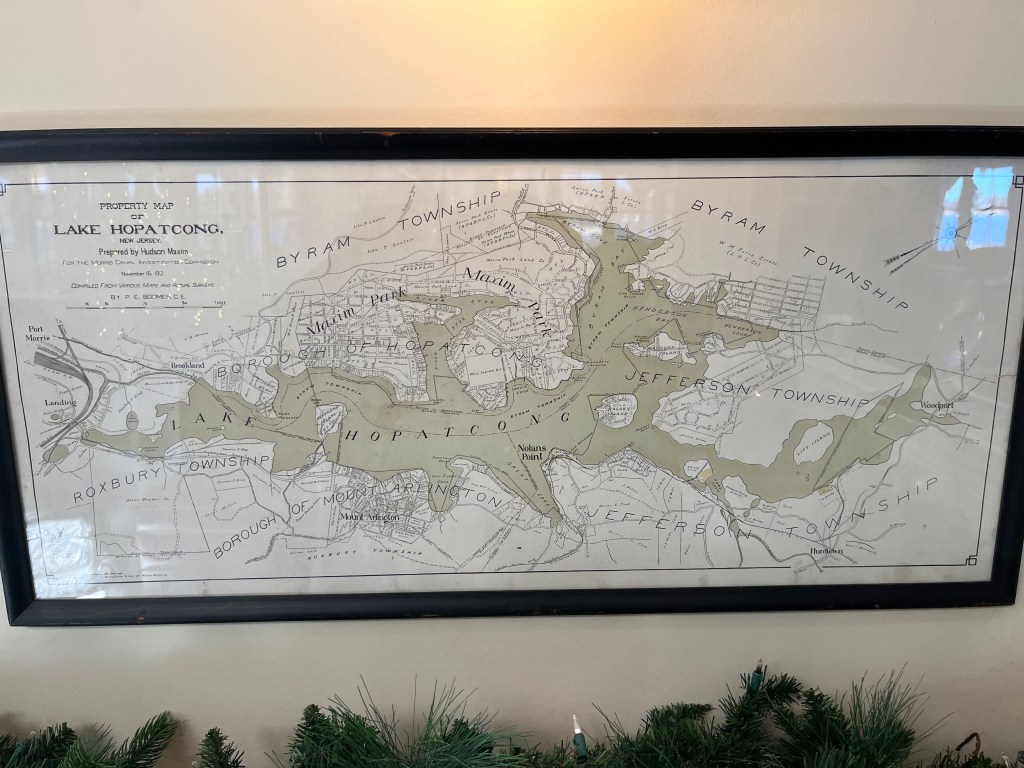
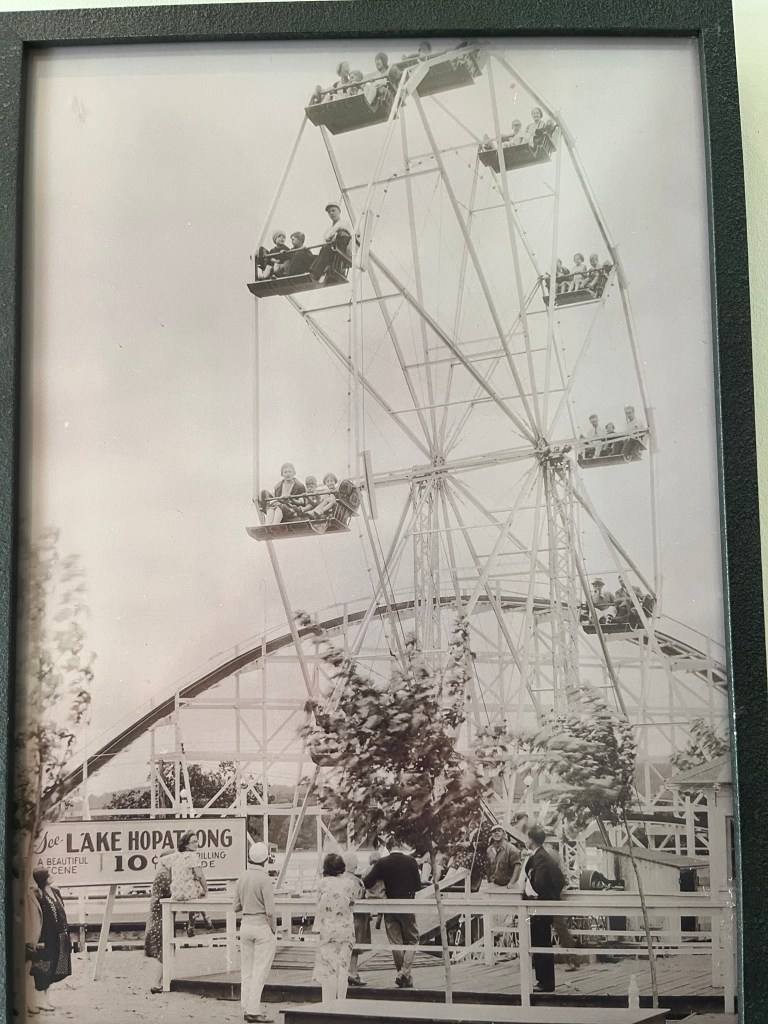
Lake Hopatcong, I learned, had been a NYC playground until zoning changes in 1950 shifted its trajectory. It had competing amusement parks, vaudeville halls, and some of the best performers from New York. The train ran from Manhattan to either the Mount Arlington station or the Lake Hopatcong station, and from there, trolleys carried the weekend frolickers to the various villages. There was no need for a car or much money. Everything four young shenanigan-prone men could have wanted was at their fingertips. They were pups at play!
I couldn’t wait to unravel the mystery.
Chapter 3
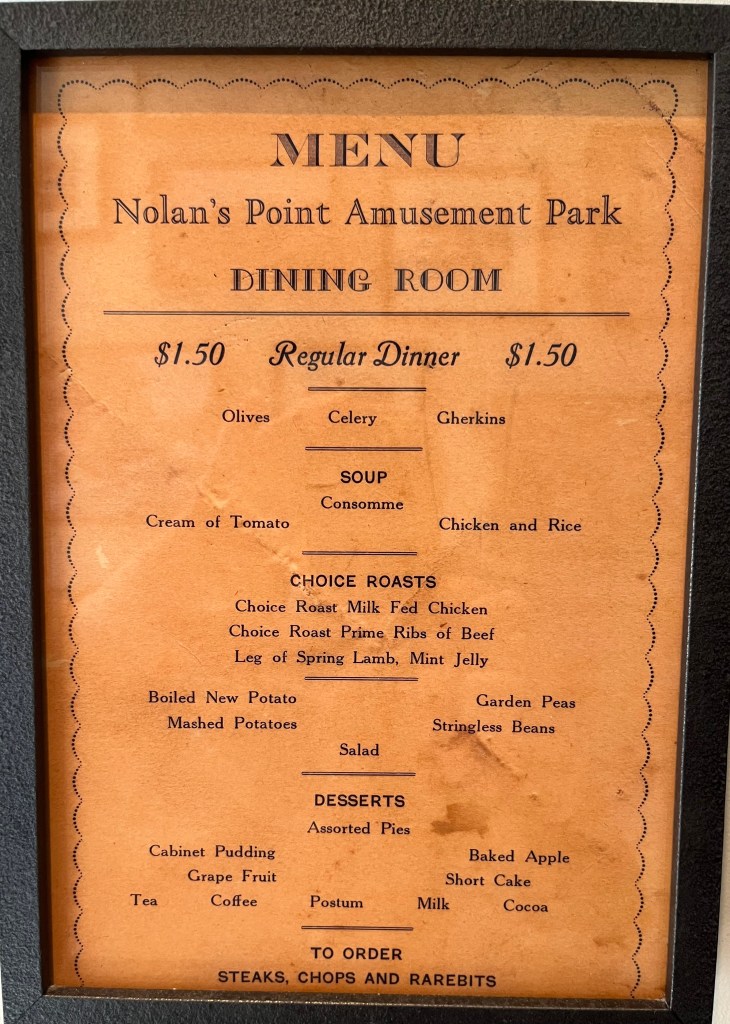
Well, that seemed easy! We drove the 20 minutes from Duffy’s house in Chester to the southern end of Lake Hopatcong. Duffy grew up just north of there, so he had stories of the lake, like the old Chris Craft speedboat that his uncle owned and kept at a marina on the lake. Jim recognized the marina where Uncle Tom had moored the boat. About five minutes after starting our drive along the lake, we saw a sign for Nolan’s Point. We had read about it on the website as being one of the centers of summertime activity. It was home to one of the two amusement parks on the lake. The other was the River Styx Cove.
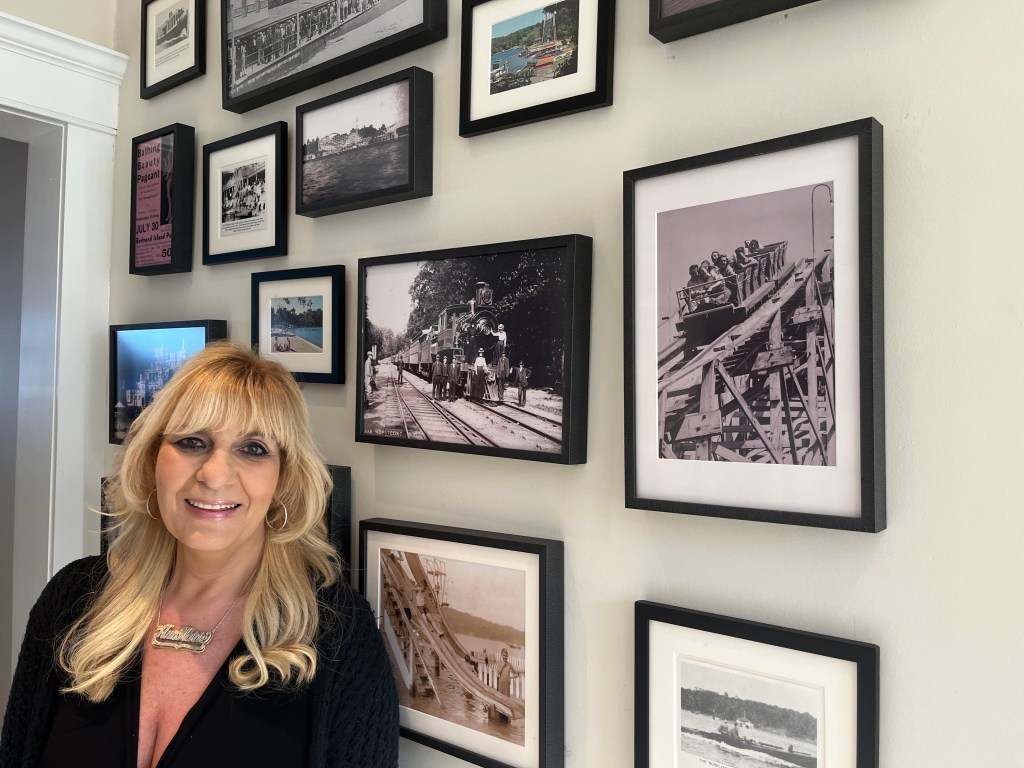
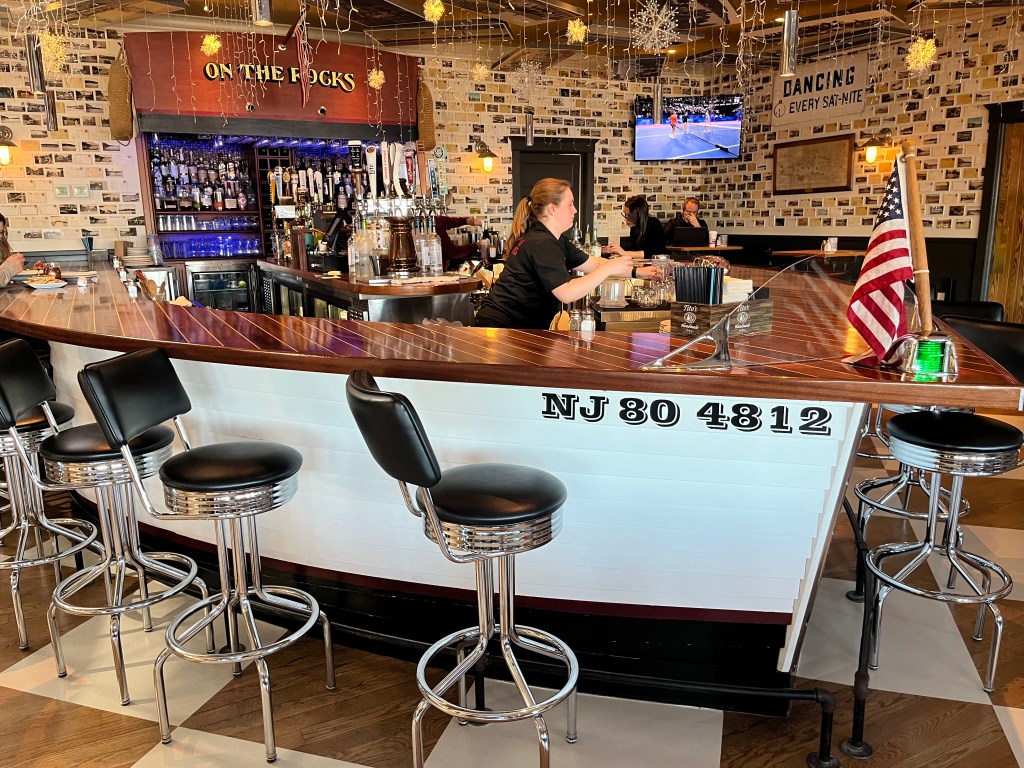
We followed the road to the point and pulled into the parking lot of the Windlass Restaurant. It was right on the water and looked old and classic enough that I suspected it might have some good pictures on the wall. I was right. The place was filled with hundreds of postcards, paintings, and assorted memorabilia from a past age of glory.
Ann Marie, the restaurant’s hostess, asked if we had a reservation. “No,” I replied. “We just wanted to look around the place,” and I showed her the picture of my father.
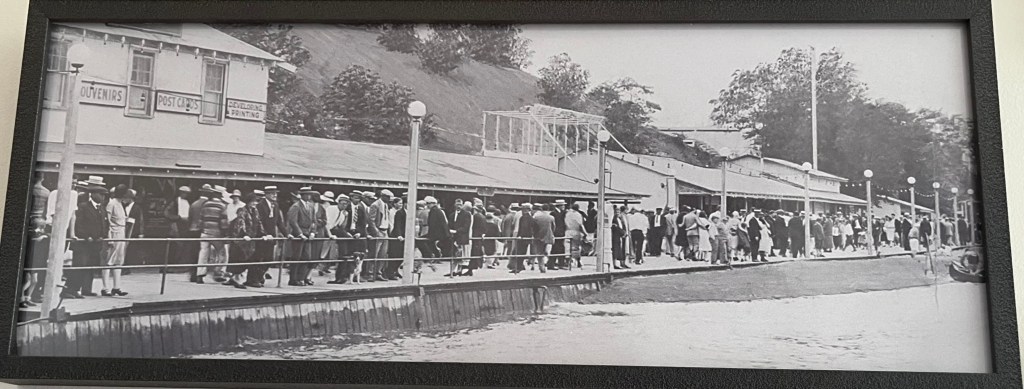
“That’s the old boardwalk,” she said. “It was right there,” as she pointed out a window. “It was torn down years ago, but that is where your father was standing.”
First stop. First conversation. Paydirt!!!! It seemed too good to believe… and probably was. We took photos, proudly showed the picture to patrons at the restaurant, then drove around the lake marveling at how vibrant it must have been in its heyday. While it is the largest lake in New Jersey, we also marveled at how tiny it is compared to Lake Champlain. We noted the density of the houses and cabins along the shore, and we imagined how thick the boat traffic must be on a pretty summer weekend. We also observed how murky the water appeared and the signs warning swimmers of algae blooms, and we questioned how so much septic effluent could possibly be managed.
Ann Marie was a gem. She showed us pictures, told stories, and introduced us, in absentia, to Marty Kane, the resident historian and founder of the Lake Hopatcong Historical Museum. At the time, I had called and emailed Marty, but we had not yet made contact. Marty is the local repository of knowledge. He takes visitors on historical cruises of the lake. This summer, Duffy will be stuck with us again when we come down to meet Marty, tour the museum, and cruise the lake.
All in all, a day very, very well spent!
Chapter 4
We slept soundly Saturday night knowing that we had been successful in our quest to find the site. On Sunday morning, that bubble sprang a leak! I awoke to an email from Marty Kane, the local historian. It read, “There simply is nothing distinctive in the photo. As you have probably learned in your visit there are some 2,200 homes on the lake, and there were formerly two amusement parks, some 40 hotels, and a host of marinas and other businesses. The wooden structure is simply not recognizable, and there is no clear view of the shoreline. Best guess is possibly River Styx Cove or Van Every Cove based on the distance to the other shore.”
A quick glance at the photo made Marty’s comment obvious. The shoreline across the lake in the photo is way too close to have been at Nolan’s point. Fortunately for us, we had driven around the Styx River Cove. The cove is narrow, so the opposing shoreline was a lot closer; in the 1930s, the area abounded with cabins, social activities and entertainment; and it was home to the second amusement park on the lake. In addition, it is a hop and skip from the Lake Hopatcong train station, maybe five minutes by trolley, much closer than the Mount Arlington station that would have served Nolan’s point.
At this point, I am voting for Styx River Cove. My father’s love of music and performance and socializing would have made that corner of the lake a perfect destination. Alas, we will probably never know, but communing with my father along the shores of Lake Hopatcong is a perfect beginning to this road-trip adventure. Thank you, Ann Marie. Thank you, Marty. Thank you, Jim and Julie. You’ve brought a smile to every cell in my body.
Thank you Ann Marie!The Boardwalk where Ann Marie thought the picture was takenLake Hopatcong State Park at the Styx River Cove, where the lake is much narrower than at Nolan’s Point. Probably closer to the site of the pictureThe station where Pop, Artie, Sy, and Wally probably arrived
A gallery of Lake Hopatcong in its prime, thanks to the Windlass Restaurant….
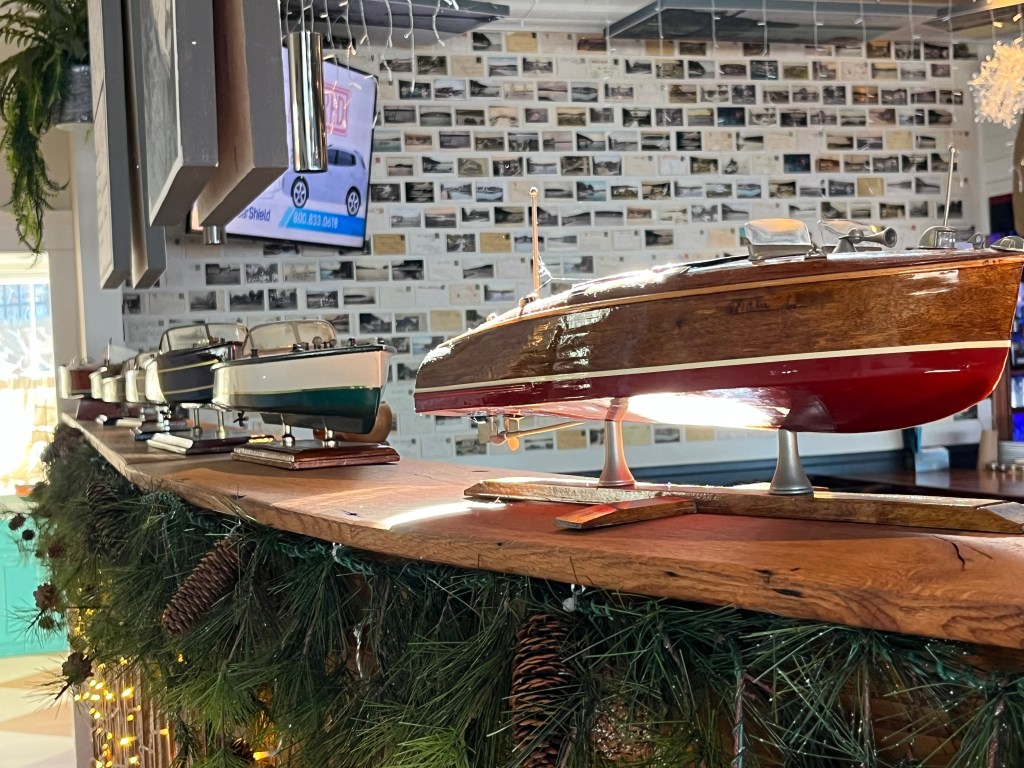
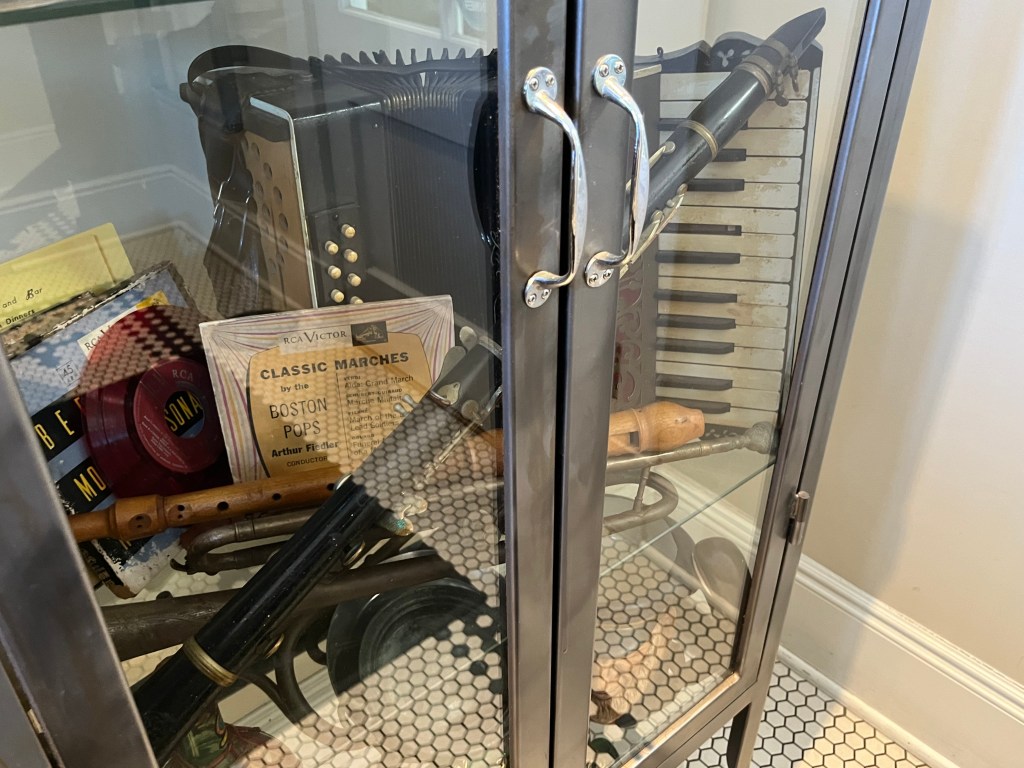
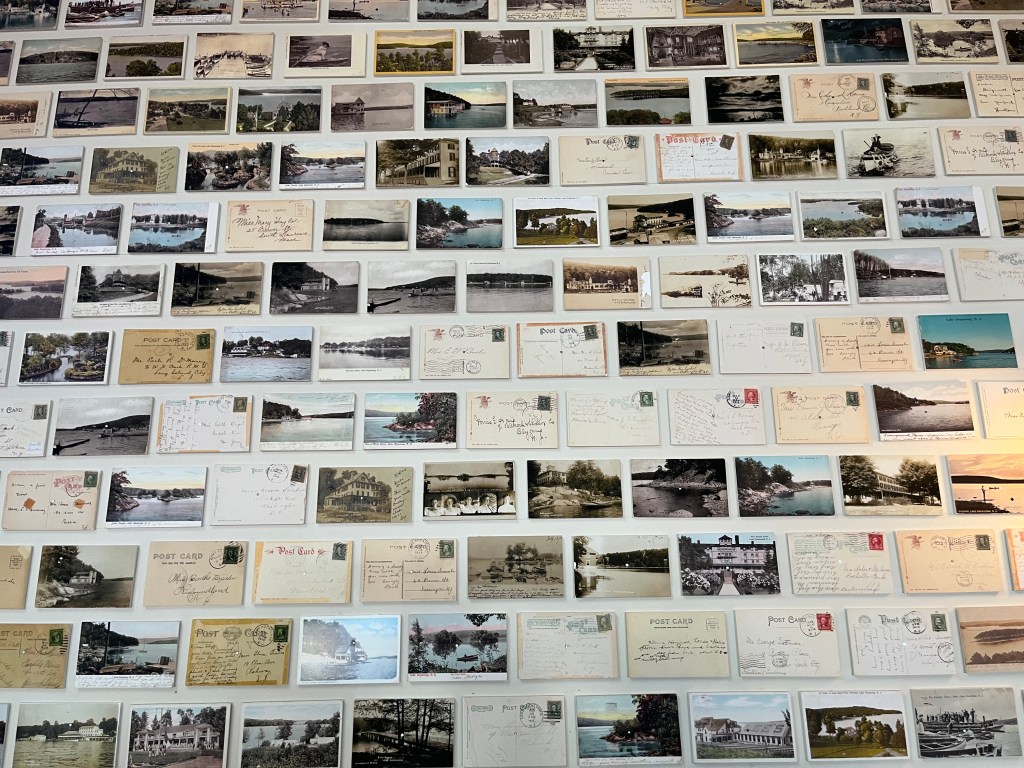
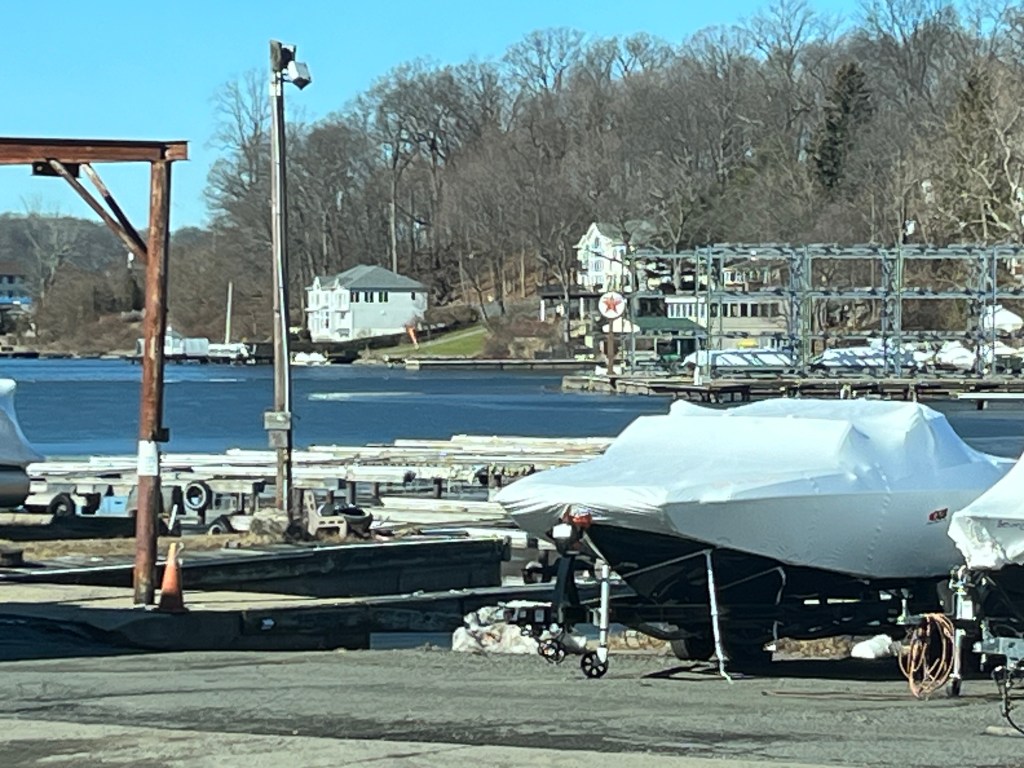
Chris Craft models…and even a Chris Craft barMusic of the 30s and 40sHundreds of vintage postcards along the walls of the WindlassThe shoreline today; the Texaco sign of the past

















 myinnersociologist