We’ve been on the road for eight and a half weeks and have fewer than eight weeks left to go. I’m already getting weepy and nostalgic!


The trip from Tucson brought us to the geographic turn: Southern California … but not before we got to say goodbye to Arizona with our friends Karen and Craig. We met 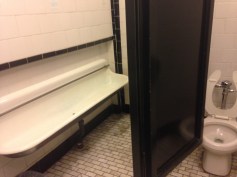 for breakfast at the Hotel Congress, a magnificent relic where in 1934 an employee recognized the face of hotel guest John Dillinger, which led to his capture. What a place! (And for the nostalgic men who remember the good-ole days at the ballpark, the men’s room off the lobby also has a classic trough urinal. You just don’t see enough of those these days.)
The rest of southern Arizona was … well, to be honest, it was a lot like the first parts of southern Arizona. Just sort-of blah. We tried a nifty-looking side jaunt from Casa Grande through Maricopa to Gila Bend, but mostly we just saw some very long trains and a lot of mineral processing. And the highly entertaining stands of saguaro cactus were growing thinner and thinner.
From Gila Bend to a few miles west of Yuma, we had no options but to take the Interstate. Boring! Then at State Route 34, we headed north toward the Salton Sea. Paydirt! We explored a bit of an old mining ghost town (not much to it) then headed west on Highway 78.
The terrain went from scrubby desert to pure sand dunes — the Glamis Dunes, part of the Algodones Wilderness Area. It could easily have been the stage set for Lawrence of Arabia: vegetation-free sand dunes as far as the eye can see. Hundreds of dune buggies frolicked on the south side of the road interrupted only by occasional spontaneous/flash RV campsites. To the north: pristine, tire track-free dunes for miles and miles and miles. It was, to run the risk of sounding a bit smug, a real gas …. a really loud gas! My do-good environmental politics notwithstanding, though, those folks really looked like they were having fun!


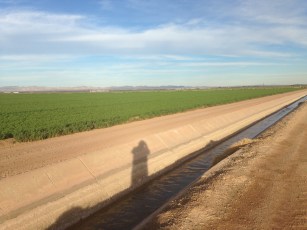 From the dunes, we entered the Imperial Valley. In minutes, we went from scrubby desert to barren dunes to incredibly verdant fields spanning the horizon! The Imperial Valley is one of the world’s richest salad crop producing regions. The juxtaposition of desert and farm is utterly surreal. Oh yeah, the occasional dairy farm also provided a bit of variation to the landscape: thousands of tightly housed cattle doing sad little with their lives except eating, mooing, shitting, and giving milk. Need I mention anything about the stench?
Our destination for the evening was Brawley, California, at the southern end of the Salton Sea. I’ve flown over the Salton Sea. I’ve read about the Salton Sea. I’ve talked with folks about the Salton Sea. But I’d never been there. I couldn’t wait to see it, and it proved to be exactly what I had expected.
Well before dusk, we drove the main street of Brawley, found a terrific looking Mexican restaurant, checked into yet another clean, quiet, personality-rich independently owned motel, and headed north to find the Salton Sea.
Despite its immense size, however, finding the actual sea is not so easy. Few public roads go to it, and as a result of the drought and the general geography of the lake, the shoreline — where there used to be water that has now receded a very long way — is just hard to find. We found a bunch of roads that went nowhere, and we saw a few of the lake’s geothermal electric generating stations. By then, nightfall was approaching quickly, so we headed back to Brawley for an amazing Friday night meal of $1.50 tacos at Christine’s.
Every weekend at Christine’s, Arturo sets up his wood-fired grill on the sidewalk in front of the restaurant and he makes pollo, asada, and tripas tacos. Yep. You got it right: chicken, beef, and tripe. I can’t say that I have ever been a big fan of tripe, but what the heck. We are on an adventure, and the taste Arturo gave me had real potential. Yep. You got it right again: tripe is cow stomach. I’ve tried it in Cuban restaurants and other Mexican restaurants but I never tolerated it, much less liked it. Arturo’s tasted good! Two tripas tacos later, I am a believer … but I’ll only be a confident believer if I eat Arturo’s tripas tacos at Christine’s in Brawley. The asada tacos were even better. Amazing, in fact. $10.50 later (7 tacos) we were stuffed, happy, and ready for a morning of more Salton Sea explorations.


On the one hand, the Salton Sea has existed intermittently as a large inland body of water for millennia. On the other hand, its current incarnation was an accident, the result of slipshod engineering. The sea itself fills the Salton Sink, which, at its lowest point, is only 5-feet higher than the bottom of Death Valley, 234 feet below sea level. Over a span of many millennia, the Colorado River shifted course. When its course shifted to the Imperial Valley, it deposited its fertile silt and filled the Salton Sink, creating the Salton Sea. As the river kept changing its course, the sea would dry up, leaving the salt-rich, bone dry Salton Sink desolate until the river decided to change its course and refill it again. Who knows how many times the Salton Sink has filled and then dried up again. Perhaps thousands. The last time it dried up was around 1700.
This time in history was supposed to be a dry period, but realizing the fertility of the valley, farmers in the early 20th Century tried to build irrigation canals. They made a cut on the riverbank to prevent silt buildup, and OOPS! The riverbank burst. Colorado River water flowed into the Salton Sink for two years before the flow could be stopped. Now, for the first time in the history of the earth, we have a human-caused Salton Sea instead of one caused by nature. And with the controls put on the Colorado River, we may not have another naturally caused Salton Sea until homo sapiens are extinct.
In the morning, we set out yet again to find the Sea. This time we succeeded, but not before finding the most delicious, unbelievable, sweet, flavorful dates I’ve ever imagined … in Westmorland, CA. If all goes well, I will never again be without Westmorland dates. They make the world a better place. How can it be that all other dates taste bland while Westmorland dates taste like a spoonful of natural sugar. Go figure.
Not far from Westmorland, we set out on dirt roads through farmlands to try to find the sea We failed yet again. But this time, we successfully found the Sonny Bono Salton Sea National Wildlife Refuge. (Sonny Bono, of Sonny and Cher fame, served in the US House of Representatives from 1994 until he was killed in a skiing accident in Colorado in 1998.) At the refuge, we saw American pelicans, endless egrets, small songbirds, and a flock of tens of thousands of Snow Geese … a totally humbling, stunning experience. We didn’t get to the sea, though, and we gave up on the bird watching because the mosquitoes beat us to a pulp. It was January. Who on earth would have thought to bring deet? Certainly not us. So we retreated.


We were confident we could actually get to the water from Salton City, so off we went to the west side of the sea, happily driving 40 miles round trip out of the way. We were right!
Salton City is an inner sociologists dream, a dusty armpit of a village (of course with a fantastic taco stand) that once had great aspirations. Decades ago, developers envisioned the Salton Sea as a southern California vacation paradise, despite the fact that it is a 300-square-mile cesspool. They bought acreage around it and built roads, waiting eagerly for in the influx of seasonal owners. Today, the landscape is barren except for hundreds of undeveloped streets with names like Sea Nymph, Sea View, Dolphin, and Salton Bay. The roads themselves are much more vivid in a blown-up Google map of the town than they are in real life, and at best, each street sports one structure, usually a dilapidated bungalow or trailer.
While three “rivers” “feed” the Salton Sea — the New, the Alamo, and the Whitewater — most of the sea’s inflow comes from nutrient-rich agricultural runoff. There is no outflow. The water just sits there, so with evaporation, the salts and contaminants get more and more concentrated. The only fish that can survive in the sea itself is tilapia, and frankly, eating a steady diet of tripe tacos sounds far more appetizing than eating anything from the Salton Sea.
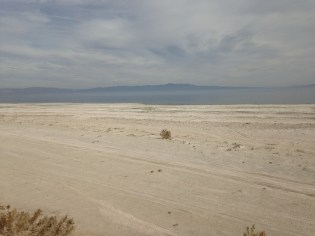 As a result of evaporation, exacerbated by the ongoing California drought, the sea continues to shrink, so the shoreline, where the developers once envisioned vibrant marinas and restaurants, continues for hundreds of feet before water finally appears at an unreachable distance.
The best part of the Salton Sea is that it is such a vibrant flyway for migratory birds. More than 400 species have been identified there, and interestingly, the only more diverse avian home in the U.S. is Big Bend National Park in Texas, where we were a few weeks ago.
The Salton Sea bugs me. Should we protect it or let it return to nature? Is it a natural part of the landscape or a human-caused anomaly? If we protect it … to protect the migratory birds that rely on it … what does that mean? Nature’s way of dealing with it was to let it fill and then dry up over cycles lasting centuries. With our harnessing of the Colorado River as an essential water supply source for the cities and farms of the southwest, those filling and drying cycles are ancient history … at least until the Colorado River infrastructure disappears. Damn it’s a hard one. If you make an argument one way or the other, I will probably agree and disagree with you vigorously.
From the Salton Sea, we headed west toward San Diego. Fortunately, State Route 78 not only kept us off the Interstate, it also took us through Julian, another village I had read about but never seen. Julian is an old mining town at the top of a mountain that is now home to a very decent smattering of hippie farmers, musicians, artists, and other neer-do-wells. We passed the first and only camel farm I have encountered this side of the Middle East, and as we passed it, we simultaneously passed a gent leading a llama on a leash. No one in Julian would ever have looked twice.
A few wineries and apple orchards later, we were in Poway, at the doorstep of San Diego. Amazing! I have seen San Diego dry and brown, and I have seen it on fire. Never before have I seen it lush, verdant, and bright green! As a result of the rains that fell earlier this winter, the mountains east of San Diego looked shockingly like Vermont, a sight that I am pretty certain I will never see again.
From Poway, it was a short hop to the Clairemont neighborhood, just south of Mesa College, where our friend Brandon had offered his mother’s condo. She and he had lived there when they attended law school, and now they keep it just in case a couple of traveling vagabonds like us need a place to crash for a few days. Other than the fact that it had no wifi and awful cellular service, it was perfect … and with amazingly convenient access to a very big city.
Our first night in San Diego we met up with our friends Risa and David Baron for dinner. (Risa is in for a fun roller coaster ride. She recently left the employ of San Diego Gas and Electric — where we became friends when she was my client — and started working for the San Diego County Water Authority. Welcome to the water industry, Risa. You’re gonna love it!)
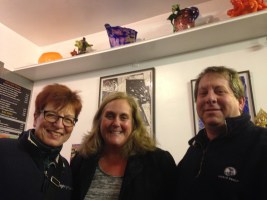 I had been itching to take Rebecca to Saffron’s, a tiny Thai take-out place on India Street near Washington. The actual history of the place is a tad too arcane for my brain, but the abbreviated story goes something like this: Su-Mei Yu immigrated from Thailand and became a successful restaurateur in San Diego, known far and wide for her Thai chicken. In 1992, she became romantically involved with the Italian-born artist Italo Scanga. They lived together thereafter at her home in La Jolla. Scanga
 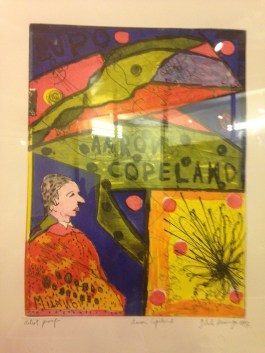 and his friend Dale Chihuly were artistic muses for each other. As a result, not only is the food terrific, and not only are the walls adorned with photographs of Su-Mei Yu and countless celebrities, but they are also adorned with Scanga art and probably 30 or 35 original pieces of Chihuly glass. As good as it is as a hole-in-the-wall restaurant, it is even better as an art gallery. Man, I love finding places like that … and like the First State Bank in Uvalde, Texas.
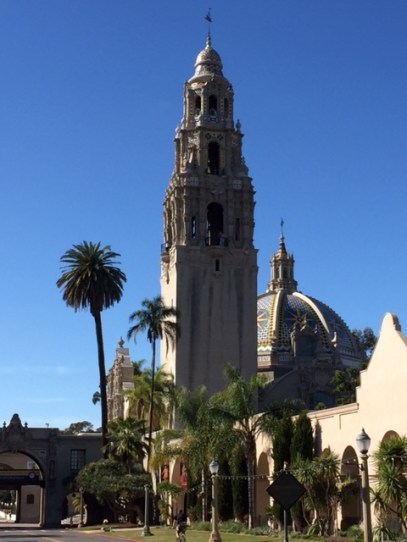
Balboa Park is no slouch of a place either! Quite likely the most beautiful city park in the US, the park was built for the 1915 International Exposition and then donated to the city. In addition to housing the world-famous San Diego Zoo, it also houses the art museum, a science museum, an air and space museum, an automotive museum, an organ pavilion, a botanical garden, a girl scout camp, endless miles of magnificent walking trails, and insane views of the city. It is a gem, and if I ever live in San Diego, I plan to visit the park at least once a week. Rebecca says that she would go every day!


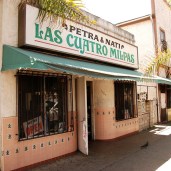 From Balboa Park, we headed south to Logan Heights, an old Hispanic neighborhood just south of downtown. Risa knew of a tamale joint she thought we should try, Las Cuatro Milpas. It’s been in the family for over 80 years, and their business plan is simple: make only a few dishes, including tamales, rolled tacos, carnitas tacos, and rice and beans; charge only $5 cash for each item; and stay open as late in the afternoon as necessary to sell out of everything. The three of us spent $15 total. The food was incredible. The place exuded personality and great vibes, thanks in some part to the palette of white and blue collars, including no shortage of bus drivers and city workers. We each ate lunch. Nothing more. We drank water. We were so full that all three of us skipped supper, and Rebecca and I ate little more until dinner the next day.
One block away from Las Cuatro Milpas … a block that is home to a few really skilled homeless beggars … I-5 passes overhead. The concrete supports holding up the highway provide the canvas for some truly beautiful under-the-highway murals. It’s amazing how people can create beauty in the most unexpected places.


During our week in San Diego, our adventure took a new turn: I started working again! I taught a writing workshop in Chula Vista on Tuesday, and another in Encinitas on Thursday. After two months of not being in front of a class, it felt great! I will now be teaching a couple of days a week until early March, with the exception of a week hanging out with Bro Joe on the coast of Oregon. The length of time we have available to drive east from Portland to Boston has already been set by my teaching schedule: March 3 in Portland and March 24 in Cambridge. That gives us 21 days to traverse the northern tier in late winter with definite stops in Salt Lake City, Omaha, Chicago, Ann Arbor, and Canandaigua/Geneva. We’re hoping for a warm, sunny spring in the Rockies!
 myinnersociologist
Saw Mr. Smitty here for a meeting. He mentioned how much he is enjoying Kens blog here. So, just wanted to pass on the love and praise.
LikeLike