The Ghosts of Virginia

Spotsylvania is a funny name and a cool place to get a marriage license, but it also has a deep and troubling history. As we drove into Spotsylvania on a drizzly afternoon for a lunch-that-didn’t-happen, Rebecca commented on the sense of ghostliness and spirit that permeated the town. No sooner had she said it, than we passed the Confederate Cemetery. The day before, we had driven by Arlington National Cemetery with its austere rows of headstones stretching seemingly forever. Spotsylvania’s Confederate Cemetery looked the same, only smaller. Thousands of lives lost. For what? We didn’t know, so we googled the Battle of Spotsylvania Court House. We still don’t know.

General Ulysses S. Grant led 100,000 Union troops against 52,000 Confederate troops commanded by General Robert E. Lee. They fought for over two weeks, often in mud and driving rain, and often face-to-face. When the battle ended, 4,240 soldiers had died; 18,830 were wounded; and 8,016 were missing or captured. Yet, the battle ­­– the fifth bloodiest of the Civil War ­– was considered inconclusive and resulted in no tactical shift in the progress of the war for either side. No wonder the ghosts seemed so present: they sacrificed so much to gain so little.

Rebecca took time as we drove out of Spotsylvania to muse on paper. In the moment, she wrote, “A mist hangs across silent open fields haunted by the misery of civil war. Palpable.”

With that, Rebecca and I entered a pensive time, realizing the role Virginia has played in our respective lives. I researched my doctoral dissertation in Virginia, in Big Stone Gap on the opposite side of the state. Rebecca’s mother grew up just east of where we were, in the “Middle Peninsula” of the Tidewater, the spit of land between the Rappahanock River and the York River. (The Upper Peninsula lies between the Potomac and the Rappahanock; the Lower Peninsula lies between the York and the James. All four rivers empty into the Chesapeake Bay.)

Rebecca’s mother, Lucy Elizabeth Fary, was born in Adner, Virginia and grew up in Shacklefords. After marrying Arthur Edwin Rowley (“Father Gregory”) and raising a family, they moved back to Shacklefords. Lucy is now buried in a bucolic tiny country cemetery by the Beulah Church near Shacklefords. Her spirit drives our relationship. She is the primary reason we thrive. She is Rebecca’s constant source of strength and serenity. About her burial spot, Rebecca wrote, “A peaceful hillside where light shines softly and bones rest peacefully.” What a contrast to Spotsylvania!

Lucy was a “Fary.” Her mother was a “Hogge.” The Middle Peninsula teems with Farys and Hogges. They’ve populated the area since the 17th Century.

So there we were, happily toodling west on Route 17 when we happened across Farys Mill Road. A perfect photo-op, and why not take a little drive on it just to see what we find? Rebecca’s grandfather had farmed timber near there, so maybe we would make some nifty discovery. There on our right appeared “Fary Brother’s Building Supply,” a large, bustling lumberyard in the middle of nowhere.

Farys Mill Road

Rebecca went in, introduced herself, and proceeded to spend a delightful hour with Joe Fary, one of the owners. They couldn’t trace the overlap of their lineage, but we did learn of the Fary family reunion, which sounds like quite the event and well worth attending. The lumberyard is where it is because that is where the mill was. “No one comes here to window shop,” said Joe, “they come here when they need to buy something.” Rebecca now proudly sports her Fary Brothers sweatshirt every day. (Thanks for the gift Joe!!!!)
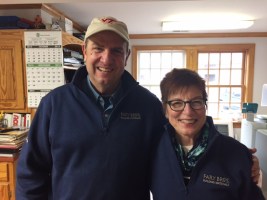
Joe Fary and Rebecca

From Farys Mill Road, the time seemed right to visit Rebecca’s folks in Beulah. The visit made all of us very happy, especially Rebecca’s brother, Gregory. Lucy’s spirit, like all of the ghosts of Virginia we encountered, is very real and very powerful.

R&G at Beulah Cemetery

A Fine Start to Our Eating Aspirations

Imagine this: We have been pondering how and what we will be eating on this trip.

Our goal: Good, healthy food all along the way coming from one of three sources: 1) Food fed to us by those who derive the same deep pleasure we do from feeding others. 2) Food we prepare for those who know how much pleasure we derive from preparing food and feeding folks. 3) Amazing food at off-the-beaten-path, family-run eateries.

So far, Days 1 – 4, we are batting 1,000.

Our first stop: Thanksgiving leftovers with the Schachters (Allie’s in-laws, our machatunim*) in Westboro. The food and company were great on Thursday; they were equally good on Saturday.

For those of you who know Allie and Joanna, it will come as no surprise to hear that Joanna needed a snack a few hours later. The matzo ball soup at the Vernon (CT) Diner was so good, she forgot to share.

When we told the Duffy’s they would be our first overnight stop, Jim started planning the menu. Watching 12-year-old twin girls devour cheese fondue is sublime! (Sometime I will write about the rib cook-off Jim and I waged at the lake in Vermont a few years ago, where we both cooked ribs all day, blindfolded the girls, dressed them in giant t-shirt smocks, and made them choose their favorites without knowing which were Daddy’s and which were Uncle Kenny’s. Need I say who won?????)

Joanna planned our first restaurant meal – Fetoosh, in Arlington, VA ­– an amazing Moroccan-Lebanese joint where the owner, Asiz, told us exactly what to order (in my case, lamb tagine with prunes) and hovered to be sure we loved every bite. (http://www.fettoosh.com)

Yesterday, Rebecca and I planned to eat in Spotsylvania, but we followed our instincts and decided that none of the places we found looked interesting enough. (We have plenty of munchies in the car if we get hungry, so restaurants are not just for food, they are for memories and adventures!) We passed a sort-of interesting joint with a 1950’s style gift shop at the intersection of Routes 17 and 301, but again, just not interesting enough. So we forged on to Tappahanock. Paydirt! Lowery’s has been serving seafood in Tappahanock since 1938. The oysters were fresh and plump; the oyster stew was, as Rebecca put it, “exactly like my mother’s.” Next time you are in Tappahanock, Virginia, don’t miss it!

Last night, Rebecca and I made a chicken saag for her sister and brother-in-law. What a thrill watching them both devour it with relish then fill their plates with seconds and devour that plateful too!

Today’s lunch, yet another homerun. Anne wanted stuffed grape leaves for supper. You try finding grape leaves in the Tidewater! We located them at a market in Newport News, 1.25 hours away. So we picked up R’s brother Gregory at his “school,” and headed east. Thirty minutes before Newport News, we passed a brand new organic grocery near Gloucester that had grape leaves! (No way!) As we pulled out of the lot, the sign at the far end of the strip mall reading “Soul Food” grabbed my eye. Hell, we were right there; why not check it out?

Barefoot Soul Food in Hayes, VA rocks! It is 3 weeks old, so no signage, no ads, no Yelp (until today, that is). Being the southern type that I am, I couldn’t decide between fried chicken and fried gizzards, so I asked if they could make a plate with both. They couldn’t. But if I ordered a fried chicken plate ($7.95, including 2 sides), they would just give me an order of gizzards. Sounded good to me, so I went to pee. By the time I returned, there were also 3 containers of dessert sitting on the table. They thought we should try them.   Maybe dining with an effusive, huggy 60-year-old Down’s Syndrome man helps, but whatever it was, we definitely brought out the best in the owner and staff.   Not only were they nice, but the food was terrific. This thought might become a cliché, but the next time you find yourself driving past the strip mall on Route 17 in Hayes, Virginia, you really ought to stop at Barefoot Soul Food.

Oh, and tonight’s stuffed grape leaves, quinoa taboolah, and yogurt went over well too. Of course, even the Patriots lose one once in a while, but so far so good.

*Definitions: Machitunim (Yiddish) Simply translated as the parents — and extended family — of your child’s spouse. English ain’t got no equivalents, so the Schachters would just be our daughter’s in-laws. In Yiddish, we all get to be family!